Beyond Zero Waste
Who carries the cost of a gathering?
A Minimum Regenerative Unit: a test any gathering can fail, tried on two solstice nights of The Soulstitch Festival, Ahmedabad, 2024–2025
Manav Sumara · Multopia
Who carries the cost of a gathering?
A Minimum Regenerative Unit: a test any gathering can fail, tried on two solstice nights of The Soulstitch Festival, Ahmedabad, 2024–2025
Manav Sumara · Multopia
Gatherings are among a city's oldest and least accounted-for infrastructures. A festival draws on ground, materials, skills, money and people's evenings, and rarely records what it gave back. "Zero waste" and "regenerative" have become easy words for such events. Both usually count materials, and leave out who carried the cost.
This paper began as a plan for a conventional report on The Soulstitch Festival, a free public evening on the winter solstice in Ahmedabad, India, and became research as the festival's own disciplines changed how its claims could be checked. It reports two prototypes, on 21 December 2024 and 2025, designed by Multopia as research instruments. The methods combine research through design, the real-world laboratory, a visual and material reading of an archive of 418 photographs and 92 video clips made by many hands, astronomical computation and material flow analysis.
The contribution is Multopia's Minimum Regenerative Unit: a test that reads any gathering through three stocks of its place (culture, ecology and micro-economy) and through every person and organisation who gave to it. No gain counts if it vanishes after the night or is paid for by a loss elsewhere, and the whole is named by its weakest strand. Event standards, circular-festival accounts and multi-capital methods each do part of this; none we found lets the people who made a gathering fail it. Here the unit is specified and illustrated on its own two editions, read after the fact; the next edition is its first test fixed in advance.
The strongest evidence is the material account. The 2025 edition handled about 680 kg of material (90% interval 610–830 kg). About 3% was bought new: rope and jute to shape foraged material into art, printed texts, and paper cups and bowls. About 76% stayed in use (lent and returned, kept, reused, recycled or made into art) and about 24% went back to the ecosystem: composted for a Miyawaki planting, used again on the land, or eaten by birds. Nothing is known to have been lost; only the plastic lining peeled from the cups, about 150 g, has no recorded destination. These are estimates from photographs, and most afterlives rest on the convenor's account: if the soil-path heaps were counted as unrecorded, the share returned to the ecosystem would fall to about 6%. Watched from before the night and through the year since, ecology and culture rose. The micro-economy did not yet: contributors gave their time and skill unpaid, the venue stopped their market, and two people met the costs. By its own test, the 2025 edition is not yet regenerative, and the test names exactly where the next step lies: a fair return for the people who make the night. A zero-waste gathering built on unpaid labour has moved its cost, not removed it. Whether a gathering can give back more than it takes is a civilisational question; this paper takes one small, checkable step towards answering it, with a test honest enough to say "not yet". The test, not the verdict, is what travels.
Keywords: regenerative events · zero waste · fair pay · multi-capital accounting · gatherings · festivals · material flow analysis · research through design · real-world laboratory · transdisciplinary research · commons · winter solstice · Ahmedabad
Soulstitch is built from four anchors: soil, culture, sky and the stitch that joins them. This paper uses the same four to say how it knows what it says. Every claim carries one mark. The marks also float beside the text: choose one to light every claim of its kind.
| Mark | Thread | What it means |
|---|---|---|
| Sky: reckoned | Computed or counted, and anyone can do it again: a solstice time, a count from a photograph | |
| Sky: estimated | Reckoned from stated assumptions; the range is printed and the method is in Appendix B | |
| Soil: recorded | On the record: a photograph with its timestamp, a label, a deck or a dated document | |
| Culture: remembered | Told by someone who was there, named by their seat (convenor, Edition 1 co-designer, artist). The festival's own Culture Zone called culture "memory in motion" | |
| Stitch: our reading | Where we join the threads: Multopia's interpretation, argued from the marks around it. Drawn as a running stitch, a plus | |
| Loose thread | We looked, and nothing holds yet. Said plainly, never filled with a guess |
In the web edition, underlined sources, section numbers, names and words open a short note where you are reading; follow one, and a button at the foot of the screen brings you back.
Nobody counted the people who came, in either edition, and nobody weighed the materials on the night. Where a number appears, its mark says how we know it. All times are Indian Standard Time. People and organisations are named in alphabetical order by first name; the order is never a ranking.
Soulstitch began with one observation: many peoples, without coordinating, gather at the same turn of the year. I didn't want to add one more celebration. I wanted to test what it would mean for a celebration to give back more than it takes: to the ground it stands on, to the people who make it, to the city that hosts it.
This paper is the first time we have written that test down, and the first time we have held ourselves to it with numbers. It is honest about what two small editions can show, and about what they can't. Read it as a prototype's lab notebook, not a brochure.
Ahmedabad is not a neutral place to try this. Here, what is profitable largely decides what counts as sustainability, and much of what reaches the public as culture passes through a few institutions and the families who built them. Many people and places told me this could not be real, or could not matter. This paper is not a complaint about that. It is a record of what could be made anyway, with borrowed earth and people's goodwill, and an honest account of what that cost them.
Manav Sumara, Multopia
Part I
Cities plan roads, water and light as infrastructure. They rarely plan their gatherings that way, yet gatherings move as much: ground is lent, materials are bought and thrown away, artists and volunteers give their time, hundreds of people give an evening. A city's festivals, weddings, melas and garbas are a metabolism of their own, and most of it goes unrecorded.
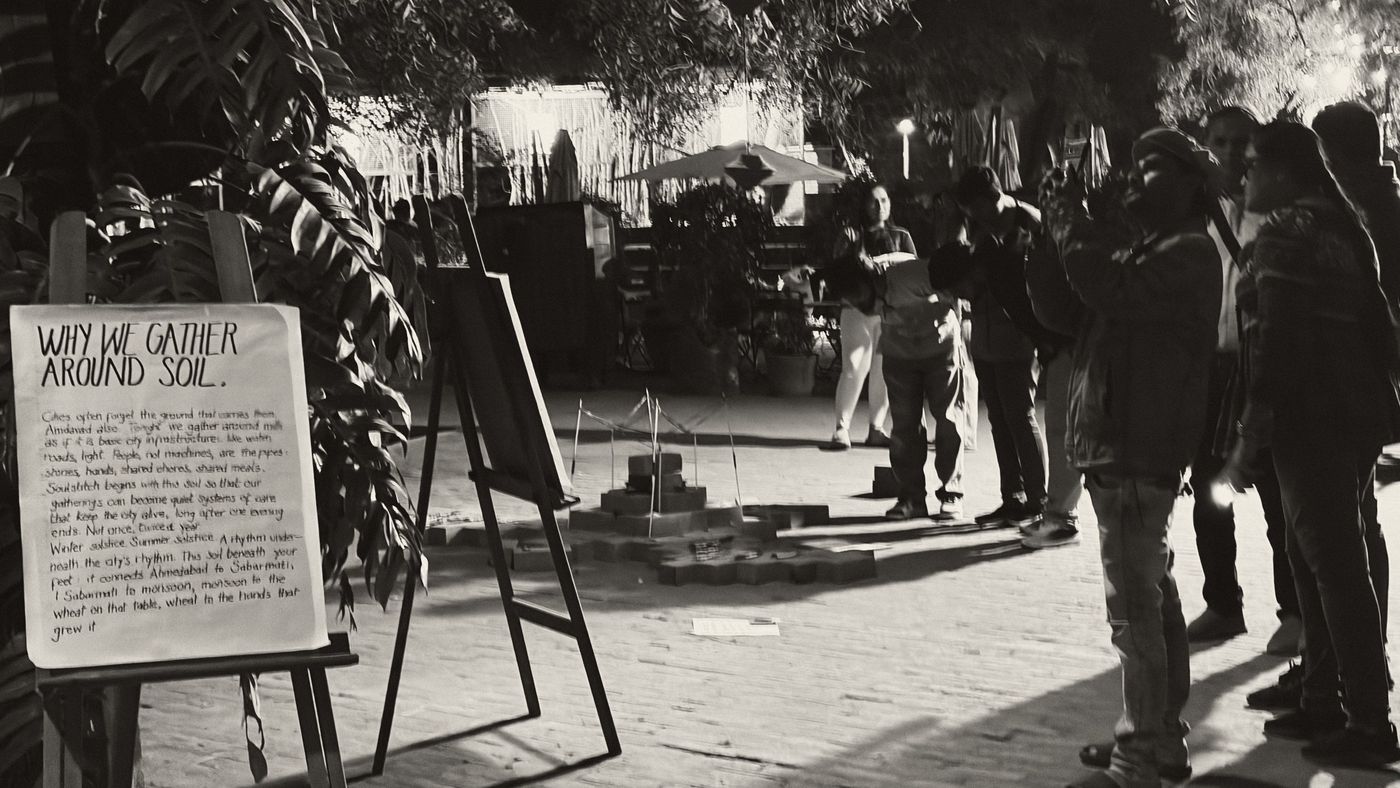
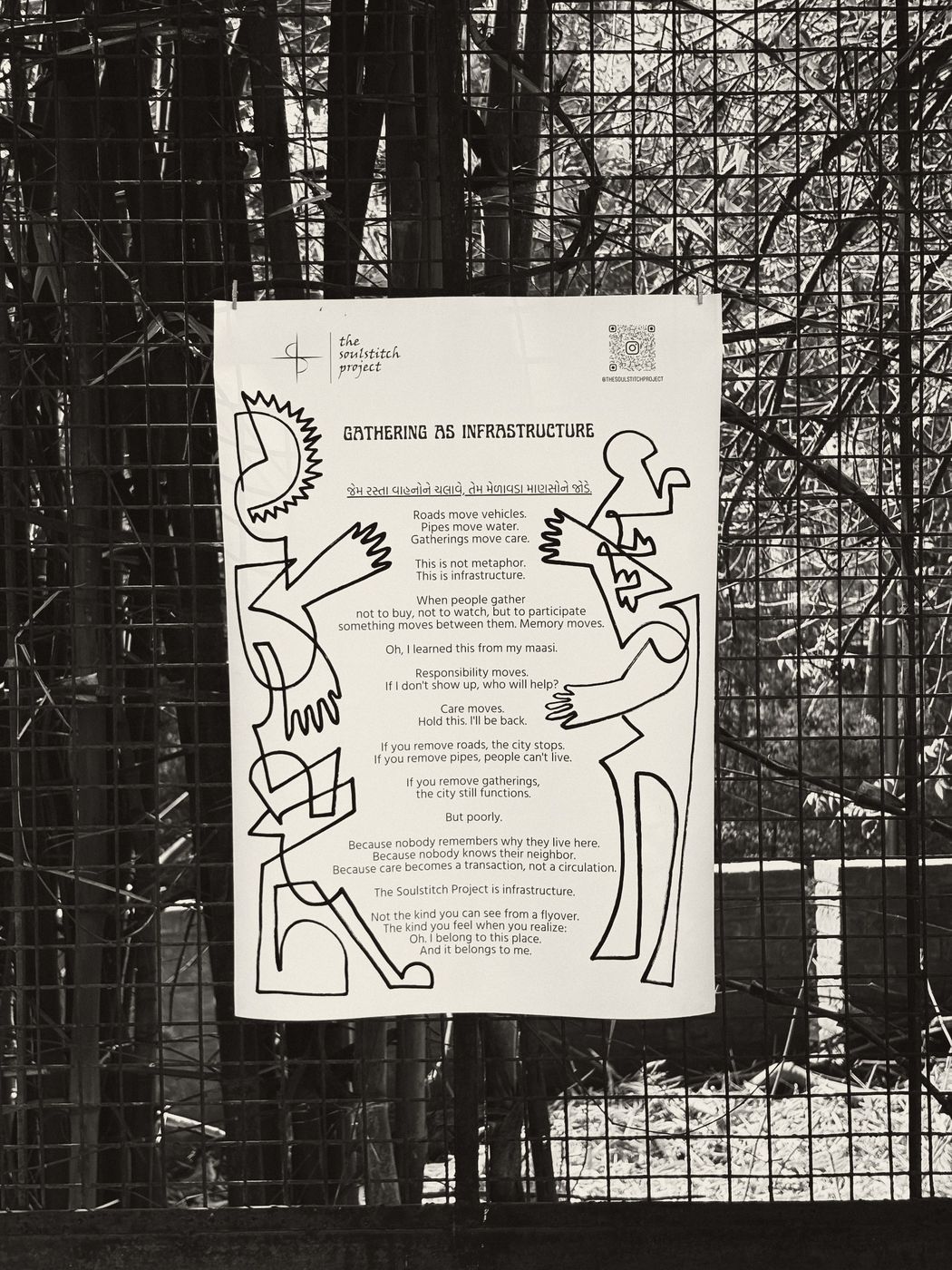
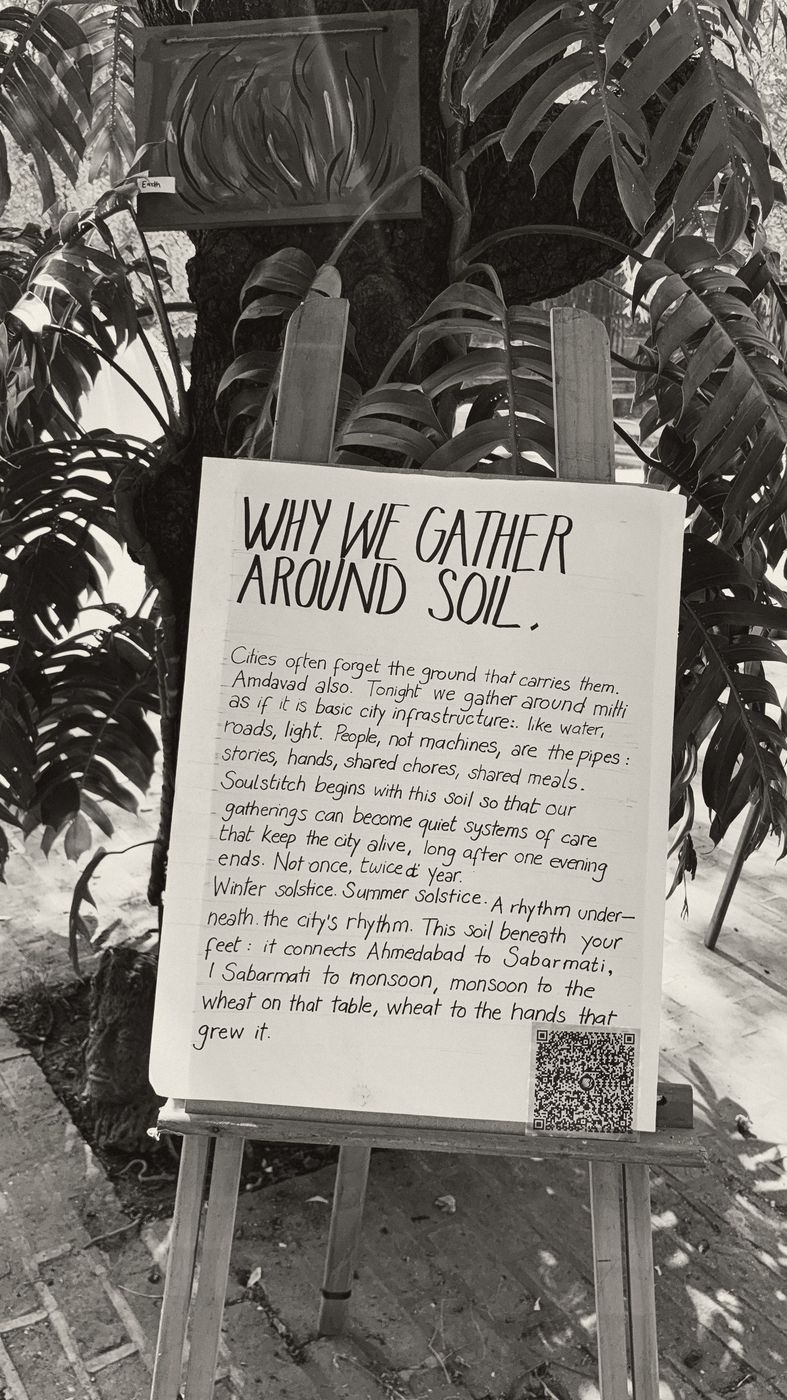
One of the texts hung at the 2025 edition put it in a sentence: tonight we gather around mitti "as if it is basic city infrastructure", with people, not machines, as the pipes.
When gatherings are described as "sustainable" or "regenerative", the claim is usually made without a definition anyone could fail. That is the gap this paper works in.
A test of what a gathering gives back depends on the place it draws from. Ahmedabad is generous in its forms and hard in its structures, and both shaped this prototype.
Much of the city's cultural and educational infrastructure was founded in the twentieth century by a few mill-owning families and the industrialists around them: the Ahmedabad Education Society (1936), on whose campus Amdavad ni Gufa stands, the Physical Research Laboratory, the National Institute of Design, the Indian Institute of Management and the Calico Museum of Textiles among them (IIMA Archives 2026; Goswamy, Sahapedia). That legacy is why the city has the institutions it has, and Edition 2 depended on one of them. It also means that access to venues, partners and audiences runs, to an unusual degree, through a small number of institutions and the families and boards around them.
Under India's Companies Act 2013 (Section 135, in force since 2014), large companies must spend 2% of their average net profit on social causes listed in the law, chosen by their own boards. In national data, art and culture received about 3.7% of that spending in 2019–20 and about 2.0% in 2023–24 (Ministry of Corporate Affairs 2025). Money for culture and for ecological work therefore grows with corporate profit and follows corporate priorities. A free, non-commercial evening that sells nothing and belongs to no company sits outside what that system is built to fund.
Ahmedabad is also among the most residentially segregated Indian cities by religion (Susewind 2017). A gathering that calls itself plural meets its public across those lines, or does not meet them at all; Section 10.1 records how far Soulstitch got.
convenor In the convenor's experience these conditions arrived as refusals: venues, sponsors and possible stewards declined, often saying the idea was not real or not important; the 2025 venue, which lent its grounds free, stopped the evening's market on the night; and nobody was paid. We record this as the setting of the test, not as a grievance. Where profit sets the terms of sustainability and few hands hold access to culture, a gathering is most likely to lean on unpaid people. That Soulstitch was made at all, from borrowed earth and goodwill, is part of the finding. That it is not yet regenerative measures how much the place asks of those who make it, and names what the next edition has to change.
On 21 December 2025 the Sun reached its southern turning point at 20:33, during the second Soulstitch at Amdavad ni Gufa. In 2024 the instant fell at 14:50; in 2026 it falls at 02:20 on 22 December. The instant moves by about 5 h 49 min a year and steps back with each leap year.
Ahmedabad lies about 0.4° south of the Tropic of Cancer. On the night of the December solstice it has about 13 hours 17 minutes between sunset and sunrise, the longest night of its year (sunset 17:59, sunrise 07:16).
Every person in the city stands under this event, whatever they believe and whoever their grandparents were. That shared condition is where Soulstitch starts: one anchor the evening takes from nobody.
People living far apart have built places and calendars around the solstices for thousands of years.
| Place or tradition | Secure date | What it shows | What it does not show |
|---|---|---|---|
| Newgrange, Ireland | c. 3200 BCE | A roof-box lets the winter-solstice sunrise into the inner chamber, by design | What the builders believed, or how many gathered |
| Maeshowe, Orkney | about 5,000 years old | The winter-solstice sunset lights the chamber | A public festival |
| Stonehenge, England | c. 3000–2500 BCE | The main axis points to midsummer sunrise and midwinter sunset | A single purpose or ceremony |
| Durrington Walls and related sites, Britain | c. 2800–2400 BCE | Large midwinter feasts; isotopes in 131 pigs show animals raised as far away as Scotland and west Wales | Who exactly came |
| Dongzhi, China | an official festival by the Han dynasty | A recurring public and family observance of the winter solstice | That earlier sky-watching had the same form |
| Yaldā/Chella, Iran and Afghanistan | living; UNESCO, 2022 | Families gather at elders' houses on the longest night, with food, poetry and light | A proven age of "3,000 years" |
| Gasco roads, New Mexico | 9th–12th c. CE | Two roads aim at winter-solstice sunrise over Mount Taylor | How the roads were used |
| Summer-solstice fires, Pyrenees | living; UNESCO, 2015 | Torches carried down to light village fires | That it is old in its present form |
The defensible numbers are about 5,200 years of architecture oriented to the solstice, about 4,500 years of evidence for large seasonal gatherings with feasting, and more than 2,200 years of documented solstice festivals. The best-evidenced early midwinter feasts, near Stonehenge, were made of what people brought from across Britain (Madgwick et al. 2019). Soulstitch's way of working, made of what people bring, is a modern parallel, not a lineage.
These practices were not one tradition and not one network. Separate communities returned to the same event in the sky and made it mean something local. We call this distributed seasonal convergence, and explain it without a "universal instinct": the turn can be seen (shadows and day length reach their extremes), it is useful (farmers need to know where they are in the year), and it carries meaning easily (the darkest point, then the return of light).
Our 2025 materials said "every civilisation", "independently evolved" and "non-religious". The evidence doesn't support those words: most solstice observances were religious or cosmological, and many societies were connected by trade. We now say numerous societies across several regions, convergent, and non-confessional and religiously plural.
Makar Sankranti, Uttarayan, Lohri, Pongal and Bhogali Bihu fall around 14 January. They follow the sidereal calendar, so they now come about three weeks after the astronomical solstice, and the gap grows by about a day every 70 years. They are festivals of the Sun's northward turn: close kin of the solstice, not its instant. Soulstitch marks the instant and leaves Uttarayan whole.
The solstice belongs to everyone; the stories, foods, songs and crafts around it belong to particular communities. Treating them as one "universal heritage" would flatten them, or take them. So Soulstitch works at three levels: the planetary anchor, plural memory (Yaldā, Dongzhi and Uttarayan stay distinct), and city authorship (Ahmedabad reads the turn through its own soil, food, crafts and public spaces). The principle is relationship without equivalence.
Part II
Most research papers hide how they were made. This one cannot, because how it was made is part of what it found. It began as an idea, became a model, two evenings and a year of watching what they left behind, and only last a paper.
An idea, then two evenings (2023–2025). convenor The idea began in 2023 with one observation: many peoples, without coordinating, gather at the same turn of the year. It was tried first as a hosted, ticketed evening on 21 December 2024, then as a free evening at Amdavad ni Gufa on 21 December 2025. The second was designed against the failures of the first (Section 7.1).
A unit, then a diagram (September to December 2025). In September 2025, three months before the second edition, Multopia's working notes wrote the Minimum Regenerative Unit, with stocks, a baseline, a horizon and four anchor functions, and stopped on purpose before it grew too complex to run (Section 6). The project decks of 1 and 9 December 2025 drew it for partners as the Soulstitch Regenerative Systems Architecture: three assets of a city in, three outcomes out. The second edition was made with the unit in hand. It had not yet been read through it.
A normal report (mid-2026). In the middle of 2026 the account of the two evenings was planned as a conventional institutional report: a designed PDF of 20 to 30 pages, "institutional record, portfolio piece, public document", in a familiar order (foreword, the editions, what we learned, the method, outcomes against the Sustainable Development Goals, what is next), with the design "to be handled separately". convenor In Manav's words, "at first it was supposed to be normal academic research": a conventional write-up, with design added at the end. That plan kept the evidence, the interpretation and the design apart, as separate jobs joined at the end.
The plan did not fail. It was changed, step by step and over the whole year after the night, by the disciplines the festival had gathered.
Five things in this paper exist because the work was transdisciplinary. None was in the report first planned.
A conventional report would have described two evenings. Once astronomy fixed the instant, the soil workers the pathways and material accounting the boundary, the question changed from what happened? to what did it take, and what did it give back? A report can answer the first. Only a test can answer the second.
We are practitioner-researchers. Multopia did not study a festival someone else made; it designed one in order to learn from it. The gathering is the instrument. That places this work in four established traditions, which we combine.
Research through design. Frayling (1993) distinguished research into, for and through design; Zimmerman, Forlizzi and Evenson (2007) made the third a method, in which designers make an artefact that moves a situation toward a preferred state and the making produces knowledge. Gaver (2012) adds that such theory is provisional and annotates what was made. Each Soulstitch edition is such an artefact, and the unit is provisional theory it produced.
The real-world experiment and the real-world laboratory. Gross and Krohn (2005) describe experiments that happen in society rather than apart from it, where knowledge is produced and applied in the same act. The German Reallabor literature sets out what such labs share: transdisciplinarity, real interventions, continuous reflection, transferable results and a contribution to transformation (Schäpke et al. 2018). Soulstitch meets two of the five in small: a real intervention, and a contribution to change in one city. It meets transdisciplinarity in the making of the evening, not yet in the framing of the research. Its reflection came after the fact, not continuously. Its transferable results are claimed here and untested elsewhere.
Transdisciplinarity. Lang et al. (2012) describe transdisciplinary research as a joint process between science and society, from framing a shared problem to producing knowledge that both can use. The evening was made jointly by astronomers, soil workers, artists, musicians, makers, a cook, wellness practitioners, volunteers and a convenor trained in international relations, journalism and design. Each zone was a discipline at work in public. The research was not yet joint in Lang's sense: the convenor framed the questions and chose the indicators, and the contributors have not yet read the findings. Section 17 makes co-framing the next step.
Reflexive practice. Schön (1983) described practitioners who reflect in and on action. The author of this paper conceived and convened the festival, which is both its main source of access and its main source of bias (Section 5.3).
| Source | What it is | Mark |
|---|---|---|
| Design documents | Project decks (1 and 9 December 2025), the venue request, the zone texts, Multopia's working notes on the unit and on materials | |
| Photographs | 418 still images, catalogued by their camera timestamps: 12 from 19 Dec, 42 from 20 Dec, 244 from 21 Dec, 101 from 22 Dec, 19 undated | |
| Video | 92 clips, including a 7 min 26 s walkthrough filmed at 13:02 on 22 December, read at a frame every 3 seconds, every sign at full resolution | |
| Accounts | Edition 1's co-designer, Aftab Pathan; the convenor, Manav Sumara, recorded and written through 2026; artists' written statements | |
| Computation | Solstice instants (Meeus), sunrise, sunset and sky (NOAA equations; PyEphem), for 23.02 N, 72.57 E | |
| Material counts | Blocks, diyas, heaps and signs counted in the photographs; unit masses and carbon factors from published sources; ranges propagated by simulation |
The author holds five roles in this study: he conceived the festival, convened it, co-funded Edition 2, designed its materials and wrote this paper. Being inside gave access no outsider would have had: the decks, the notes, the network, the night itself. It also gives reasons to read the evidence kindly. Three checks answer that: every claim that rests on his memory carries convenor; a photograph overrules a memory on what was there and when; and the verdict on his own festival is printed even where it is negative. One check is missing: no second person has marked the claims independently.
| Limitation | Claim it weakens | What would fix it |
|---|---|---|
| Both editions compiled into research after the fact, from what was observed before and since | Every reading | The protocol for the next edition, fixed in advance (Section 16) |
| No baselines for any stock | Every "rose" and "fell" | A baseline a month before the night |
| Materials estimated from photographs, not weighed | The material shares | Weighing at arrival and clean-up |
| Edition 1 rests on two accounts and no photographs | The Edition 1 reading | Cannot be fixed; read it as the weakest evidence |
| Attendance never counted; who came was observed, not measured | The scale of the culture gains; access | A counted gate |
| The archive was sent in by people who chose to send it | What the photographs show was there | A photographer's log and a fixed shot list |
| One person assigned every mark | The epistemic profile; borderline calls | A second, independent marker on a sample |
| The convenor is the author | The interpretation | Contributors read the findings before print; an outside reader |
convenor Everyone named in this paper gave their consent to be named. Visitors were not asked for consent to be photographed, so we chose photographs of materials, works and crowds over faces where we could. Where people can be recognised, they were working the evening, and the photograph was chosen by the convenor. People are always shown in black and white; where a colour is kept, it is the colour of a flame, a flower or a work, never of a person. Photographs and clips were sent in by volunteers, artists and visitors, who keep their rights. We credit the makers of every work shown.
In the spirit of transparency, we acknowledge that an AI tool, Claude, assisted with parts of this paper, used mainly for grammar and structure. The research, the readings and every claim are Multopia's; Manav Sumara is responsible for them.
Part III
The unit grew with the festival in three steps, each written down before the next; this paper is the fourth. The unit was written in September 2025, before the second edition, and the edition was made with it in hand. The test and its rule were written for this paper, after both editions. The next edition is the first that will be read against a test fixed in advance (Section 16).
Step one: a unit (September 2025). Multopia's working notes wrote a Minimum Regenerative Unit, with three anchors (culture, ecology, micro-economy), three stocks, a baseline before the gathering and a level at a horizon after it, flows in and out of each stock, cross-effects between them, and four anchor functions for Soil, Culture, Sky and the Stitch. The notes end with a decision: stop here, because more would be "too complex for a first prototype to maintain within systemic constraints".
Step two: an architecture (December 2025). Before the second edition, Multopia's project deck drew the unit for partners as the Soulstitch Regenerative Systems Architecture: three existing assets of a city (its cultural assets and social capital, its local economic infrastructure, its local ecological systems) pass through a regenerative design framework, an immersive cultural intervention and zero-waste circular protocols, and come out as three outcomes: cultural cohesion, circular local economies and net-positive ecological impact. It was a diagram of intent: it said what should flow, not how to tell whether it had.
That decision is part of the method, and it is why the unit is called minimum: the smallest whole a gathering can be read as, small enough for a volunteer team to run. A unit nobody can run is not minimal. In the rest of this paper we call it the unit.
Step three: a way to account for materials (2025). The same notes define materials "not as objects but as flows" in each of the three stocks; fix a system boundary "to prevent greenwashing and to show methodological maturity"; follow each material from source through use to afterlife; name its context depth (where it comes from, what knowledge it carries, whether it belongs to the place); name leakage and friction (what was not reused, what was compromised); and look for regenerative signals, what left the system better than it entered.
Step four: this paper. Here we formalise the unit, give each stock indicators a small team can collect, define a test that sorts any gathering, and apply it to both editions.
A gathering touches three stocks of its place: culture C (practices, relationships, shared memory, skills), ecology E (soil, materials, living systems, the care given to them) and micro-economy M (craft livelihoods, nano-enterprises, local supply). Each stock changes through what the gathering adds, what it uses up or loses, and what moves across from the other two stocks. The four anchors generate the inflows: the Soil anchor mostly feeds ecology, Culture feeds culture, Sky gives the anchor in time and feeds culture through wonder and knowledge, and the Stitch joins people and materials across all three. In one sentence: the gathering opens an account in each of three stocks; every exchange draws on one and returns to one; the account is read one turn of the Sun later; each stock gets a sign, never a sum; and the whole is named by its weakest strand, the people who made it included.
Each equation below is drawn beside it. Point at a term, or at a part of the drawing, to light the other.
(1)
Each stock is an account: it opens at zero on the first draw and changes only by what the gathering returns to it and what it draws from it.
(2)
Every flow is an exchange with two ends: it draws on one stock and returns to one, tagged with its anchor and the holder who gave or received. A stock also loses what leaks out of the boundary and what fades before the horizon.
(3)
What a gathering left in a stock is its account read at the next solstice instant, never on the night itself. A rise that has faded by then was already counted as a draw: no spike.
(4)
Each stock gets a sign, never a sum. It rose only if even the weakest reading shows a rise; it fell if even the strongest shows a fall; it held level inside a band fixed before the night; otherwise it is not known.
(5)
The whole reading is the weakest of the three stocks and of every holder who gave, in the order fell, not known, level, rose. A cord is as strong as its weakest strand.
What an account measures. Each account opens at zero at the gathering's first draw (equation 1). It does not measure how much culture, ecology or economy a place has. It measures what this gathering added to each, net of what it took. "Rose" means the gathering left the stock better than its own draws left it, not that the stock as a whole grew; whether it would have changed anyway is a question of attribution that needs a baseline and a comparison (Section 16). Holders are the people and organisations who gave time, skill, money, ground or materials: contributors, lenders, funders and the host. Each is signed once, for everything they gave, so a contributor who also paid costs is one holder, not two; visitors are not holders unless they gave more than their evening. The level band (ε in equation 4) says how small a change counts as no change, and it has to be fixed before the night. None was fixed for Editions 1 and 2, so their signs are read by judgement; the next edition fixes the bands in its registered protocol.
The stocks are never added together. A kilogram of compost, a new friendship and a rupee paid are not one currency, so each stock is read in its own units and the unit's verdict is a rule across three readings, not a sum.
Two constraints, both from Multopia's notes, make the unit hard to greenwash. The equations build them in.
Read each stock at the horizon. Then:
Try it:
| Reading | When |
|---|---|
| Regenerative | Every stock rose, the rise lasted to the horizon, and every holder who gave got back at least what they gave, or what they agreed in advance to accept |
| Frugal | Nothing fell and nothing is unknown, but not every stock rose. Does little harm, builds little |
| Not yet read | Nothing is known to have fallen, but something is unknown. No claim is made |
| Not yet regenerative | Any stock fell, or any holder carried a loss they had not agreed to, whatever the others did. The strand that fell is named: the gathering is still drawing down there |
Most gatherings are mixed, so the test is reported stock by stock, and the whole is named by its weakest strand, in this order: fell, below not known, below level, below rose. That rule is deliberate. A gathering is only as regenerative as the part of its place, or the person, it leans on hardest, and not knowing can never be rounded up into a claim. The rule is strict so that it can guide: "not yet" always comes with the name of the strand to work on next.
Why the weakest strand, and why a year. The rule takes a strong-sustainability position: a gain in one stock cannot pay for a loss in another. Research on composite indicators calls such rules non-compensatory and weighs them against weighted sums (Pollesch and Dale 2015); we chose the strictest, because the people who make a gathering are not a resource another stock can replace. This paper reports all three signs before the verdict, so a reader who prefers another rule can apply it (Section 17.3, item 8). The horizon of one solar year is practical as well as symbolic: it is the gathering's own cycle, and the time in which most of its materials find an afterlife. Some effects run faster, such as compost, and some slower, such as relationships and soil; the year is a reading date, not a claim that everything has settled by then.
How this paper reads the stocks. The unit asks for a reading at the horizon, one turn of the Sun after the night. Soulstitch's stocks were not read once, a year on. They were watched before the night and through the months after it, as materials came back, were reused and composted, and as relationships held, and were compiled into research as the year closed. The readings that follow rest on that running record, mostly the convenor's (convenor), not on one dated measurement. The next edition adds the dated measurement (Section 16).
Nothing in the test is specific to Soulstitch. A wedding, a garba night, a temple fair, a conference or a city's flagship festival can be read the same way: what did it draw from the place's culture, ecology and economy, what did it give back, and who carried the difference.
We draw the unit on the analemma, the figure the Sun traces when seen at the same clock time on every day of a year, which the 2025 Stitch laid out as a net and which the festival's mark already carries. The year is the unit's horizon. Follow the figure in the Sun's own order, day by day: each stitch along it is one day.
After the night, the returns, reuse and composting happened through the year; their dates here are approximate.
The figure is the Sun at local mean noon for Ahmedabad (12:39:43 IST every day), computed with the NOAA equations, and drawn about five times wider than the sky, as the festival's mark is. The two loops cross on about 13 April and 30 August. From the crossing on 30 August to 21 December is 113 days, and from 21 December back to the crossing on 13 April is 113 days. So the figure gives a gathering sixteen weeks to draw on its place and sixteen weeks to give back.
The red knot is the night, 21 December, at the foot of the figure, where the Sun stands lowest. The Sun runs down the right side of the large loop towards the knot: what the gathering drew on is drawn inside the loop. It runs up the left side after the night: what the gathering returned, composted or lost is drawn outside it. The small upper loop is the keeping, mid-April to late August, where what was returned either holds or fades; in Ahmedabad these are also the hot months the festival refuses to gather in. The reading comes when the path returns to the knot, one turn later. The three stocks run as three threads, each with its own texture as well as its colour: culture a single thread, ecology two-ply, micro-economy beaded. Drawn whole, a return was made; frayed, the stock fell; loose, it is not known. From the knot to the dot marked this paper, the threads follow what was observed through the year; the path closes at the knot one turn later.
Every part of the unit has a precedent; the combination is what we did not find. We searched the event-sustainability, regenerative-design, commons and multi-capital literature and practice listed in Sources (November 2026). A systematic review might find a closer match; we would welcome the correction.
What the unit adds is one thing: a pass-or-fail reading of a single gathering, a year after it, in which the people who gave to it are a strand that can fail it. A zero-waste gathering built on unpaid labour reads as not yet regenerative. Two further claims are for the next edition and for others to show: that a volunteer team can collect the indicators with a phone, a notebook and a scale, and that the unit works for other gatherings (Section 17.3, items 11 and 12). It is published openly so that they can.
The same habits shape the rest of Multopia's work: the honesty marks in this paper, the computed sun path in the festival's mark, the material notes. They are one institution's way of making claims that can be checked.
Part IV
How it came together. convenor The idea had been taking shape since 2023. In the second half of 2024 Manav Sumara, who was born and raised in Ahmedabad, took it first to his friend Aftab Pathan, an architect, then to Hiren Joshi of Gathering Green. It came together only a few days before the date, when Gathering Green took it to Inner Circle Garba, which runs its own grounds and offered to host.
Who did what. Edition 1 co-designer Aftab and Manav shaped the evening: the idea, the acts, their order, and why each came where it did. Aftab designed its visual language. Gathering Green and Inner Circle Garba did the physical setup after agreeing the layout and sequence. Inner Circle gave the ground, arranged the services and the food, and promoted the evening on its channels. Manav was away in Delhi that night; with no one assigned to hold the evening, Aftab held it from the stage, saying before each act what was about to happen and why.
The evening. Edition 1 co-designer It ran from 8 to 11 pm and started 40 to 50 minutes late. About 50 to 60 people came, an estimate; nobody counted. It opened with a guided meditation. Then the fire: one fire at the centre, with the wood brought to it by the people rather than handed out. Dried twigs and branches, foraged near the grounds by the Inner Circle team, were laid in piles across the ground; people looked for the wood, carried it in, lit the fire themselves and kept feeding it. The food was Kathiawadi and of the season: bajra no rotlo, sev tameta nu shaak, tempered garlic, a gourd salad, pickle and chhaas, cooked on site. Then the daayro: stories first, then songs. On the songs, a few people began to dance garba around the fire, unprompted, and then the whole crowd joined. When it ended, people stayed at the fire and drifted out slowly. What happened to the ash is not recorded.
Who carried the cost. convenor Gathering Green and Inner Circle Garba were the named organisers; the evening carried the Soulstitch name on its poster and from the stage. Inner Circle met the costs of the ground and services and kept the ticket money; the core team paid for the prints.
Edition 1 was presented as open to everyone. It was gated three ways, and we name them because this is the most important lesson it taught.
So the first edition gathered people who could already pay, travel and feel at home in a private ground. Calling that accessible would overstate it. Every design decision in Edition 2 started from this: free entry, a public cultural institution, in the middle of the city.
Twice in one evening the public did the work: it gathered and lit the fire, as designed, and it started its own dance, which nobody designed. That is the first evidence for the Stitch anchor: a gathering finished by the people who came.
A hosted evening proved the idea could happen. It couldn't prove what the idea was for. Soulstitch needed to be free at the gate, because the sky is. It needed to meet the solstice moment, not just the date. It needed its makers named, and a way to see what it took and what it gave back. Those are standards I set for us, not judgements of anyone who helped in 2024. Without the people who said yes that December, there would be no second edition to hold to them.
Manav Sumara
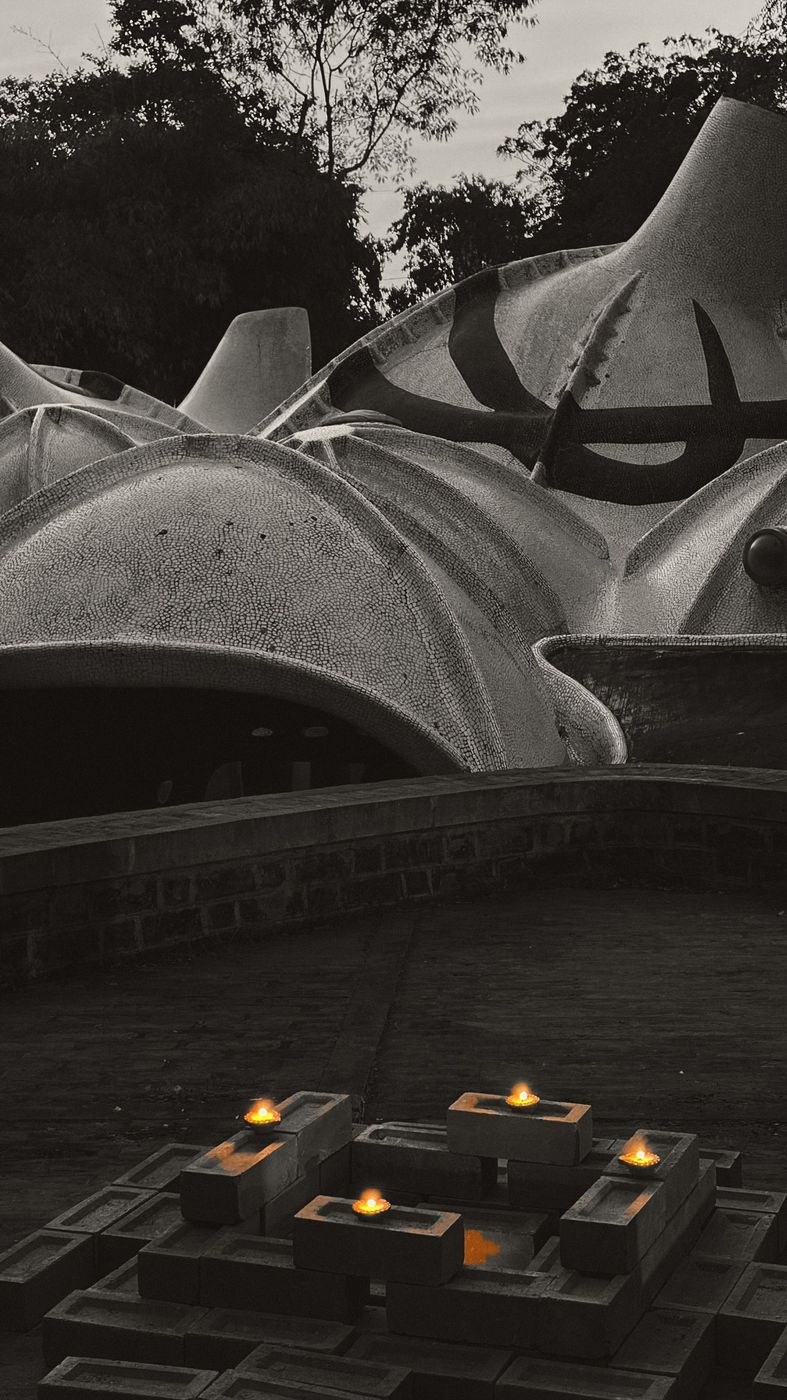
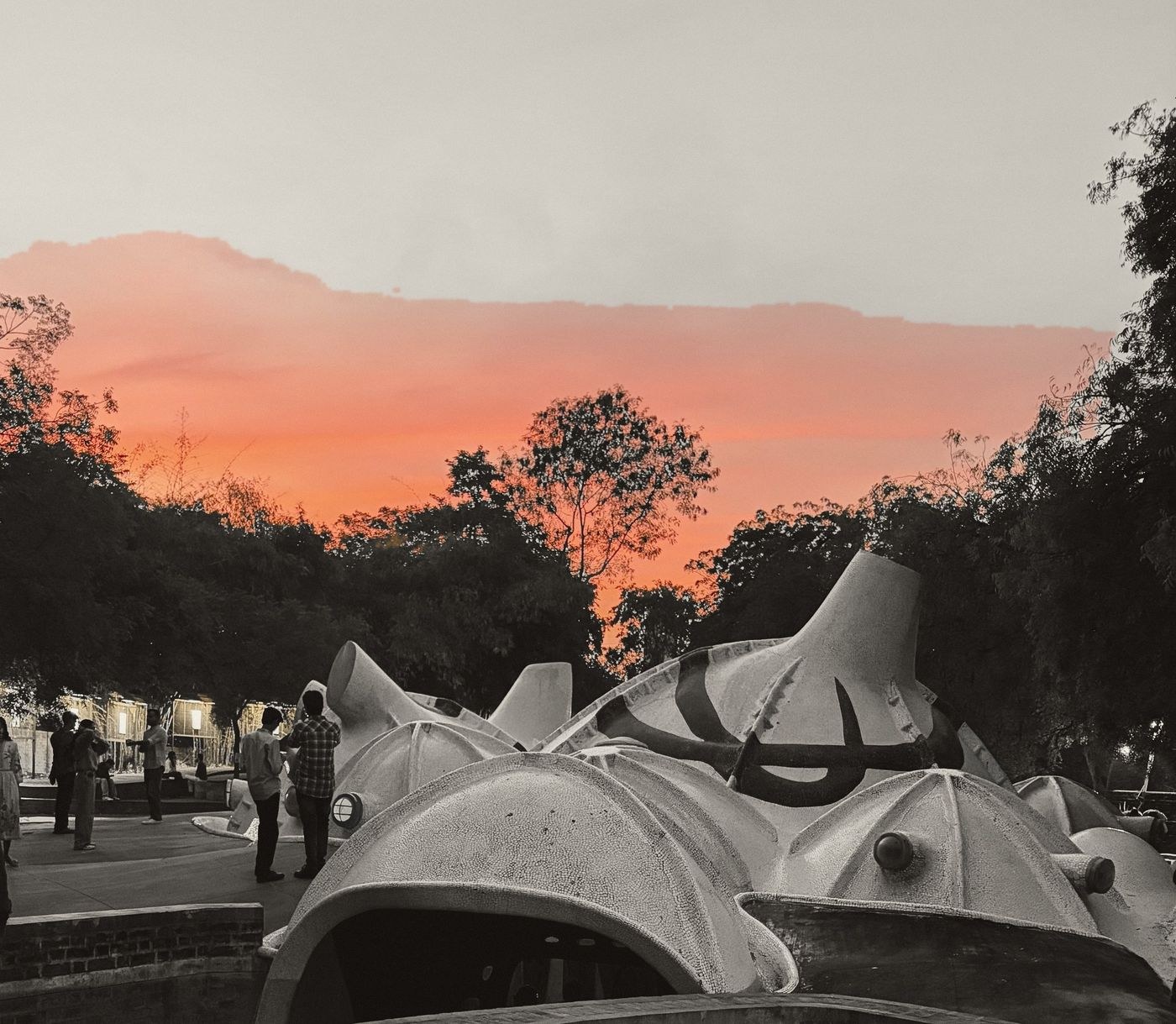
Amdavad ni Gufa is an underground gallery designed by B. V. Doshi with M. F. Husain on the campus of the Ahmedabad Education Society, in the middle of the city. Its thin shells rise from the ground like a tortoise's back, skinned in a mosaic of broken china. The venue already holds what Soulstitch is about: a building pressed into the soil, open to the sky, made from fragments other people threw away. Edition 2 didn't have to bring those ideas to the site. It had to answer them.
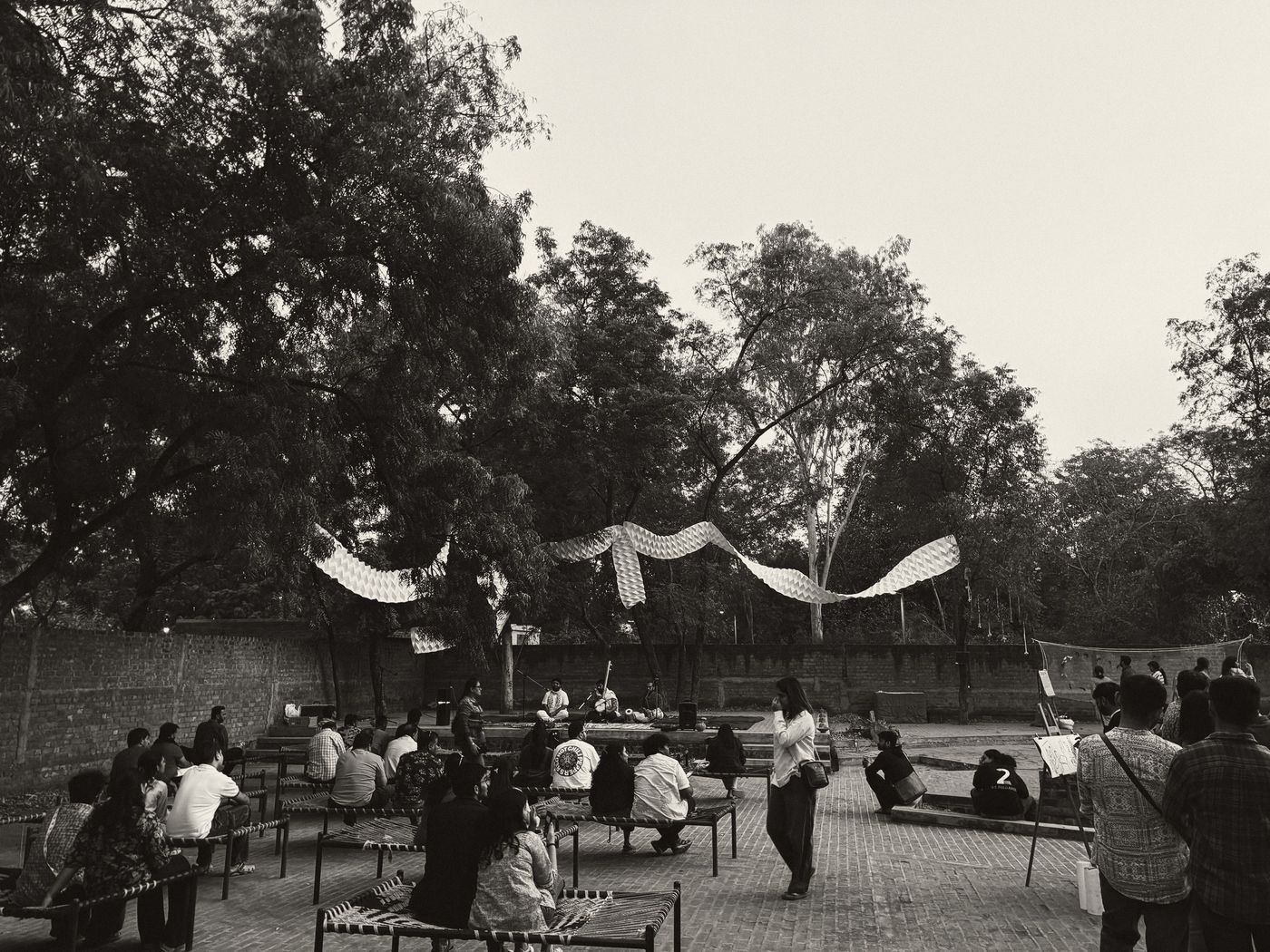
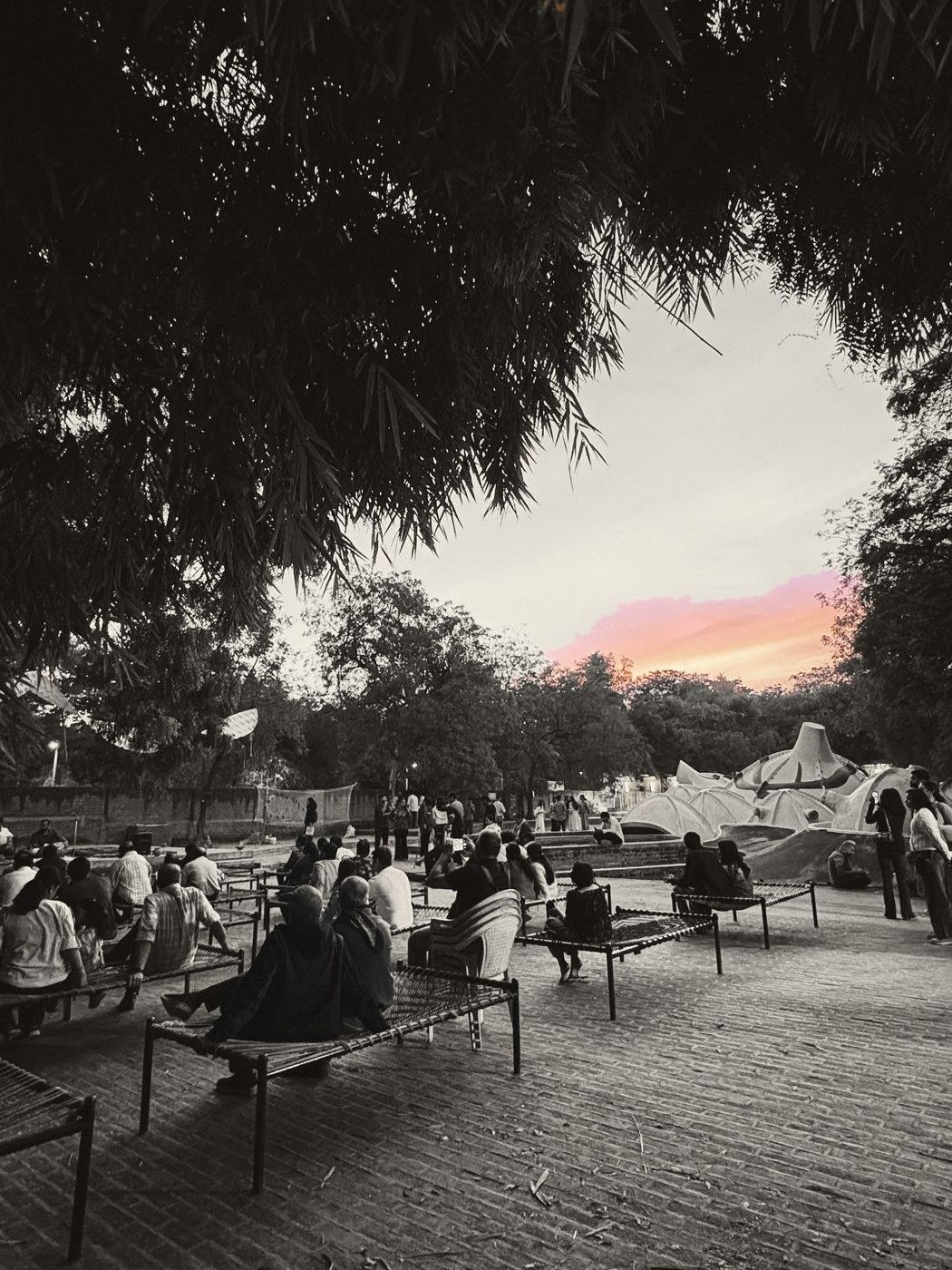
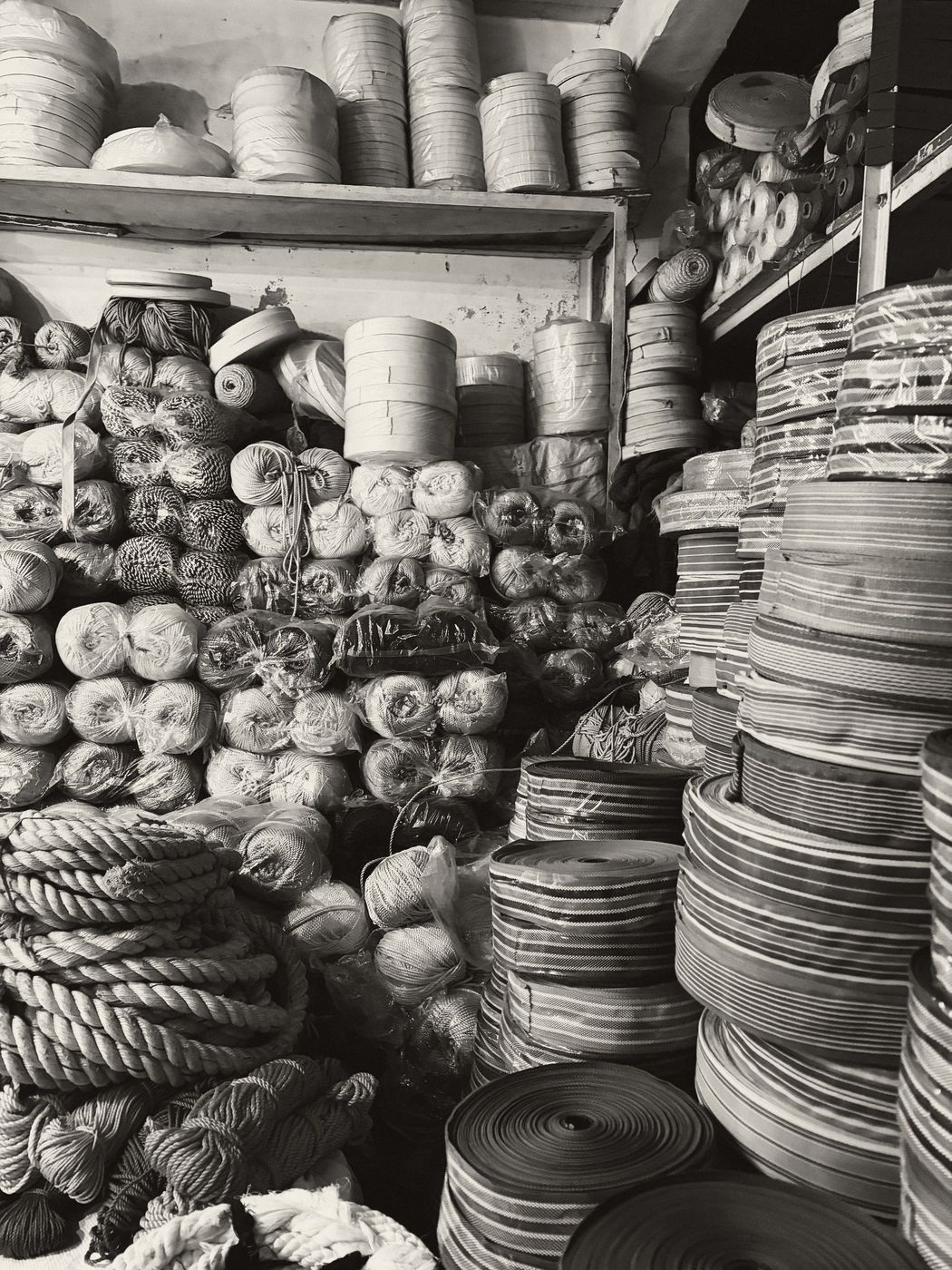
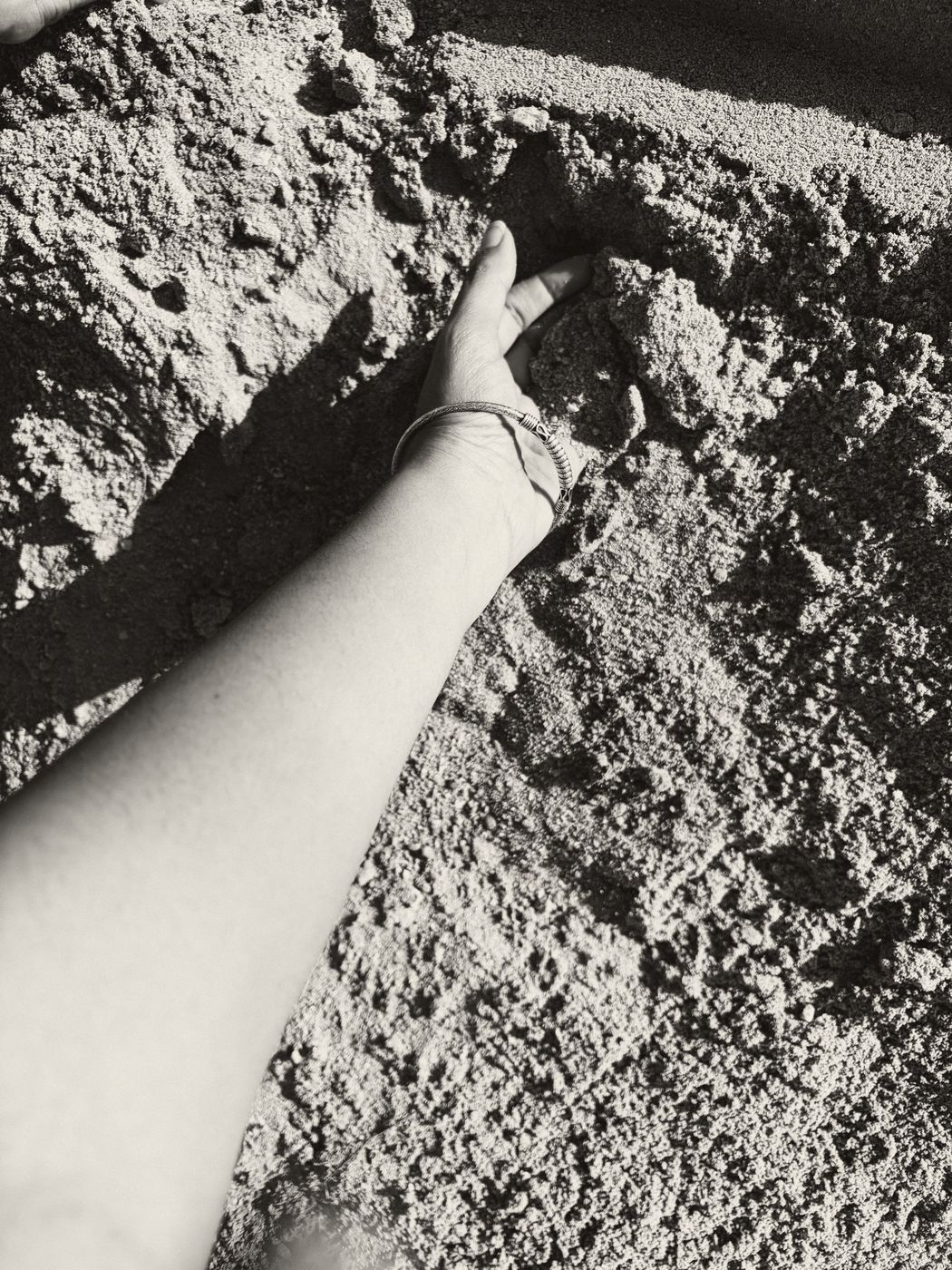
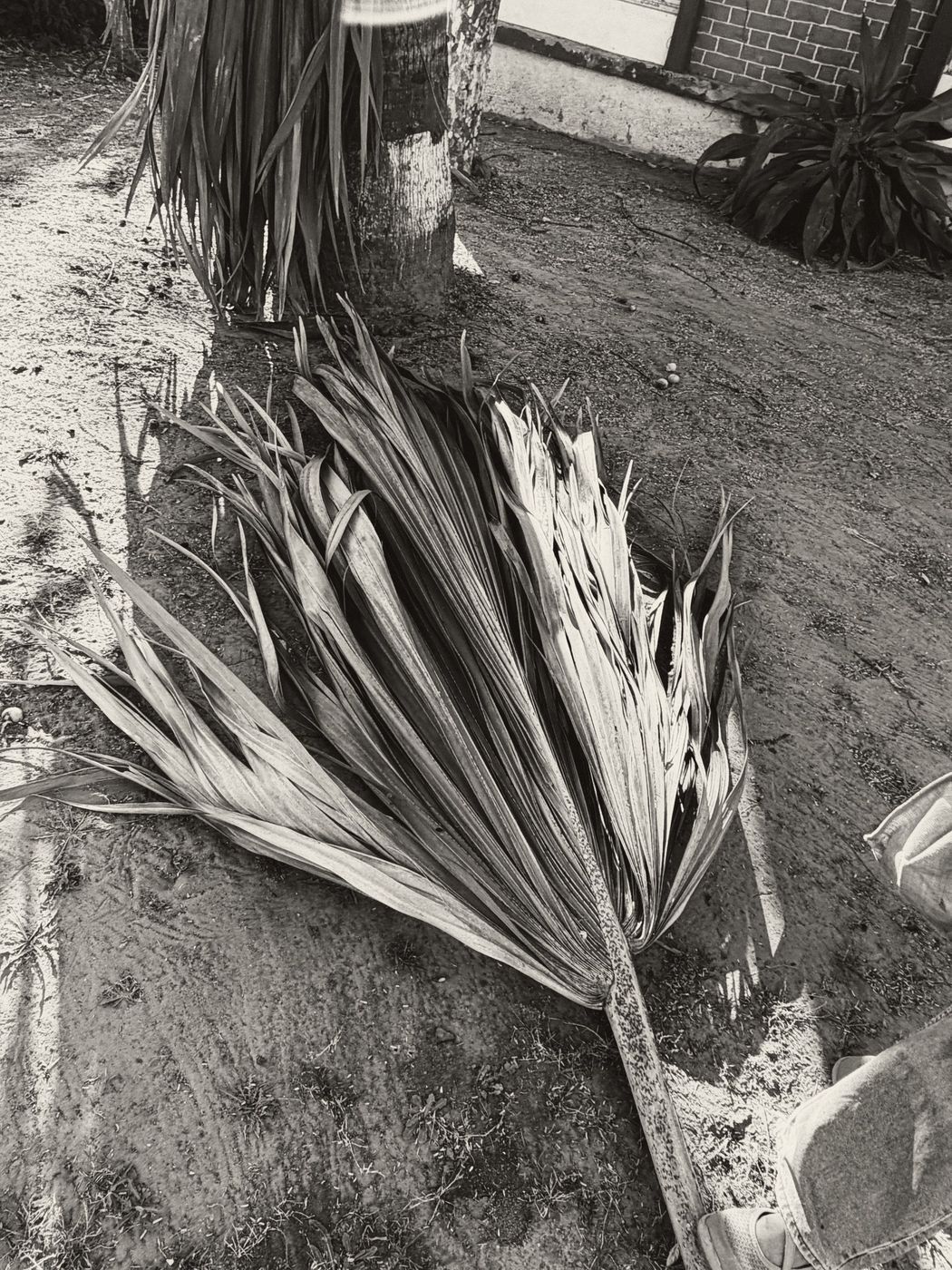
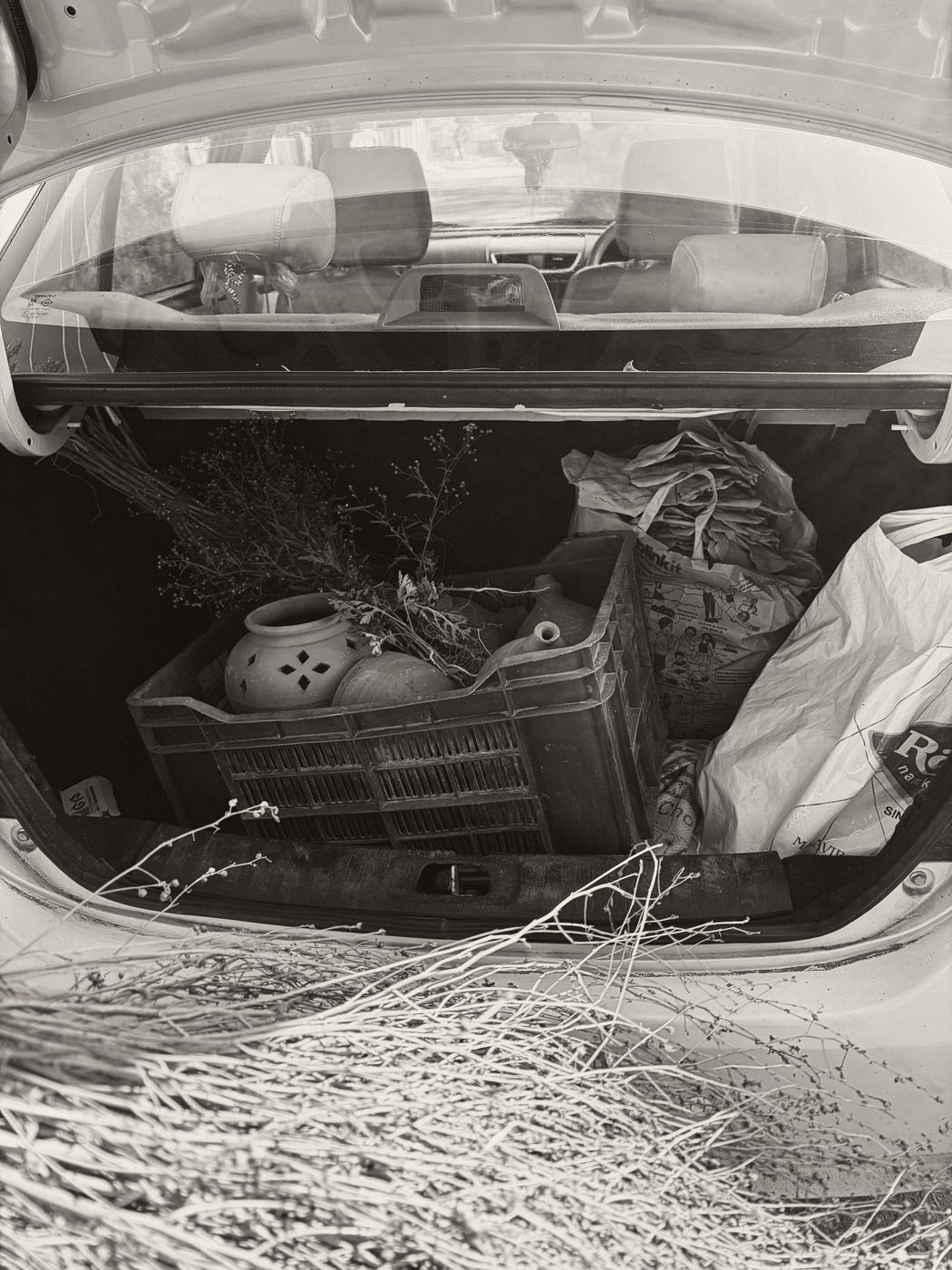
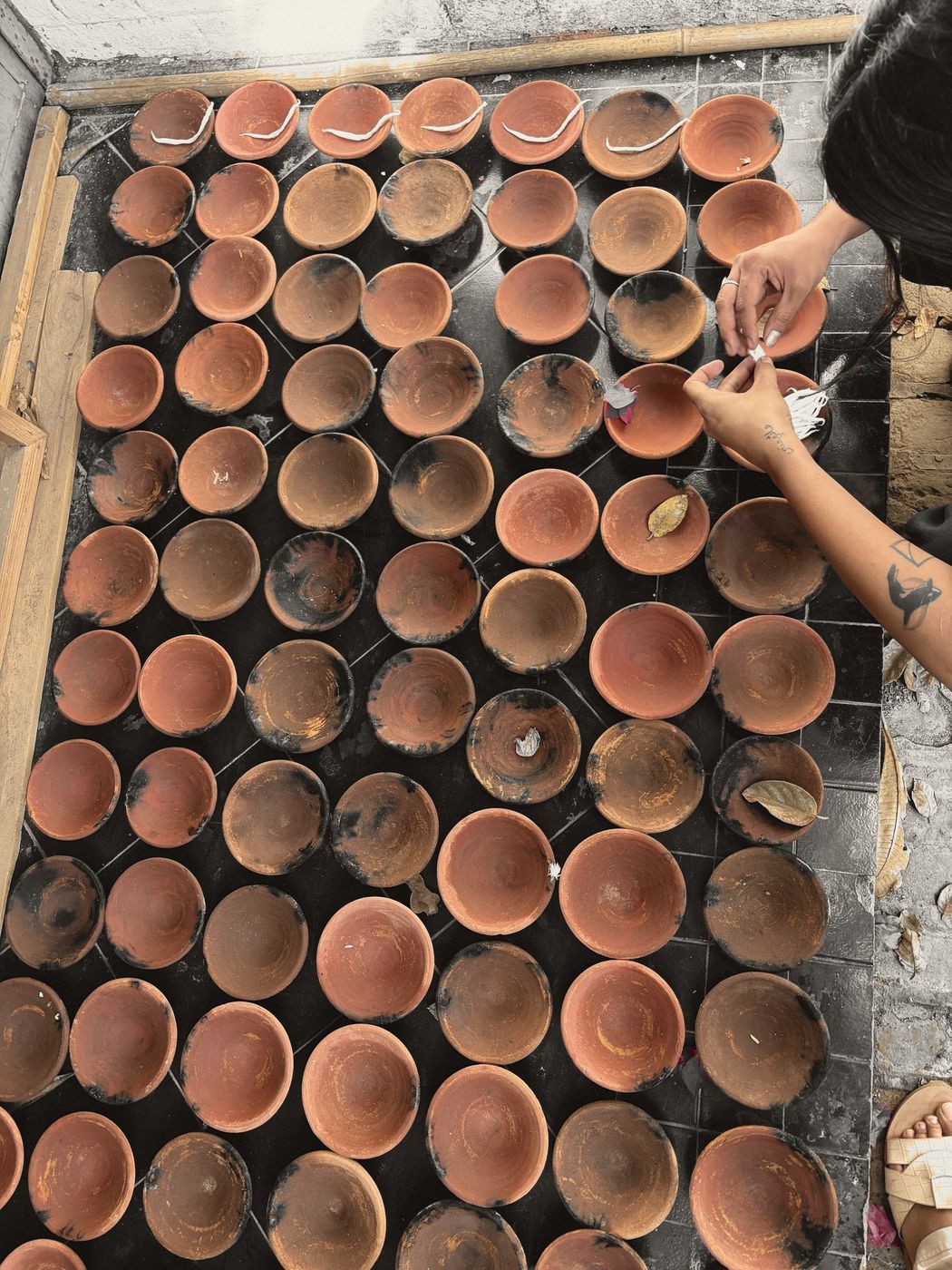
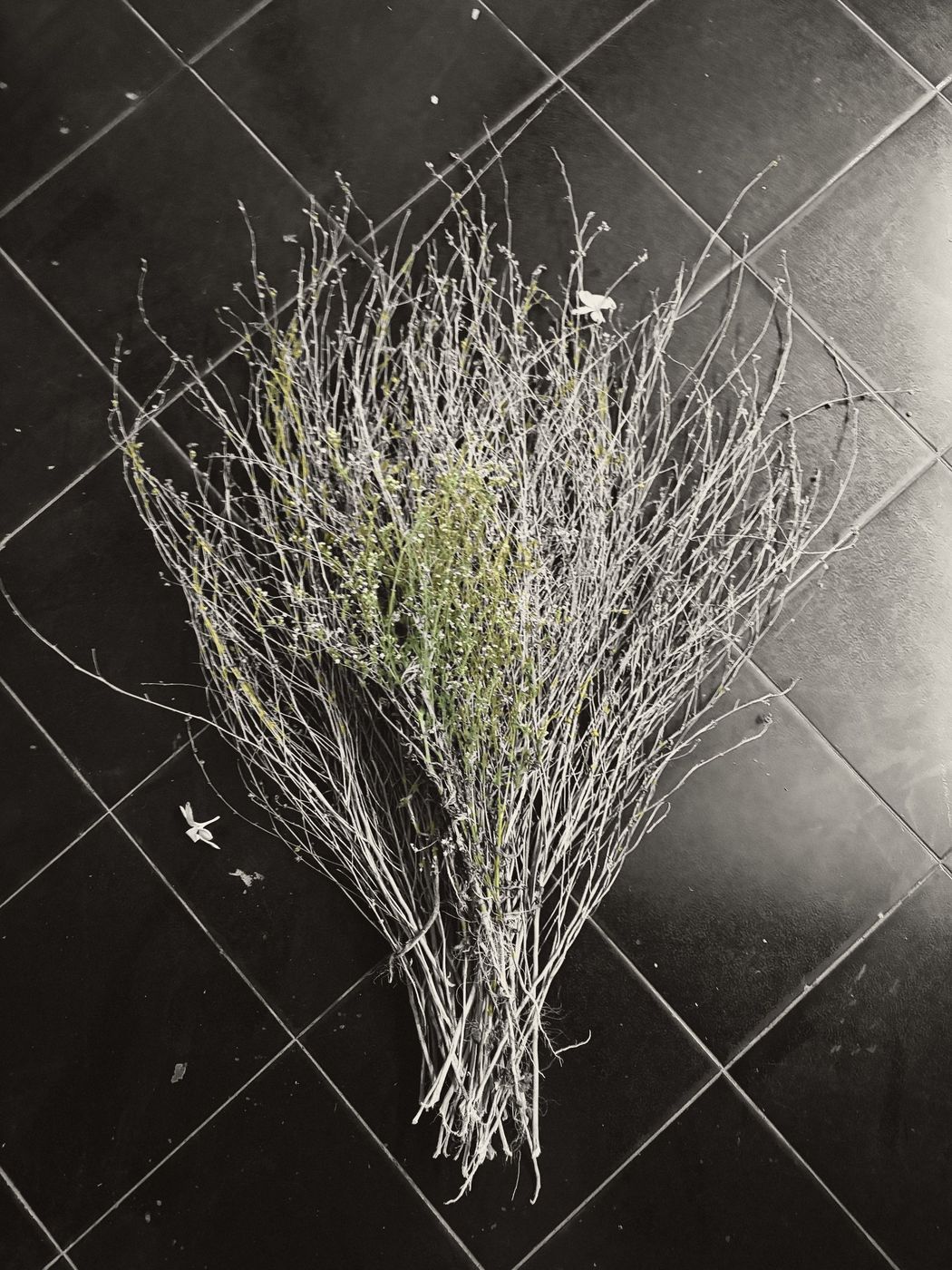
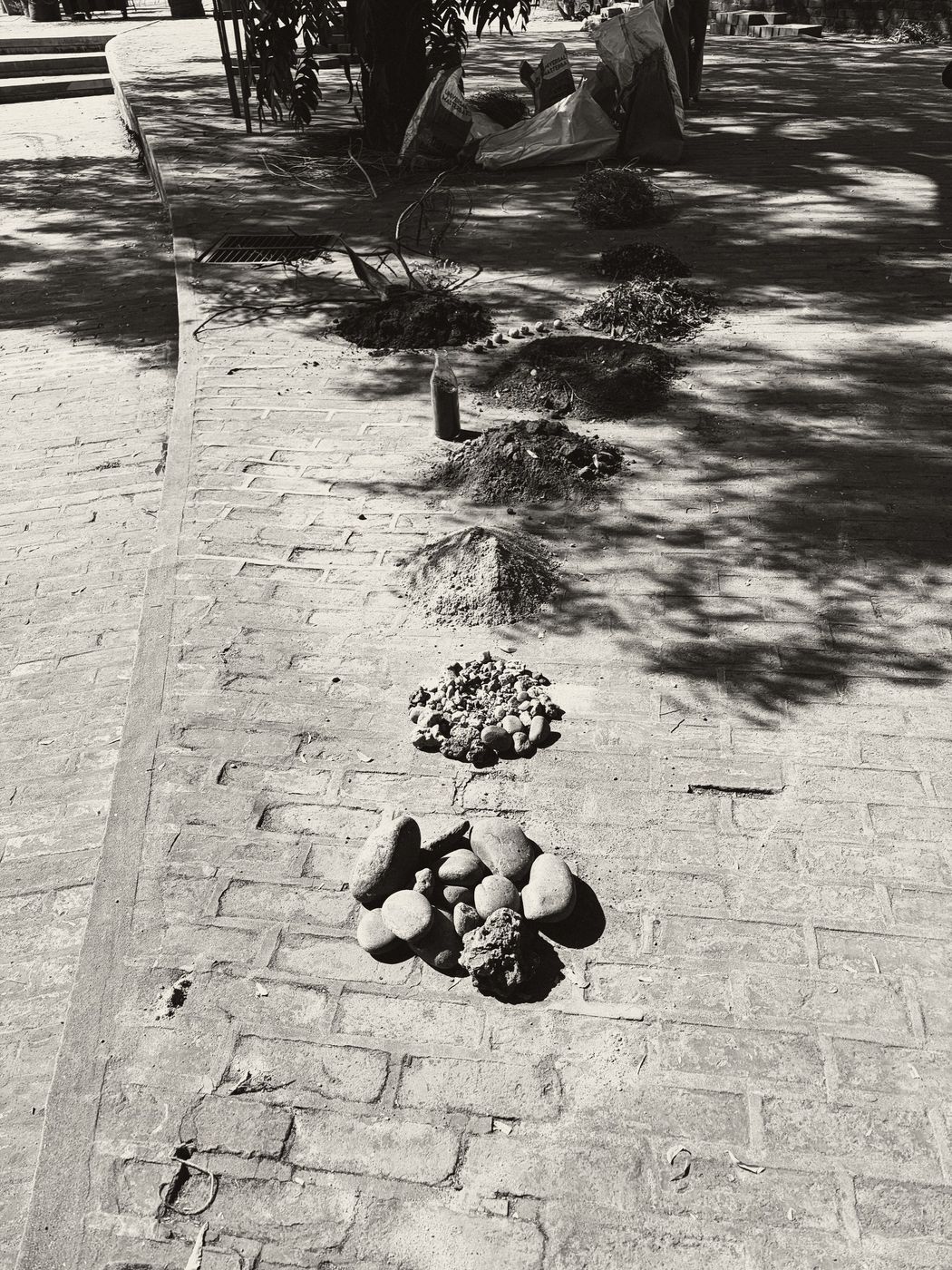
The photographs' timestamps show the evening being assembled from the city over three days: a thread and rope market on 19 December, where rope and jute were bought; soil, sand, ash, fallen palm fronds, dry grass and terracotta collected on 20 December and carried in a car boot; on the morning of 21 December, diyas set out in rows and wicked by hand, the soil path laid heap by heap, and Vedi built block by block.
A chalk notice at the entrance read "Amdavad Winter Soulstitch 2025 · 21 Dec · Free for all · 4–10 PM". convenor The programme ran from 4 to 11 pm, an hour past the time on the notice. Manav was first on site, at 8 am, and the last to leave.
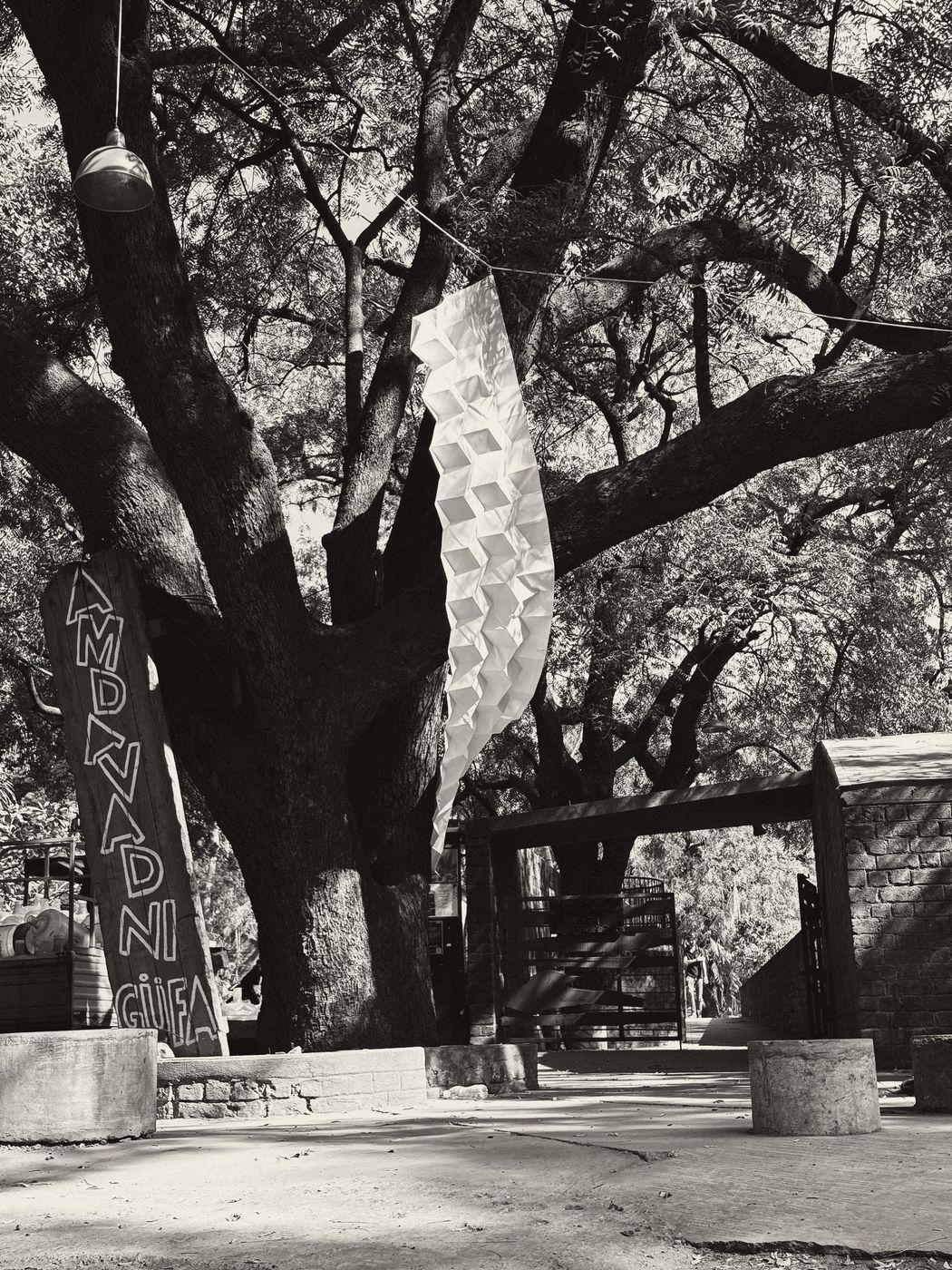
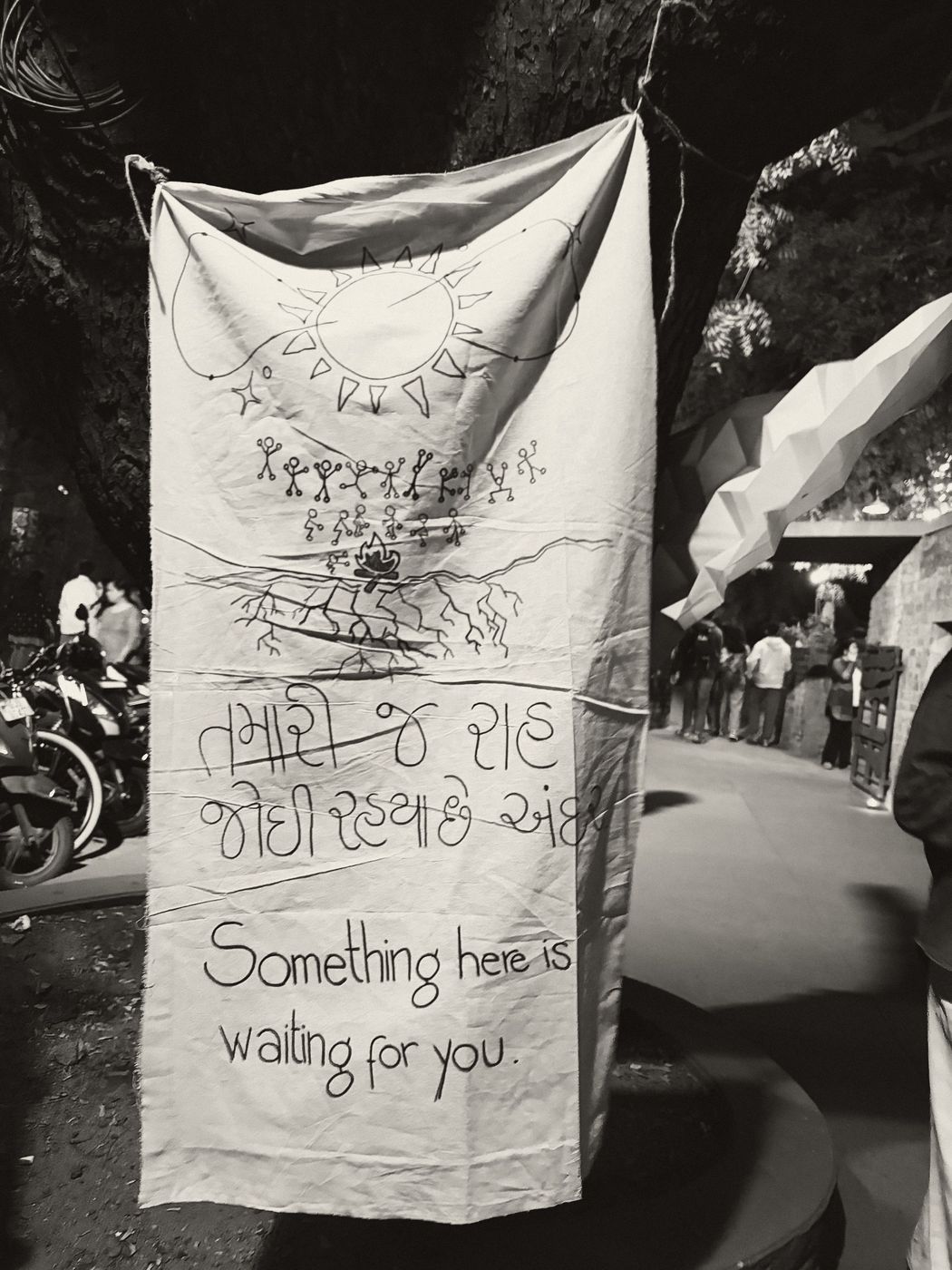
Arriving. convenor A large tree stands at the entrance. It carried an illustrated cloth banner by Kavin, tamari j raah joi rahya che ahiya ("here, we have been waiting just for you"), which Multopia still holds, and an origami work by Khushboo Padiyar of Badhikala, wrapped around the trunk: one of a series of her folded-paper works that also hung over the arena.
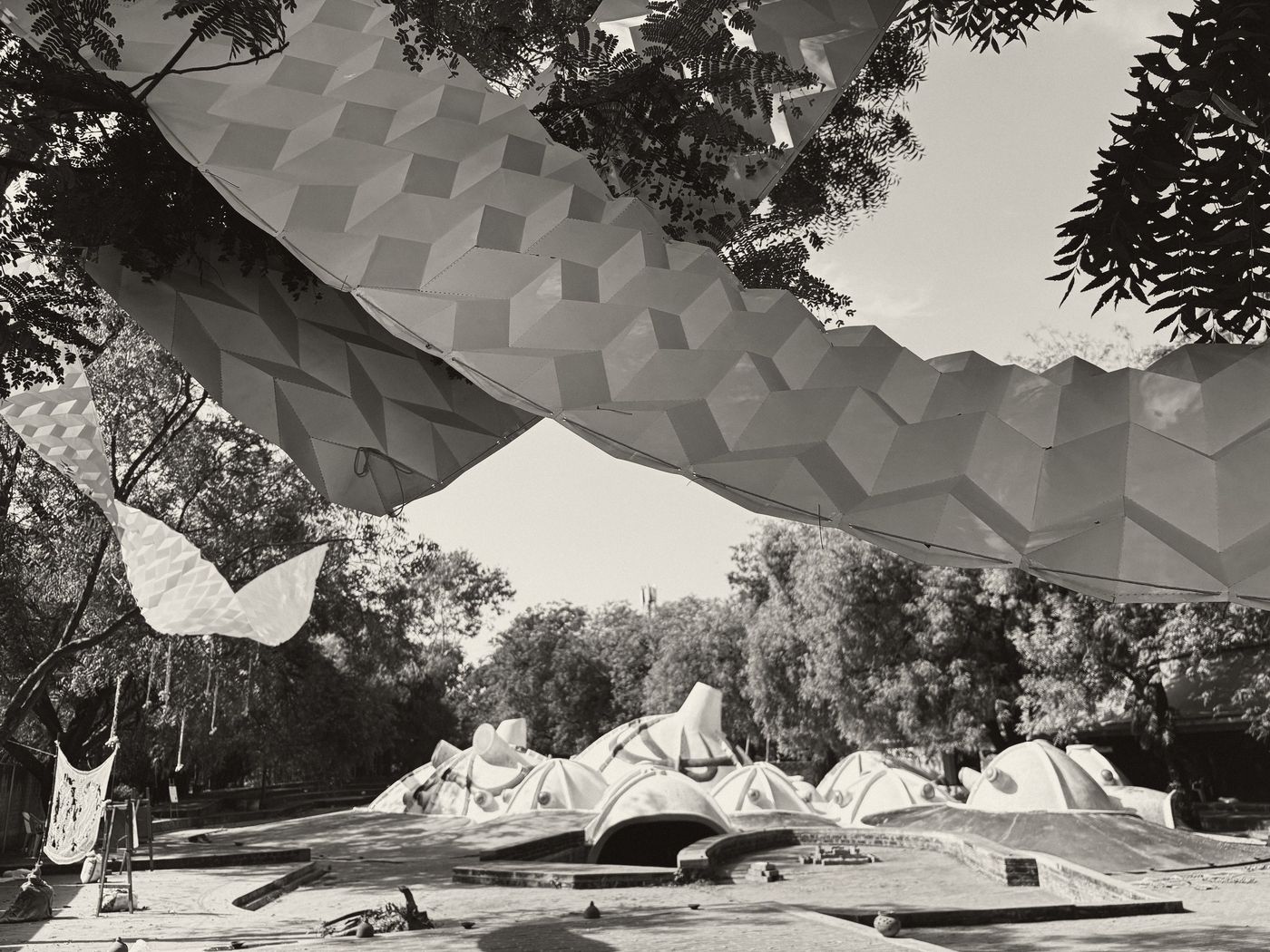
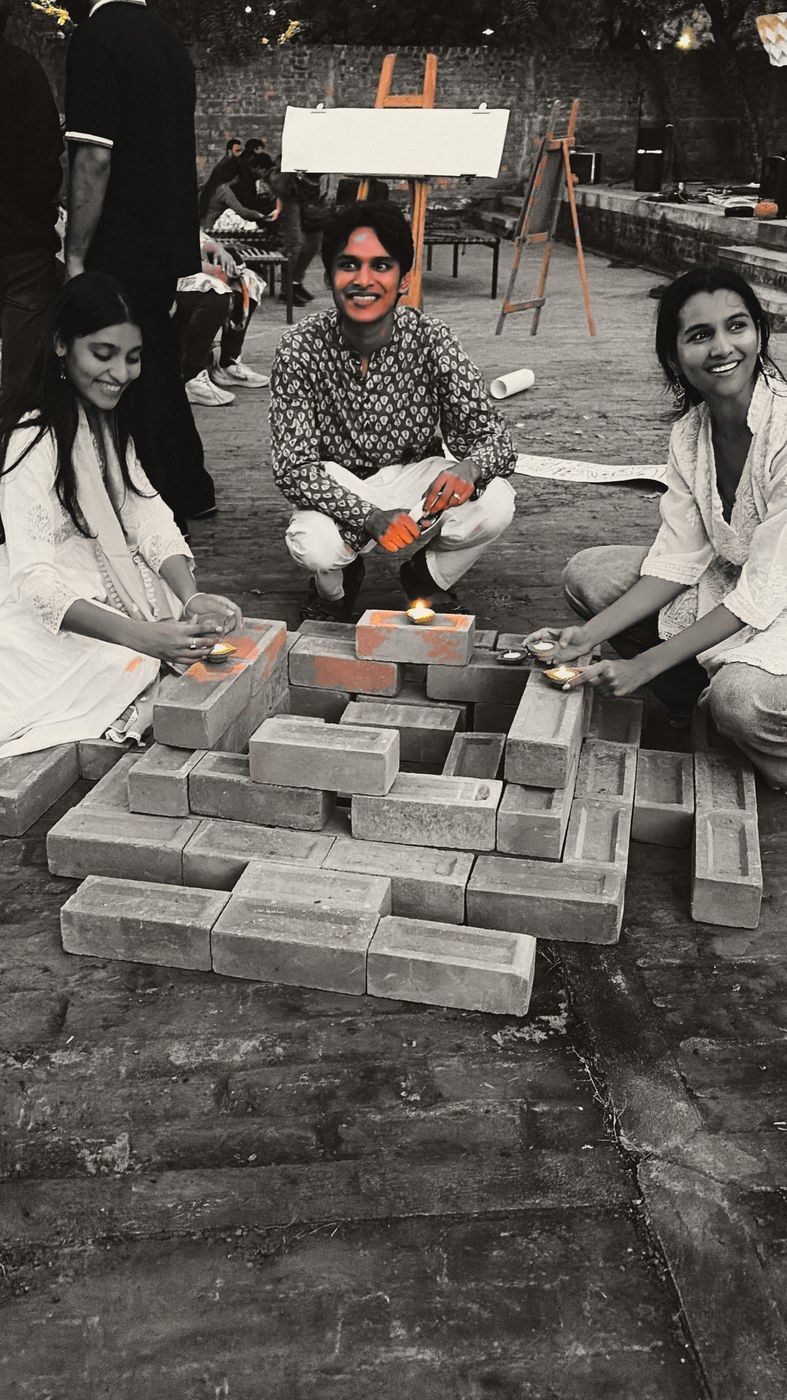
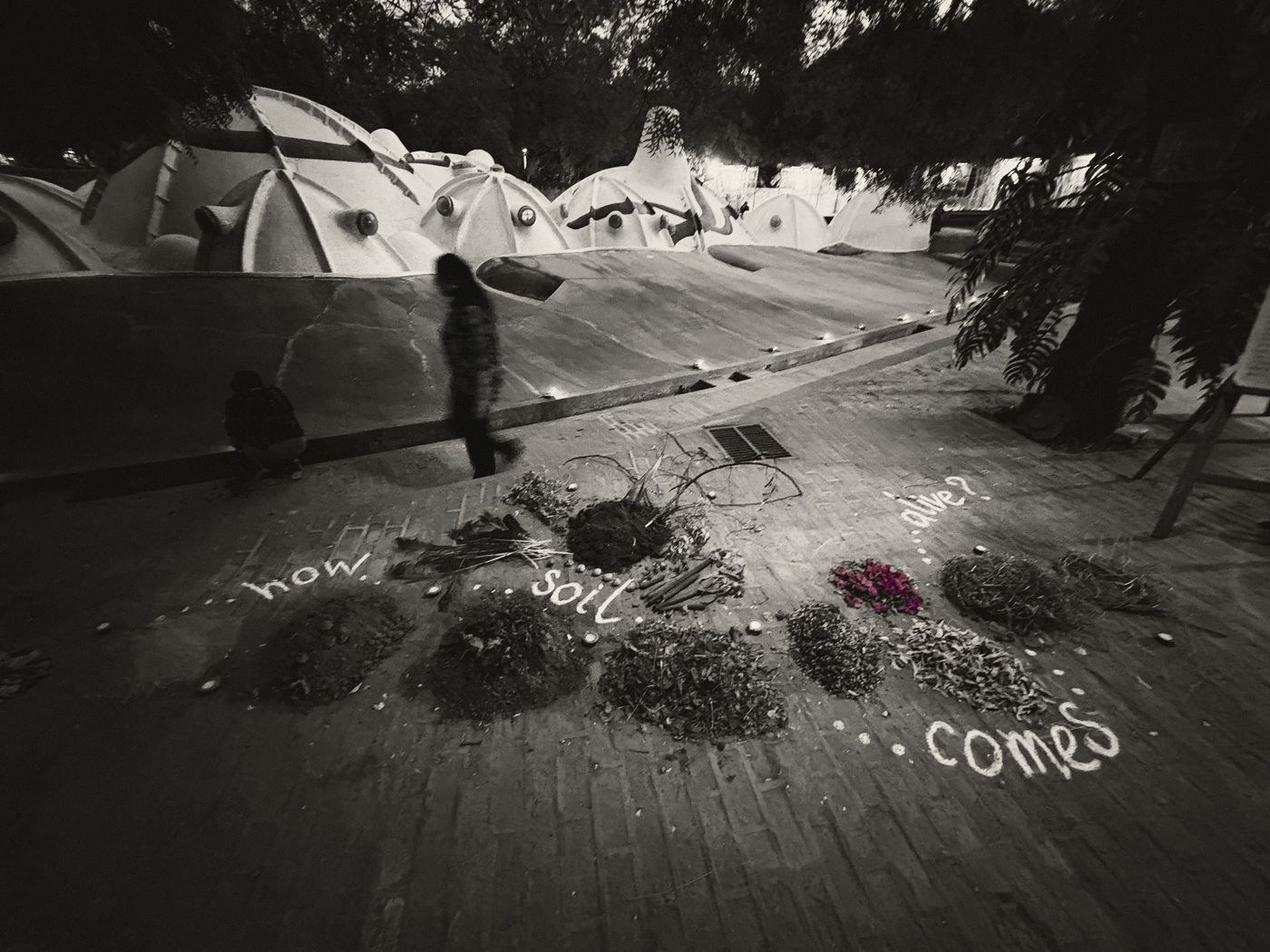
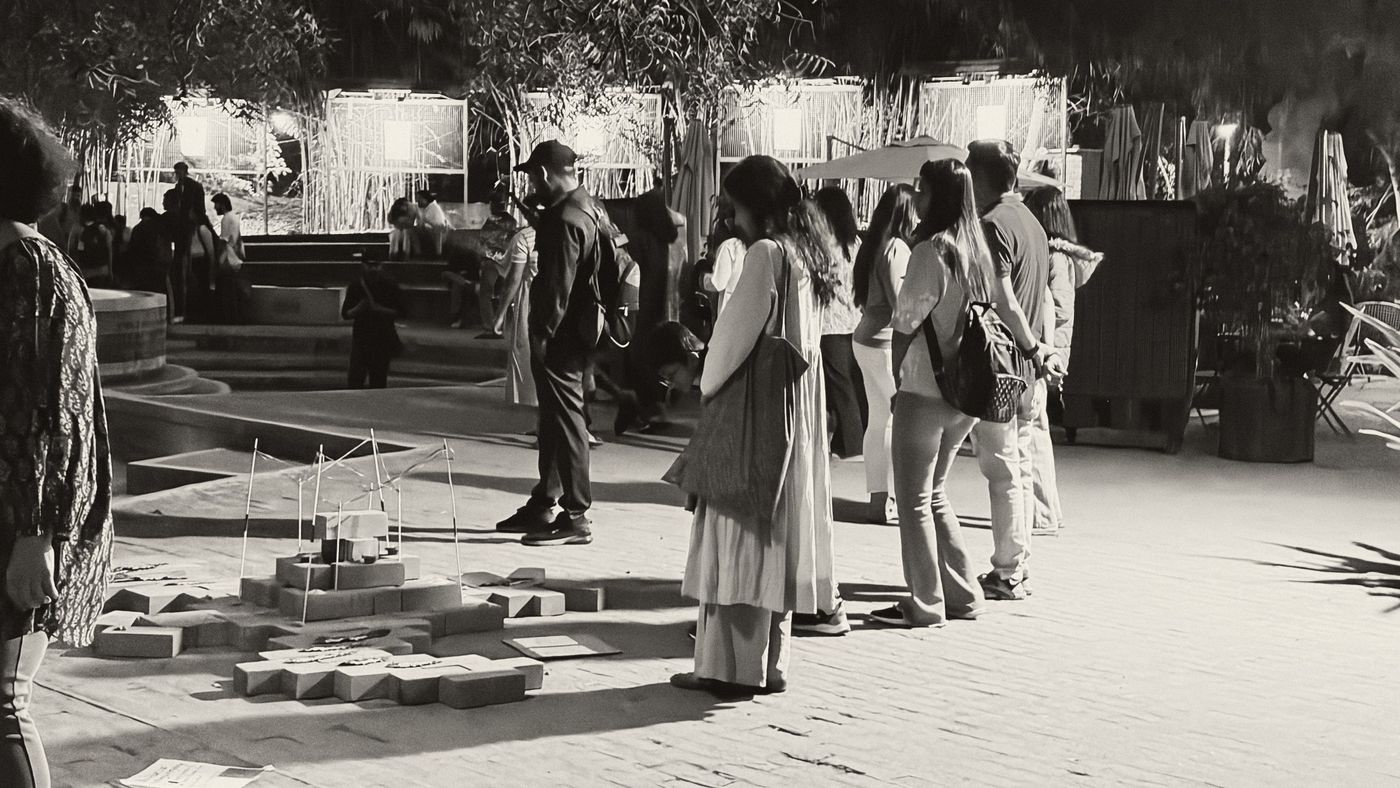
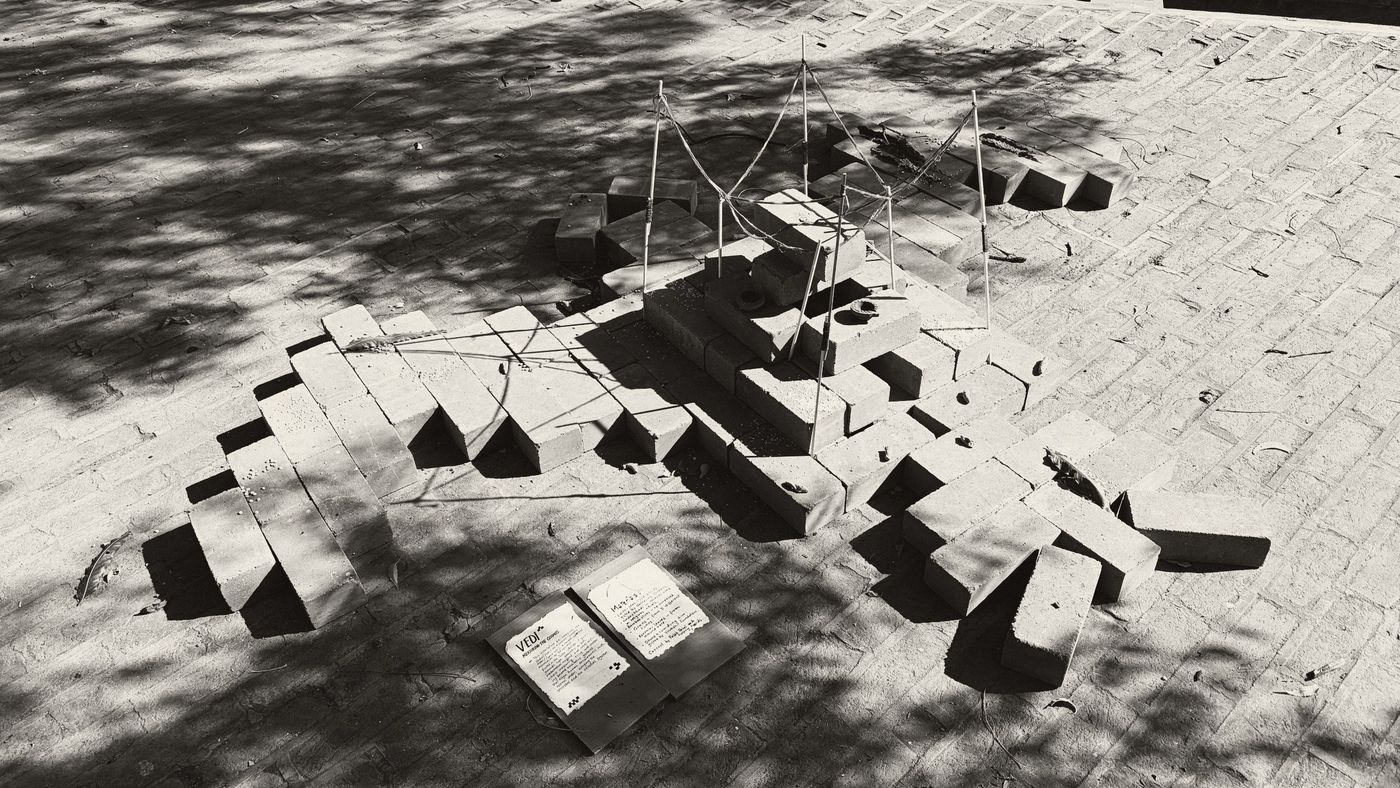
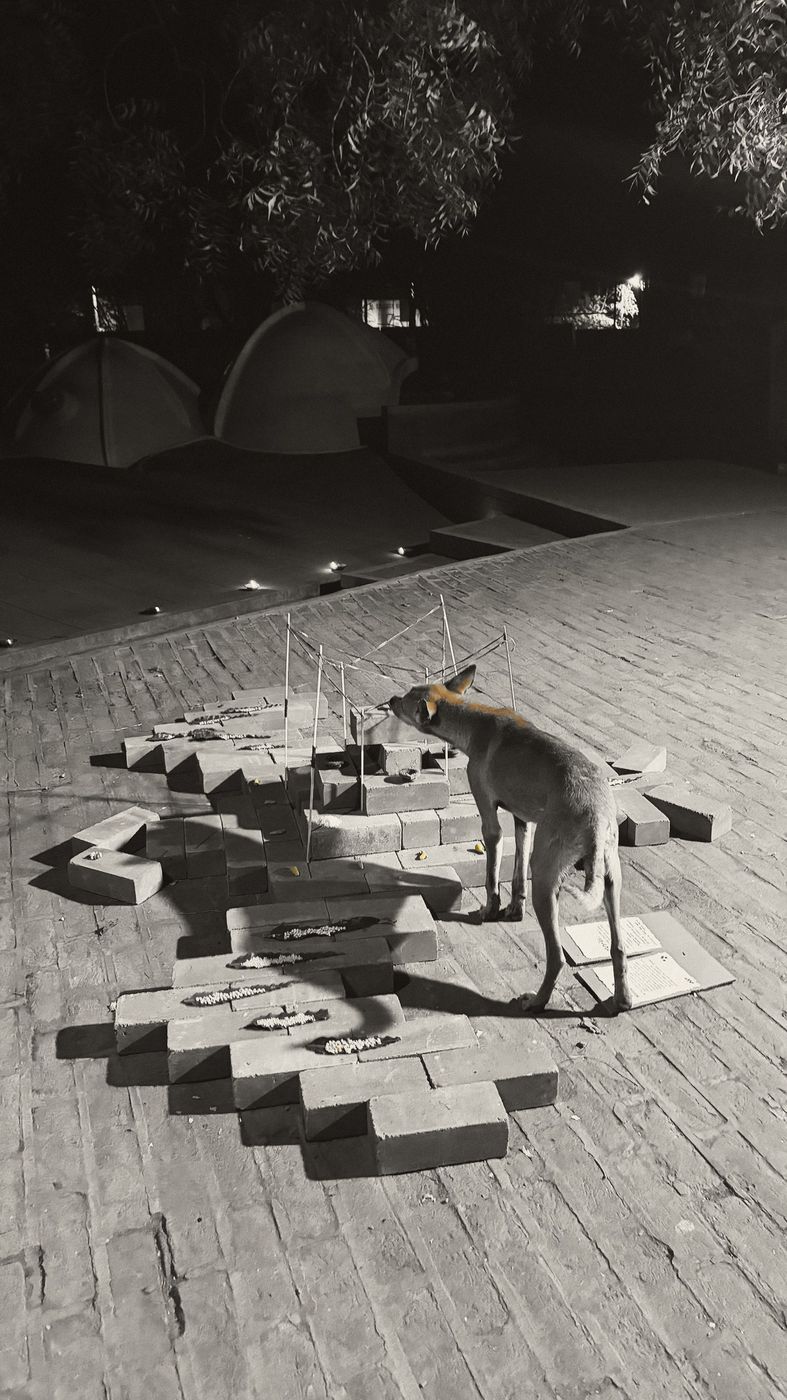
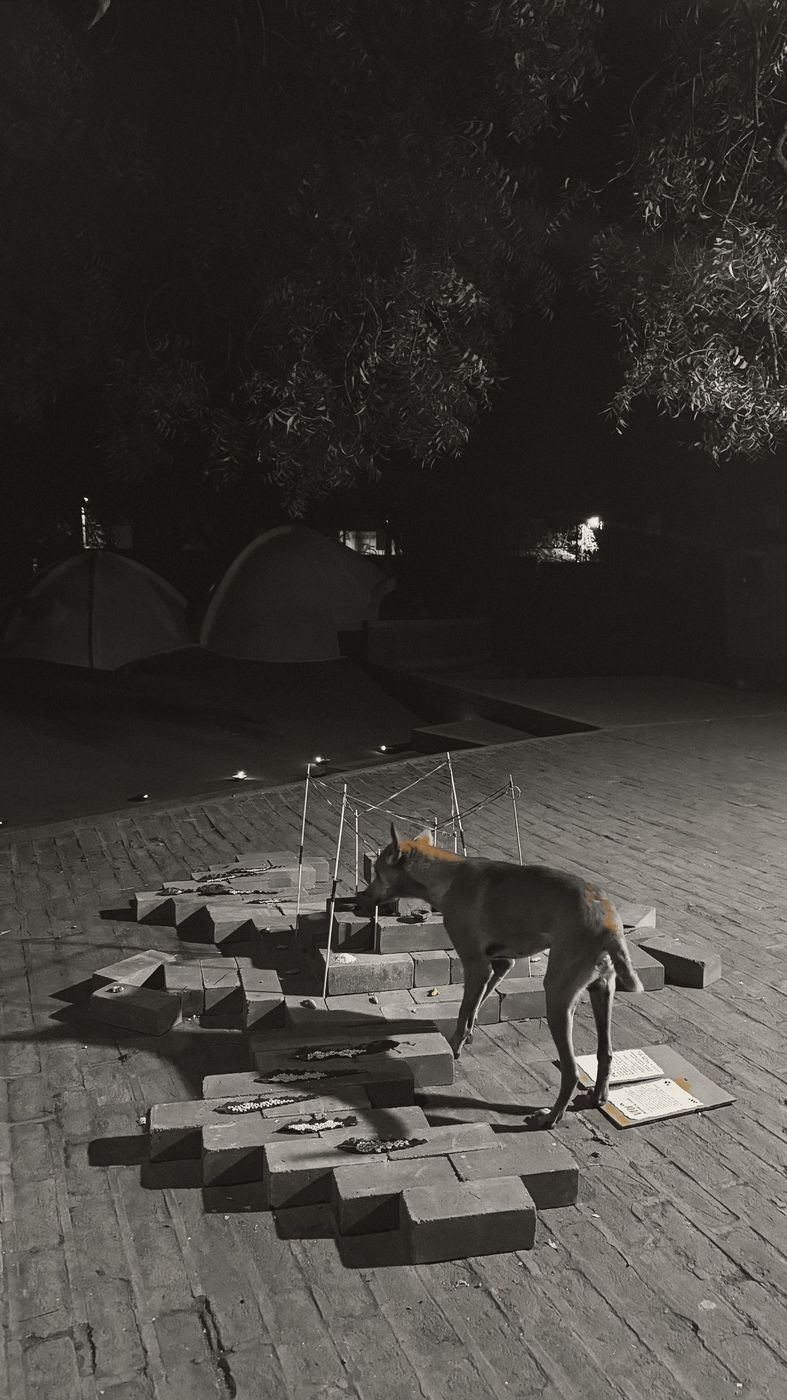
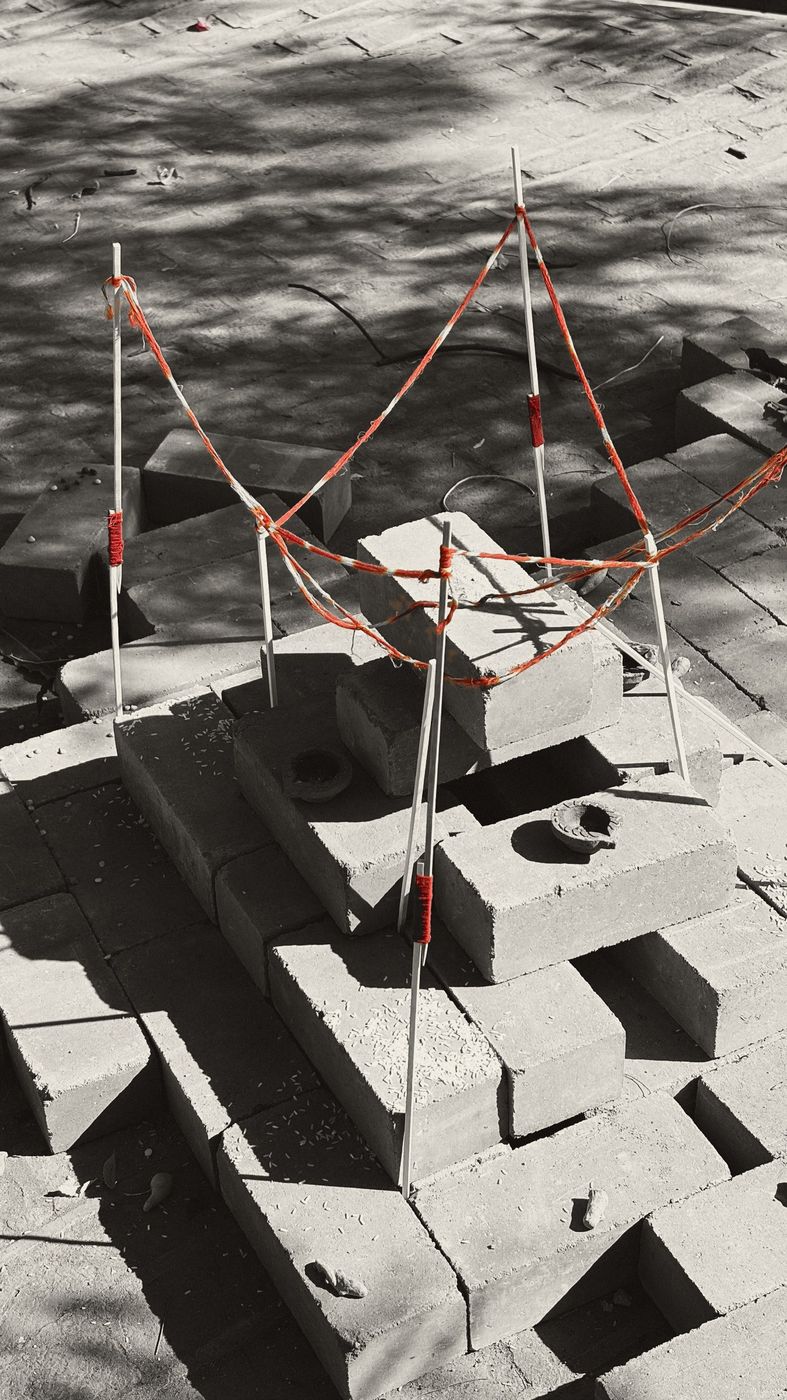
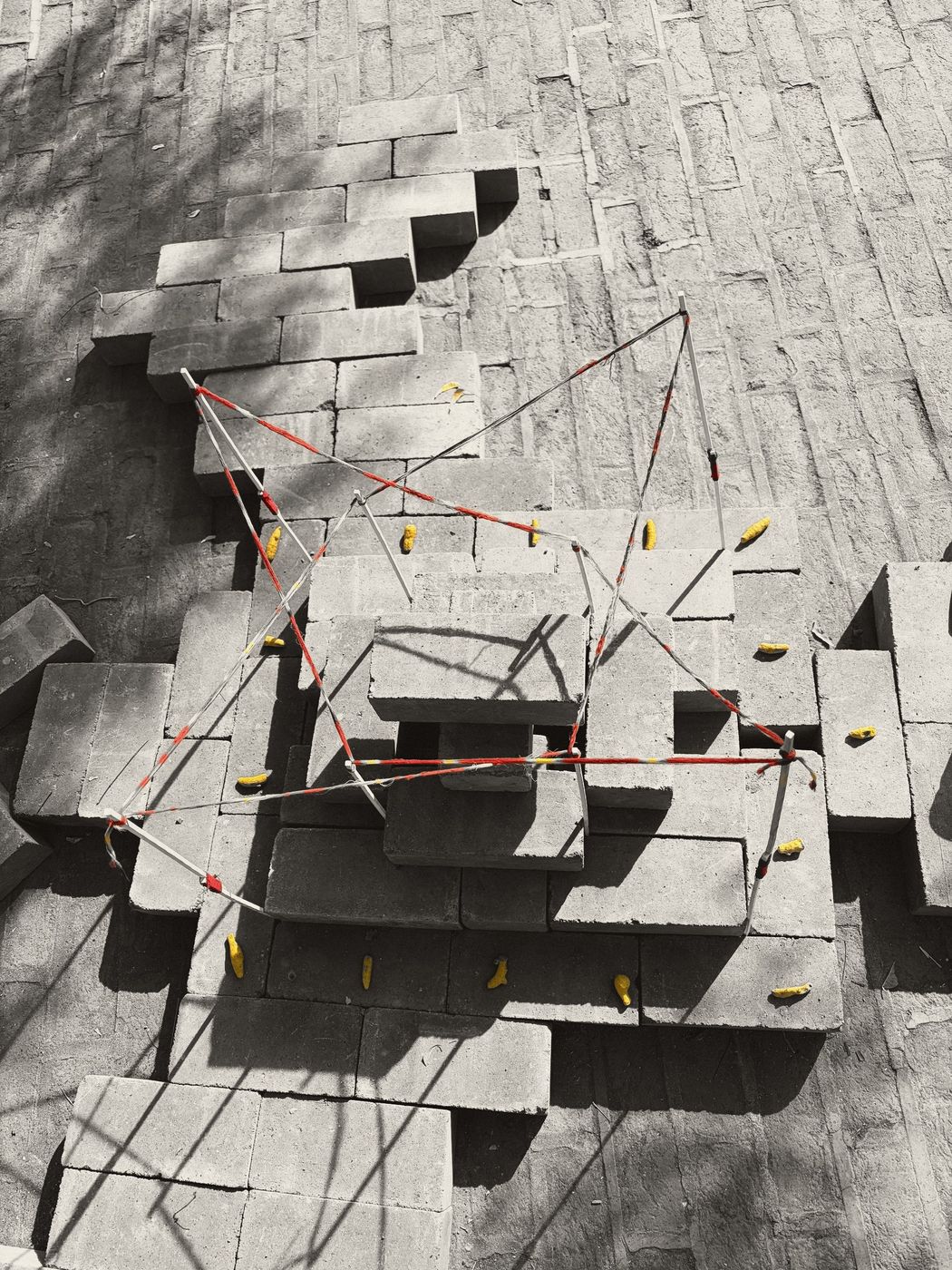
Soil. The first installation past the entrance was Vedi: Measuring the Cosmos, "concept by Palak Patel & helping hands": earth blocks lent by Gathering Green, nadachhadi thread and bamboo from Palak's home, grains from five homes, asopalav leaves from around the site, and dhoop and cow-dung diyas given by Vrikshit Foundation. artist In Palak's words, it "reimagines the Vedi as a falcon-shaped altar", where measuring, tying and stretching rope become meditative gestures. Beside it, Kairavi Shah and Saloni Gajjar (The Rooted Circle) laid a path of heaps from rock to life: rock, pebbles, sand, compost, manure, leaf litter and flowers, with the question chalked between them: how … soil … comes … alive?
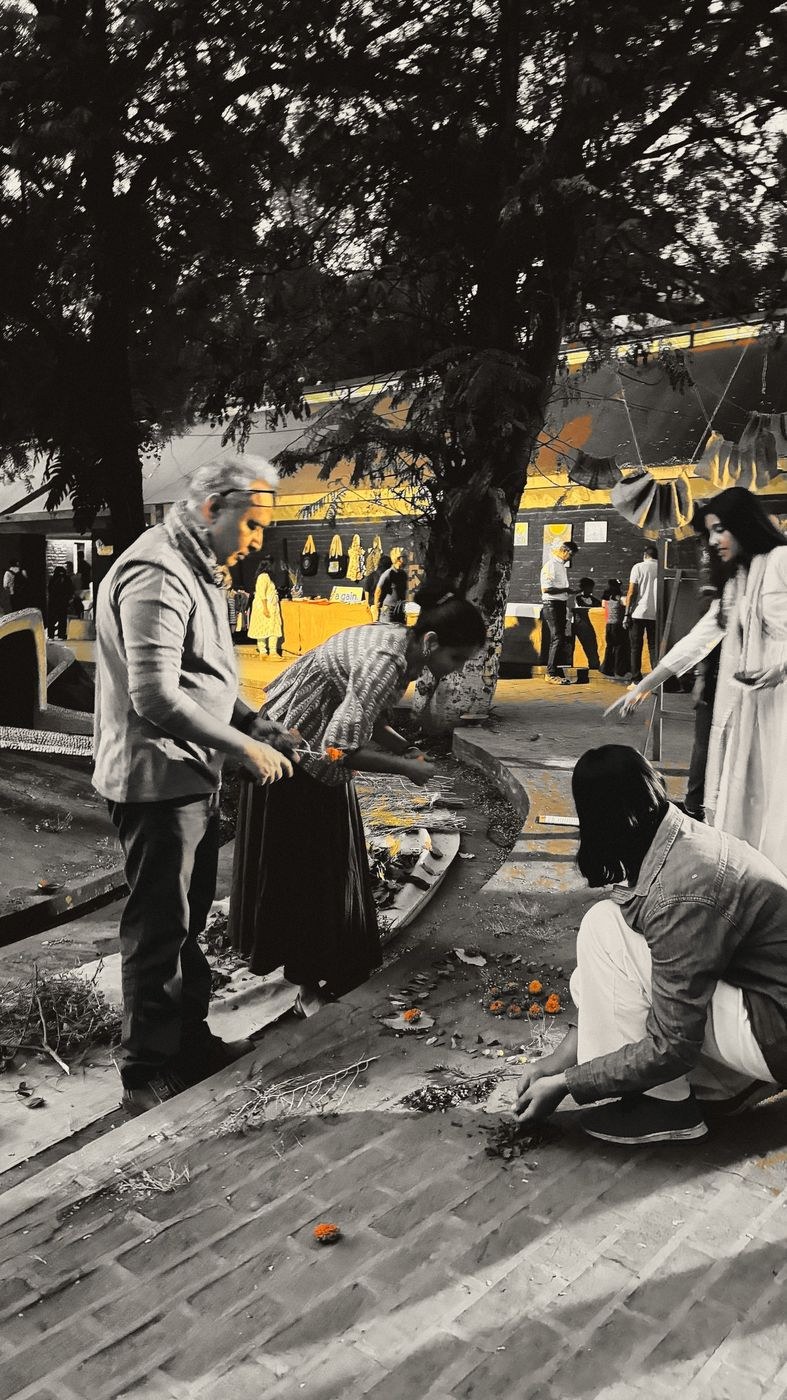
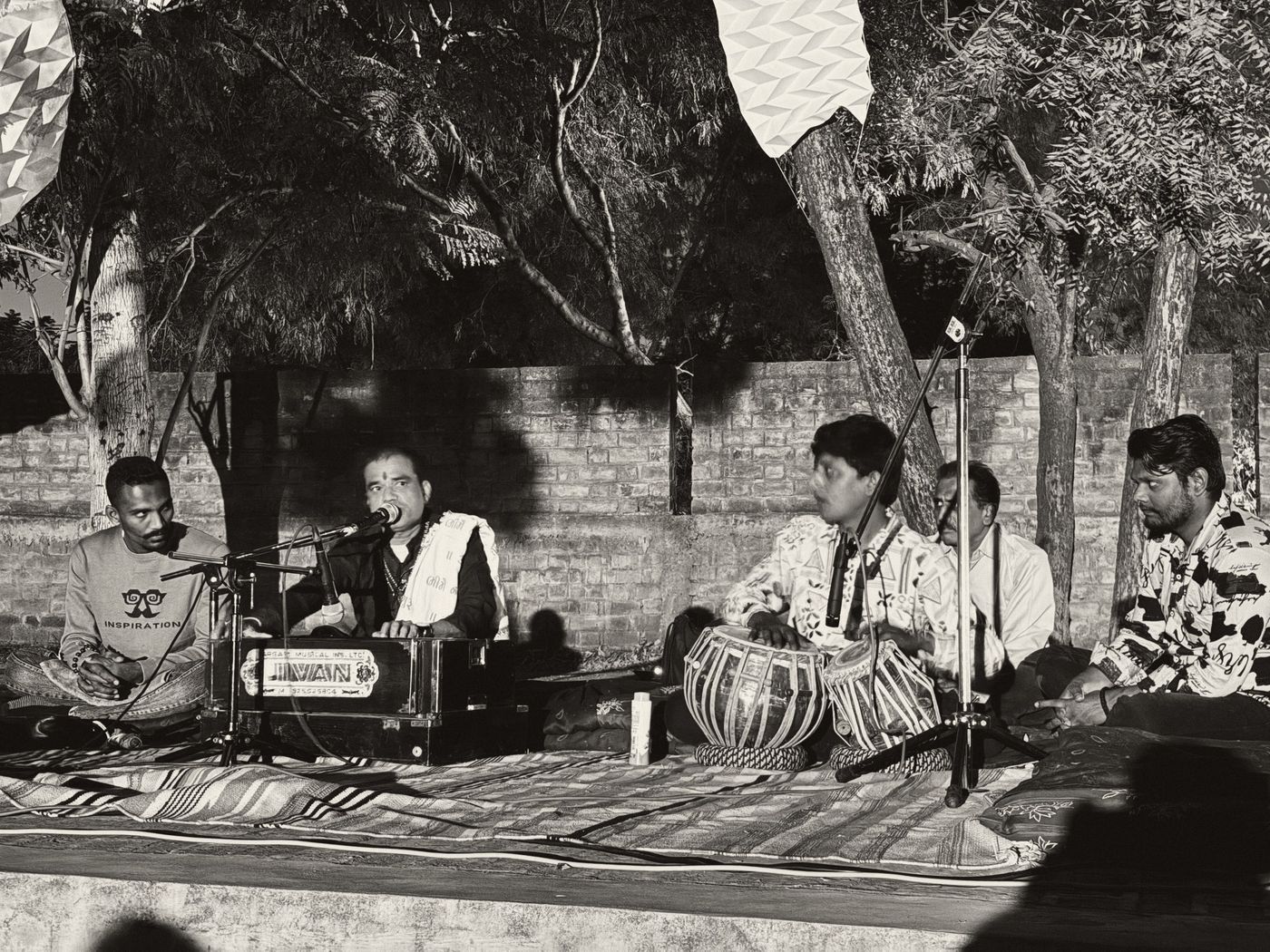
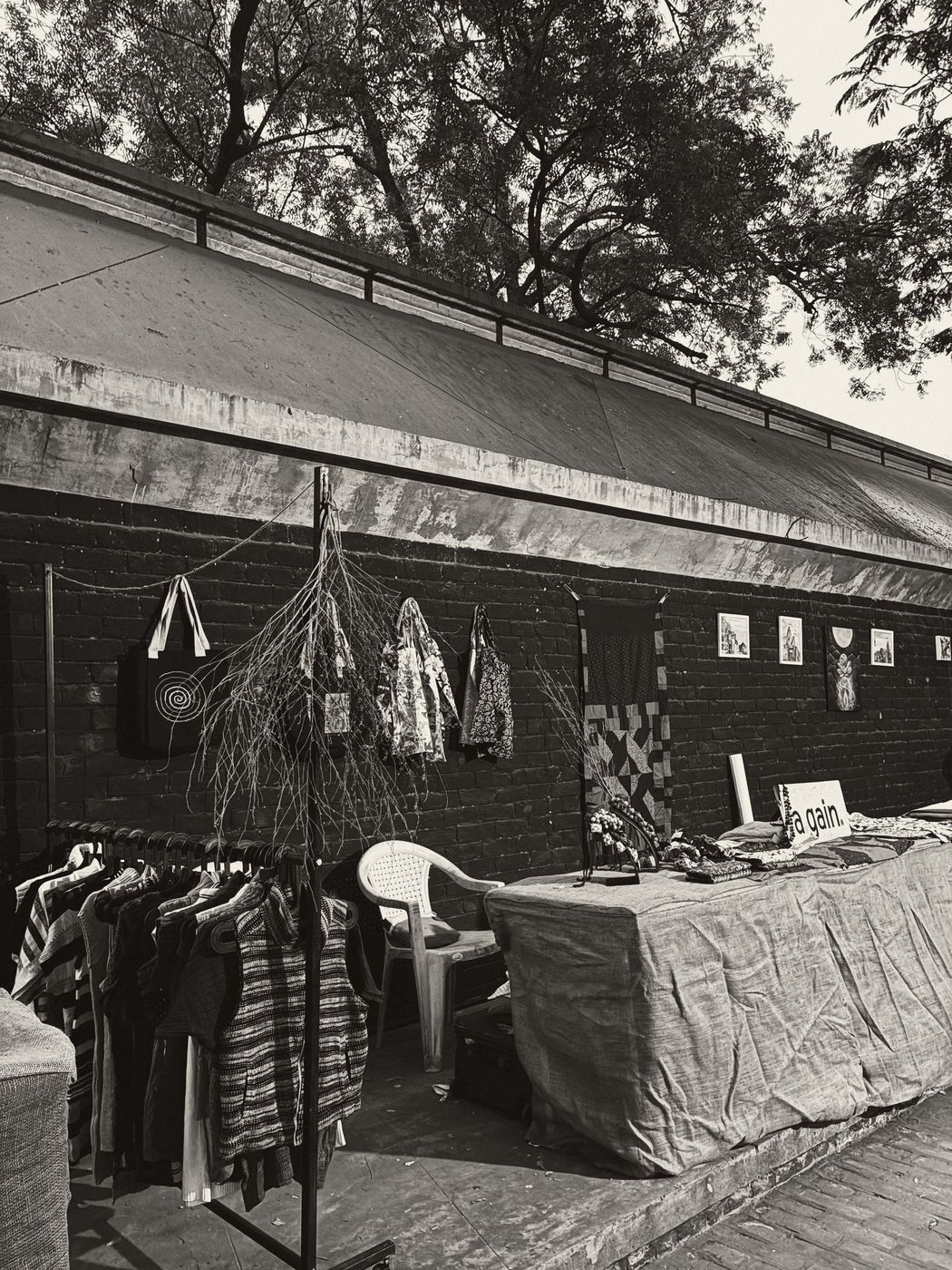
Culture. convenor Apurva of a.gain, at a makers' table, with recycled cloth stitched into usable art; Harsh Hingu, drawing live in charcoal; Harshdeep Jadeja and team, in the first of two daayro performances; Kavin, with illustrations; Nithin Kumar of Kaley Studio, at a makers' table, with handmade clay; Pooja Mathur of Greenstraw Foundation, at a makers' table; Rakesh Wani and team, in the second daayro; and Shrutav Patel, with sound design on his own equipment. Rohin Sher of Project Co.We. cooked for everyone: a rajgira (amaranth) raab in Gir-cow ghee, cooked into a spiced jaggery brew with ginger, black pepper, clove, cinnamon, cardamom and mulethi, topped with raisins and almonds, every ingredient organic, regional and seasonal, served in paper cups and bowls, without straws.
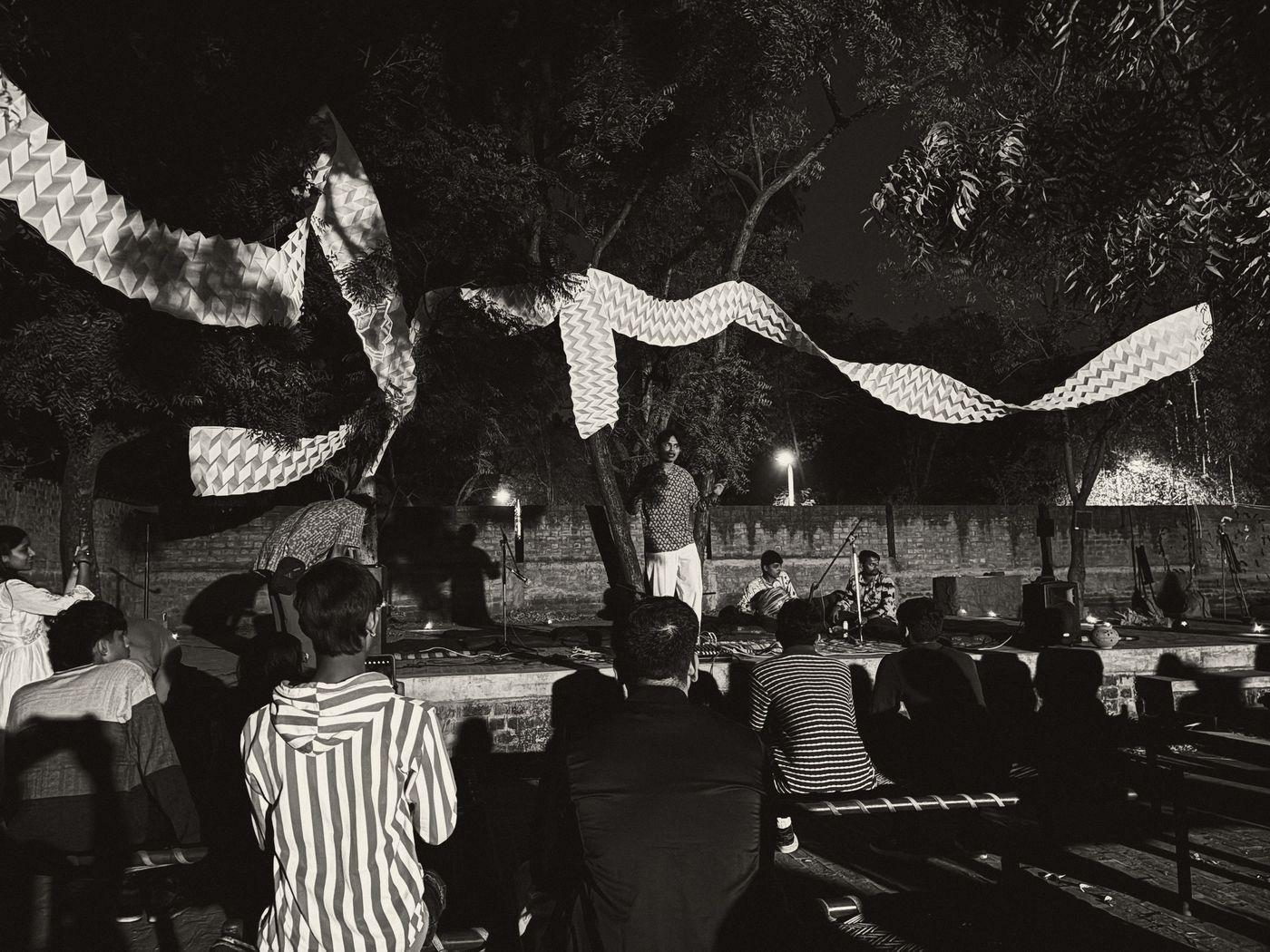
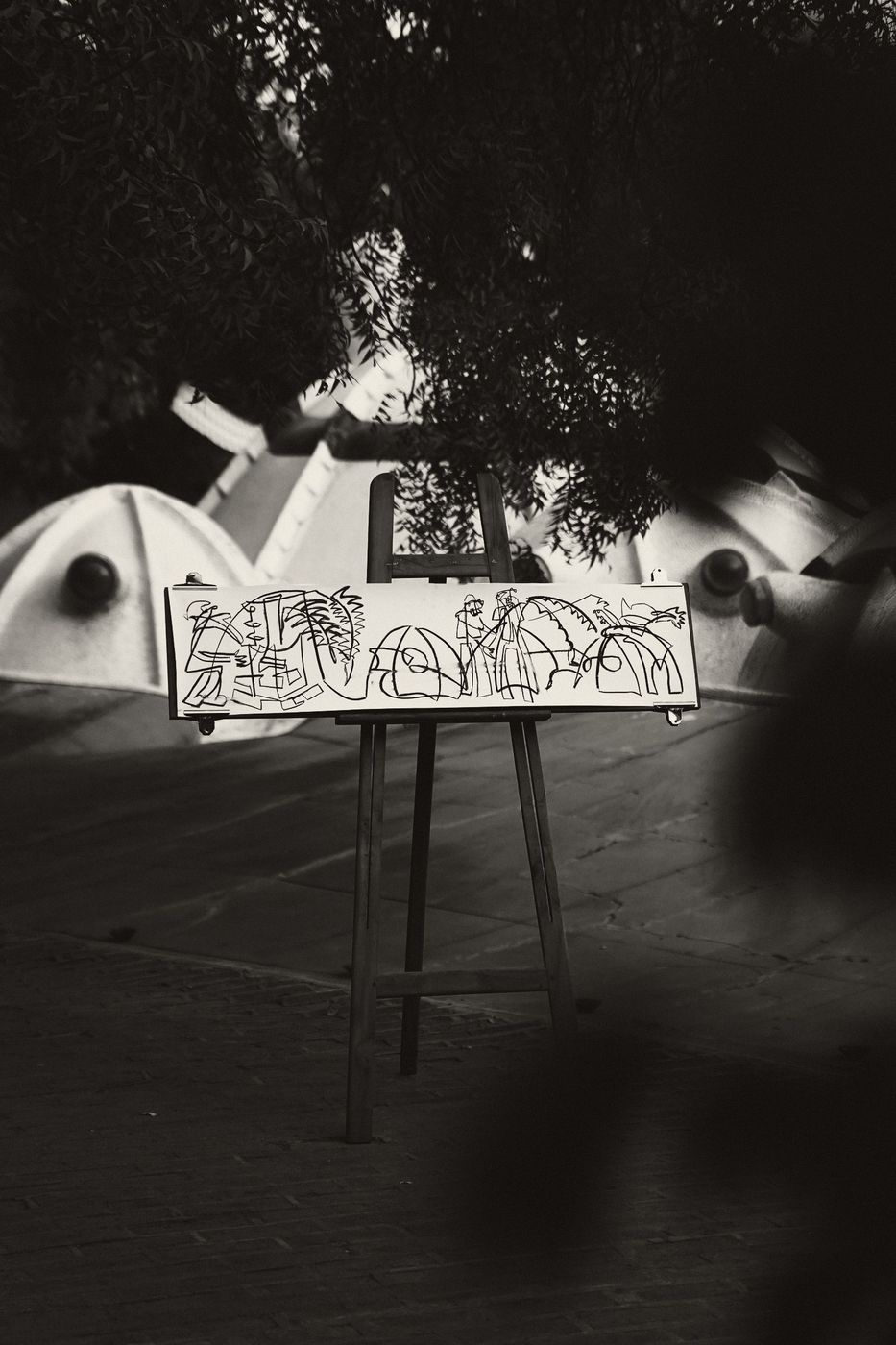
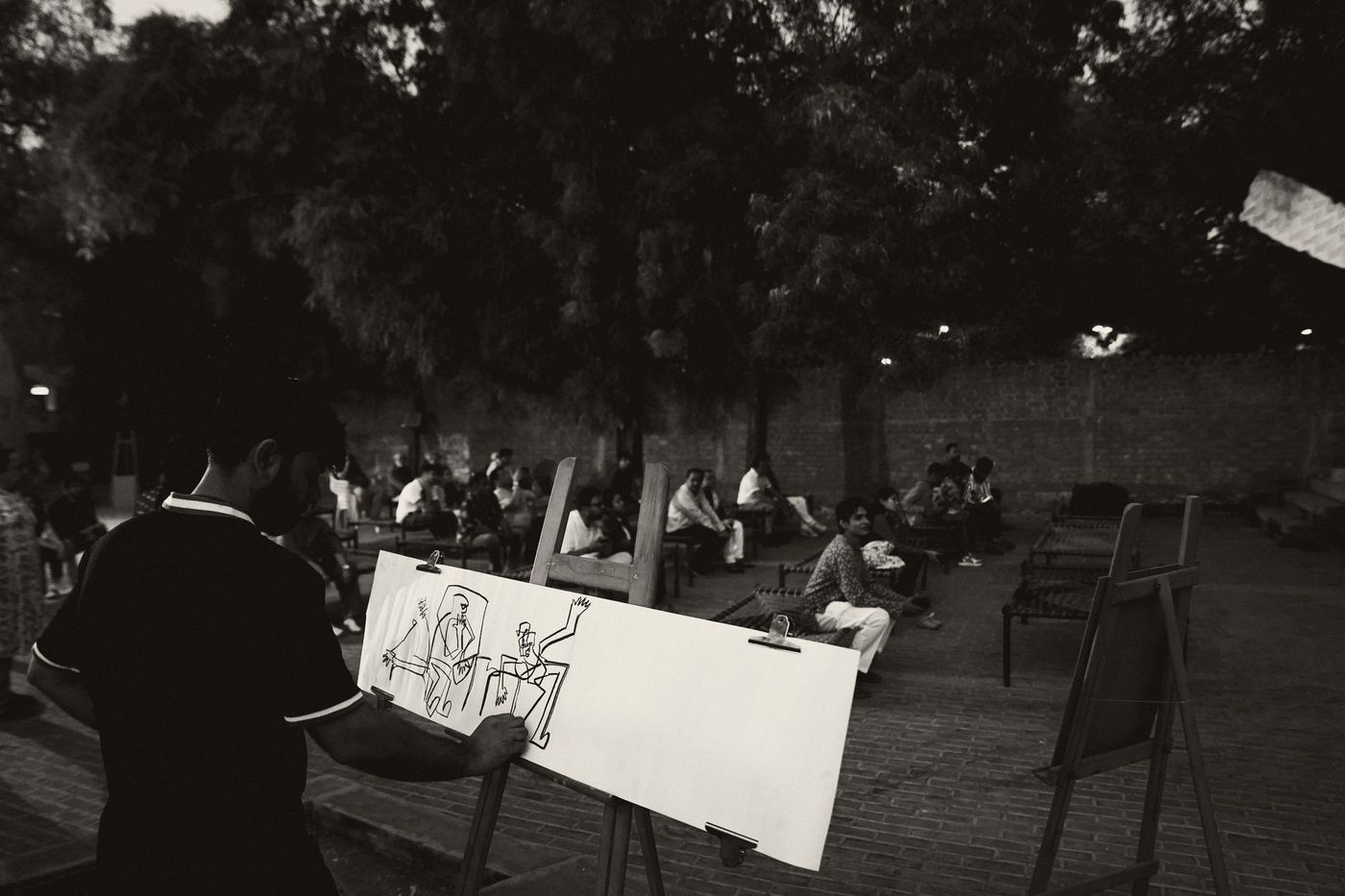
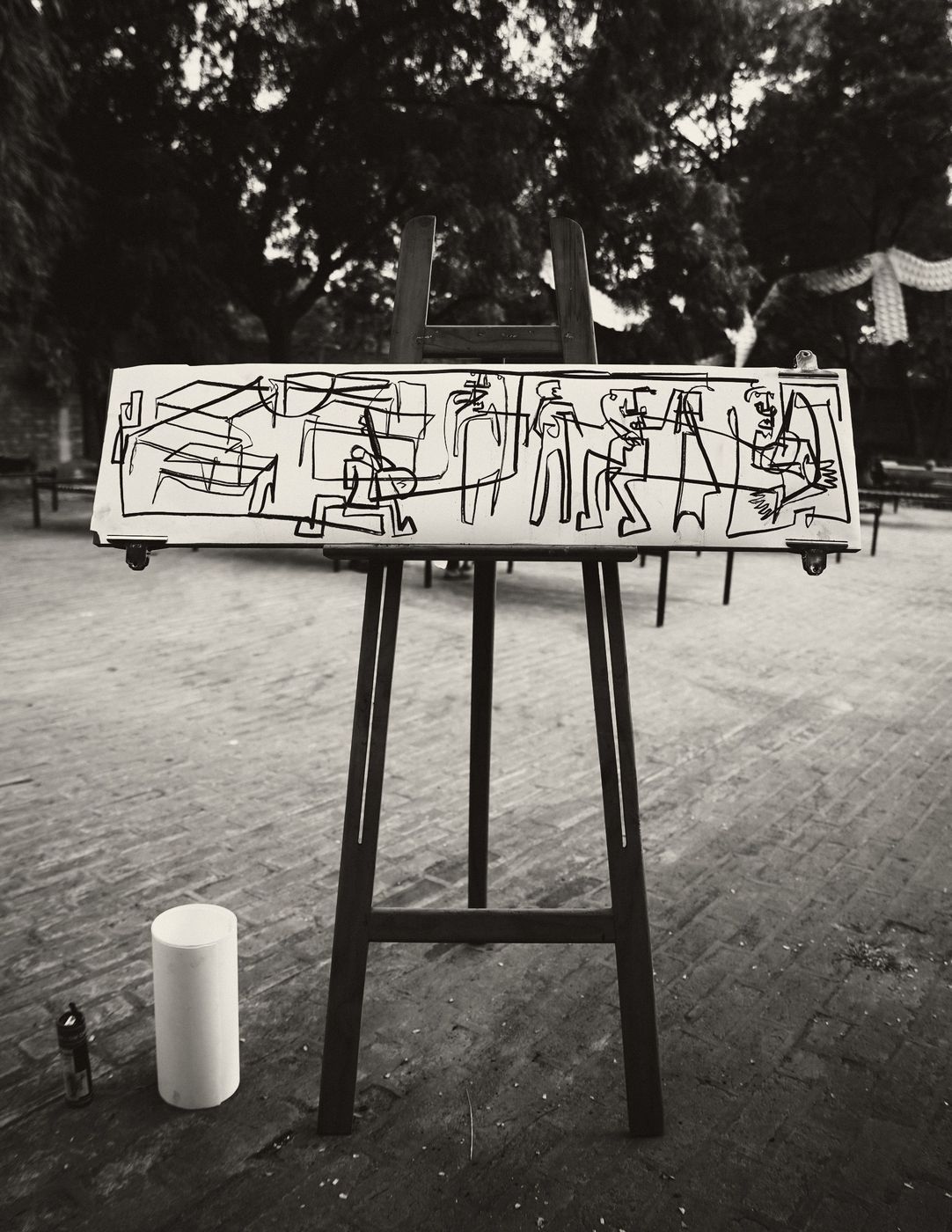
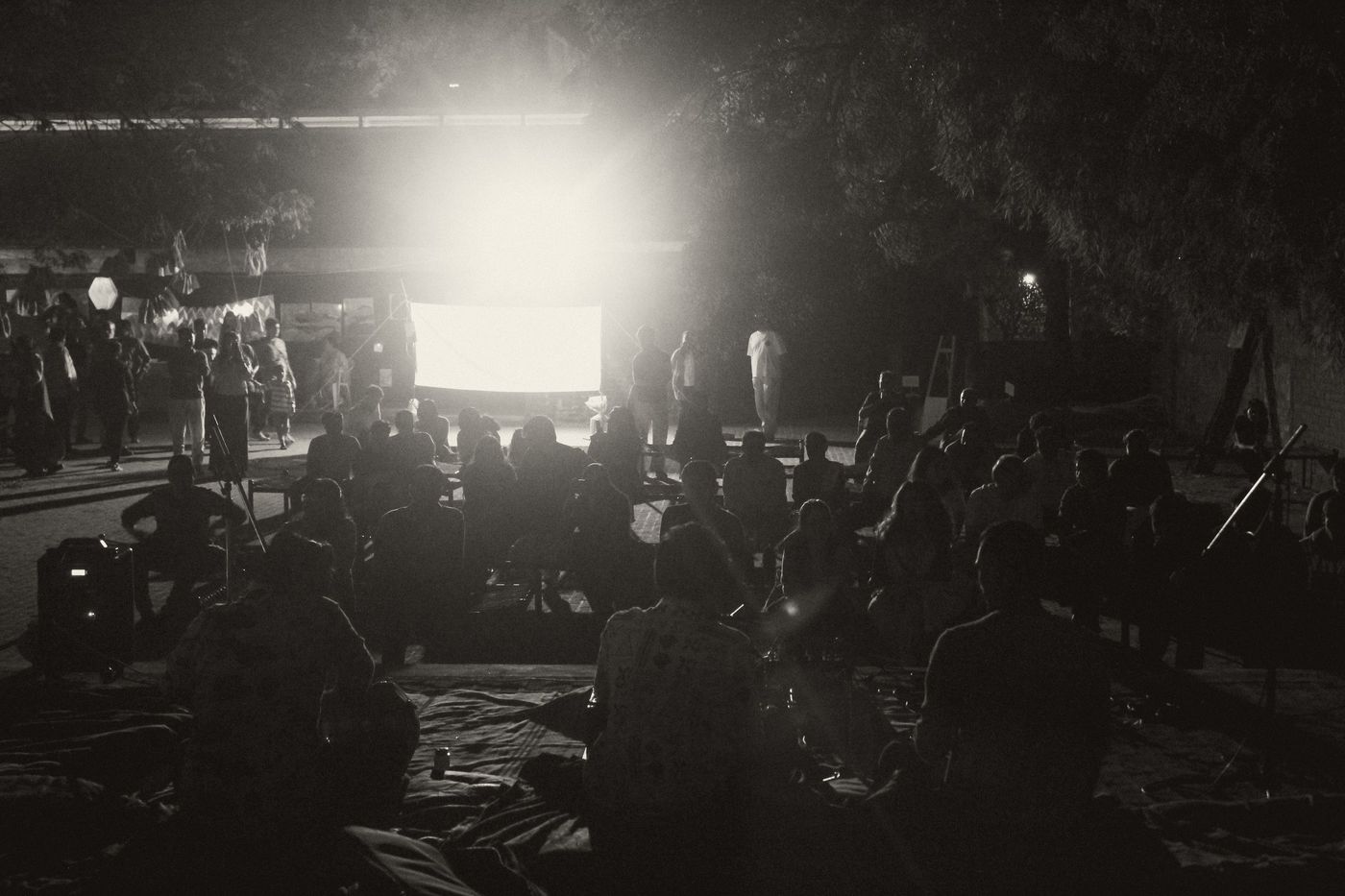
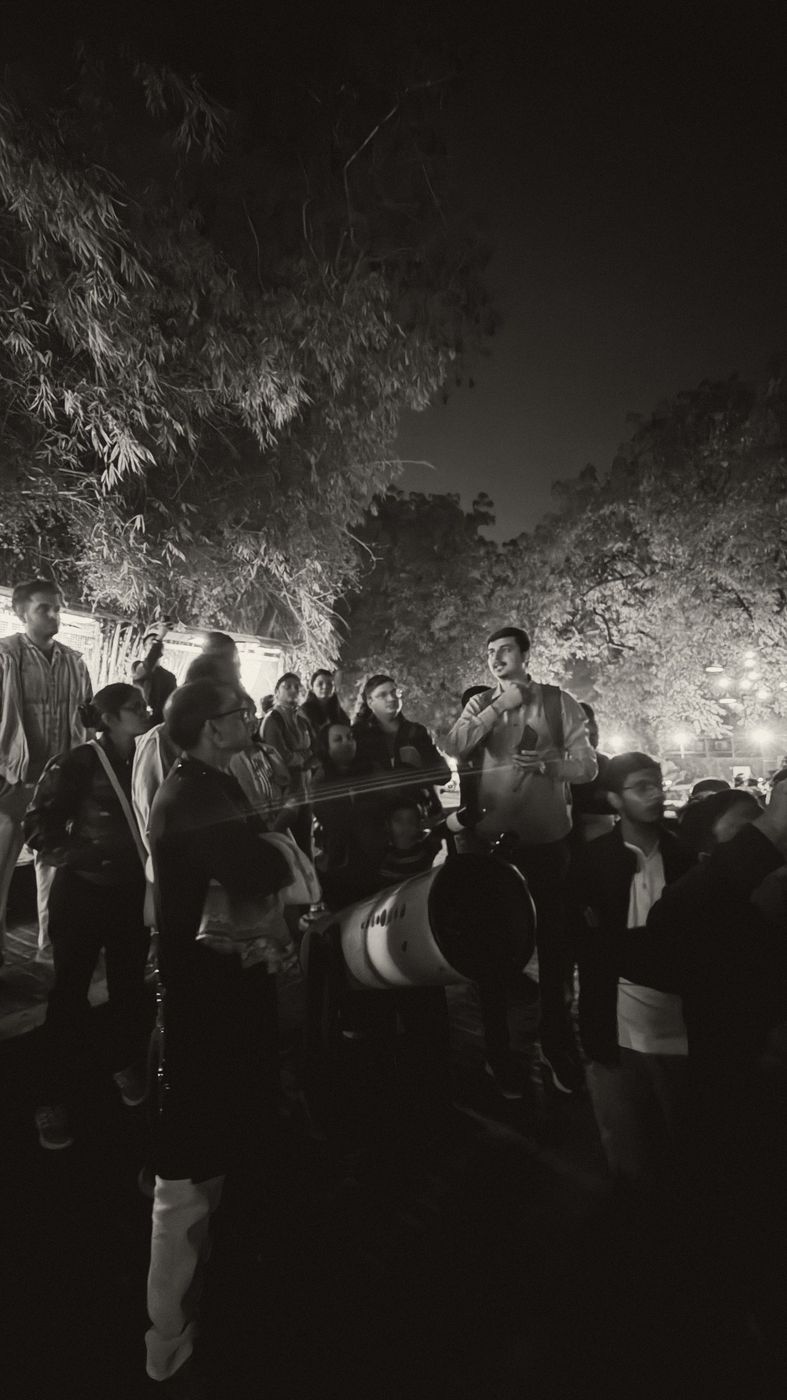
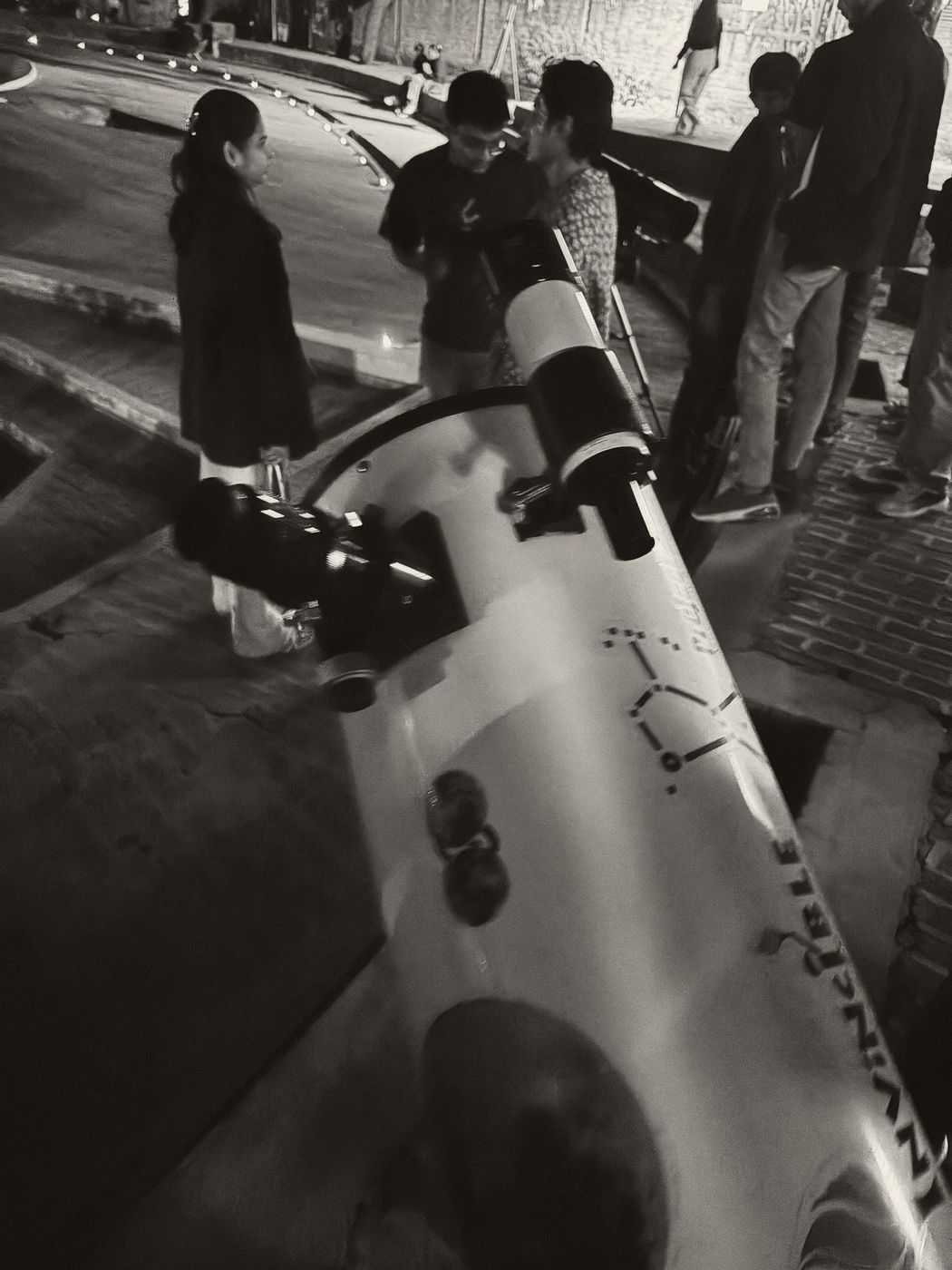
Sky. convenor A closing meditation outside, led by Kanchi Shah of Amatra Wellness; an abstract green laser pattern on the trees by Radhika and Stavan of 0 OD; and three large telescopes on the open ground, brought by the Project Orion team of Invincible NGO, with Ravi Varasada as Sky steward. That night the Moon, two days past new, set at 19:03, too thin to matter; Saturn stood high in the south with its rings nearly edge-on, as they appear only every fifteen years or so; Jupiter rose at 19:34 and Sirius at 19:51. convenor Manav remembers the telescopes showing Sirius and Betelgeuse among others.
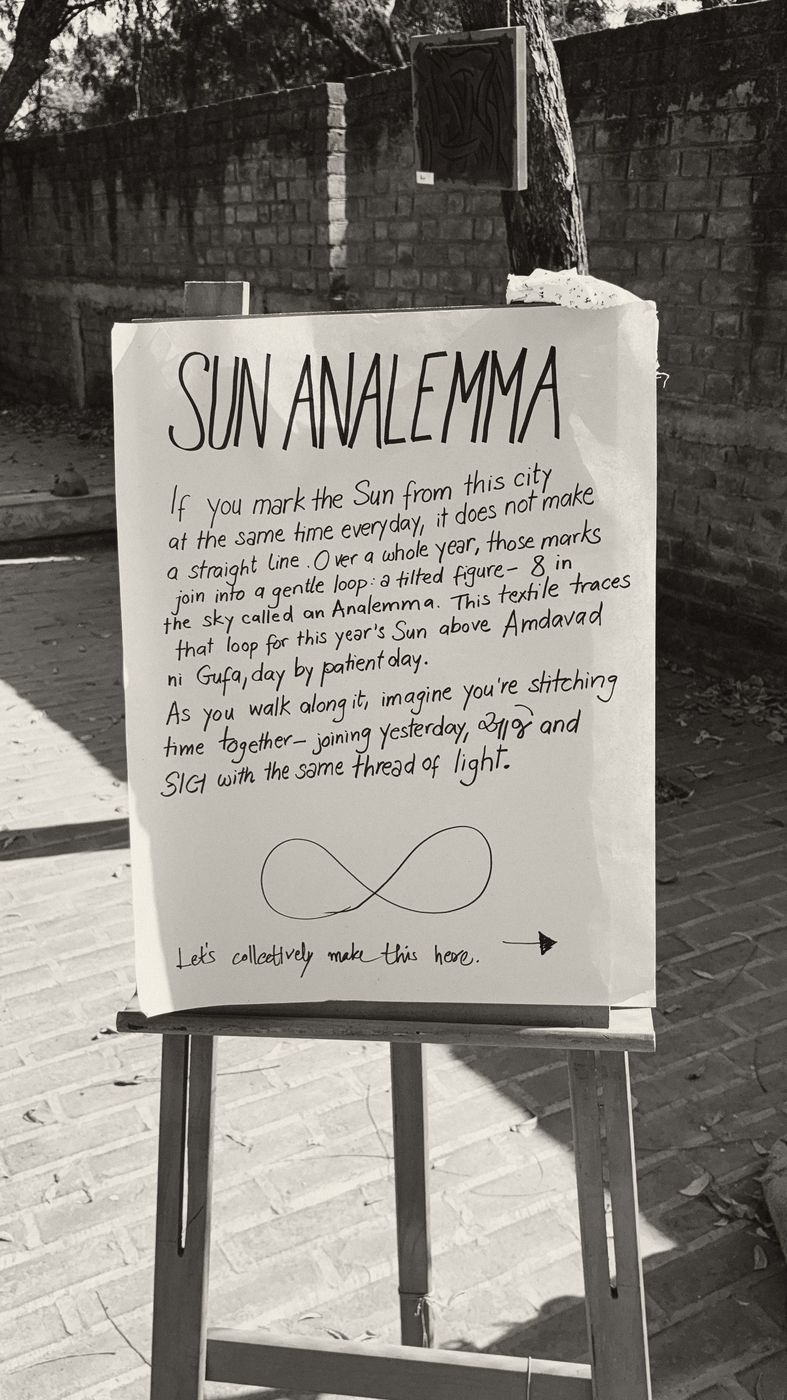
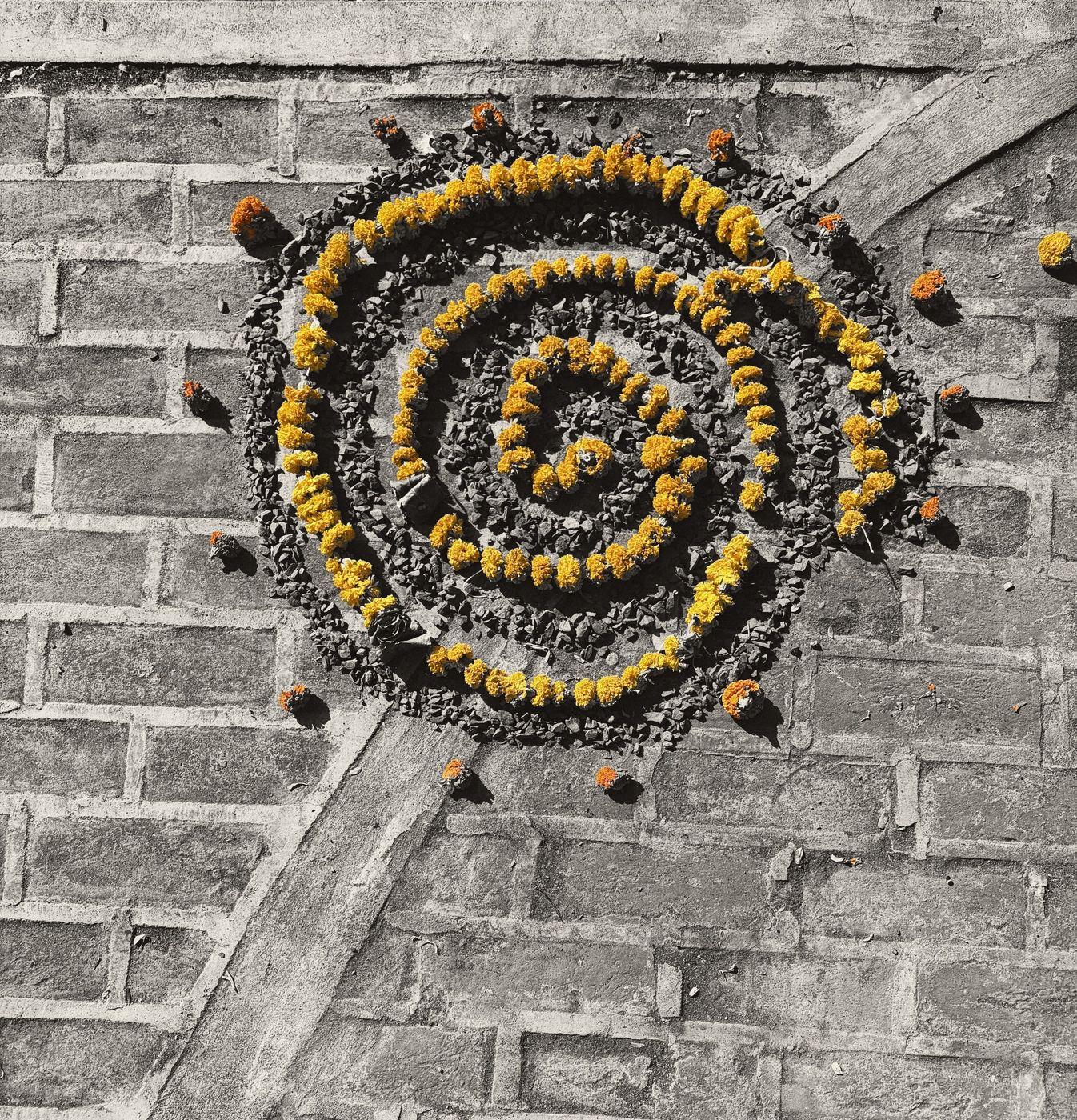
The Stitch. In the sunken arena a large rope net hung between bamboo poles, labelled Sun Analemma: "This textile traces that loop for this year's Sun above Amdavad ni Gufa, day by patient day." convenor Through the night people tied small pieces of cloth to it, completing the Sun's path by hand. The net is still with Multopia. On the terraces, a second invitation, Make your own ritual: Cosmic Relations, laid out marigolds, grit, stones, leaves and twigs on cotton strips; "there are no fixed rules, only presence and participation". The next day at least nine arrangements made by visitors were still on the ground.
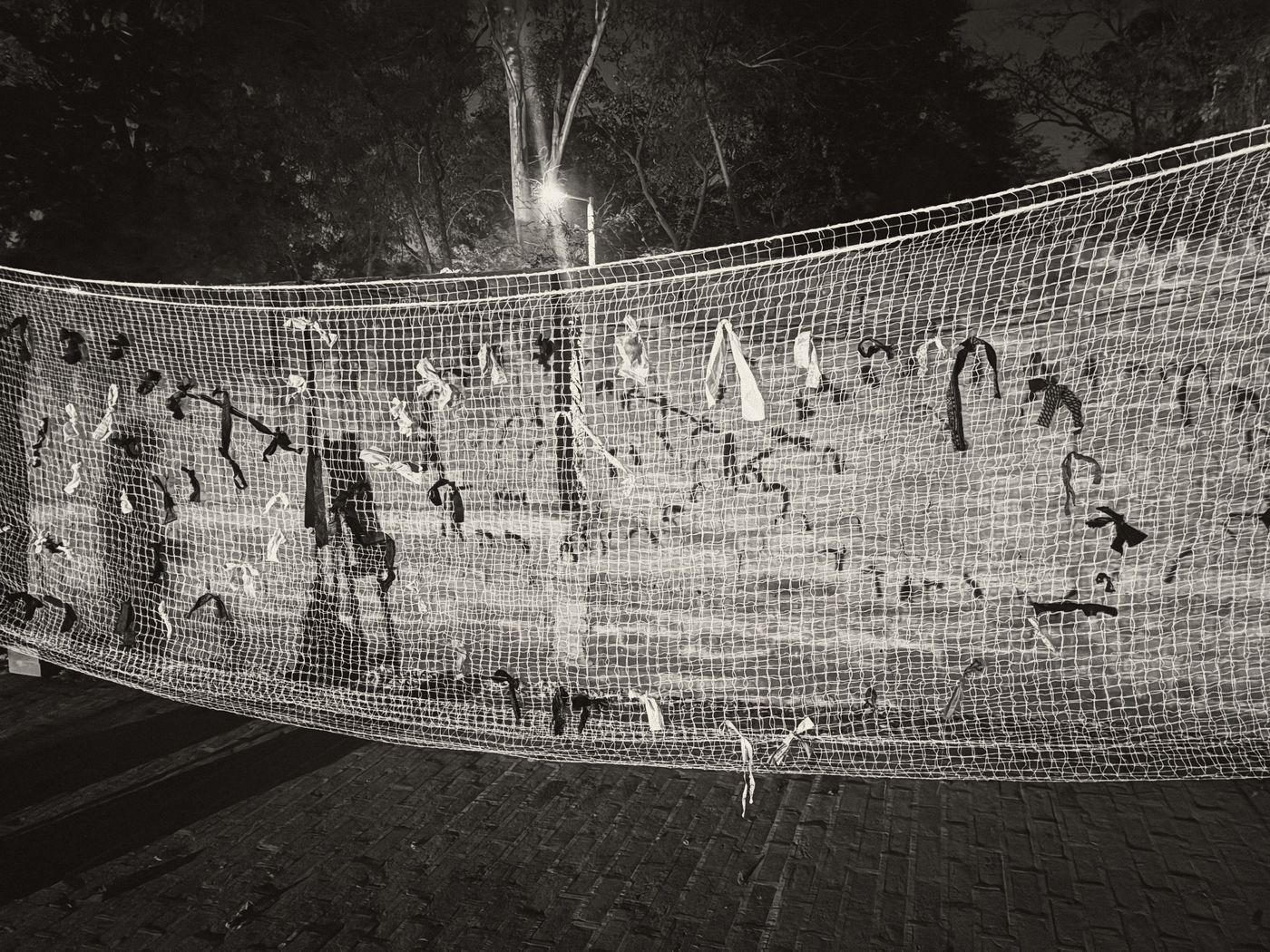
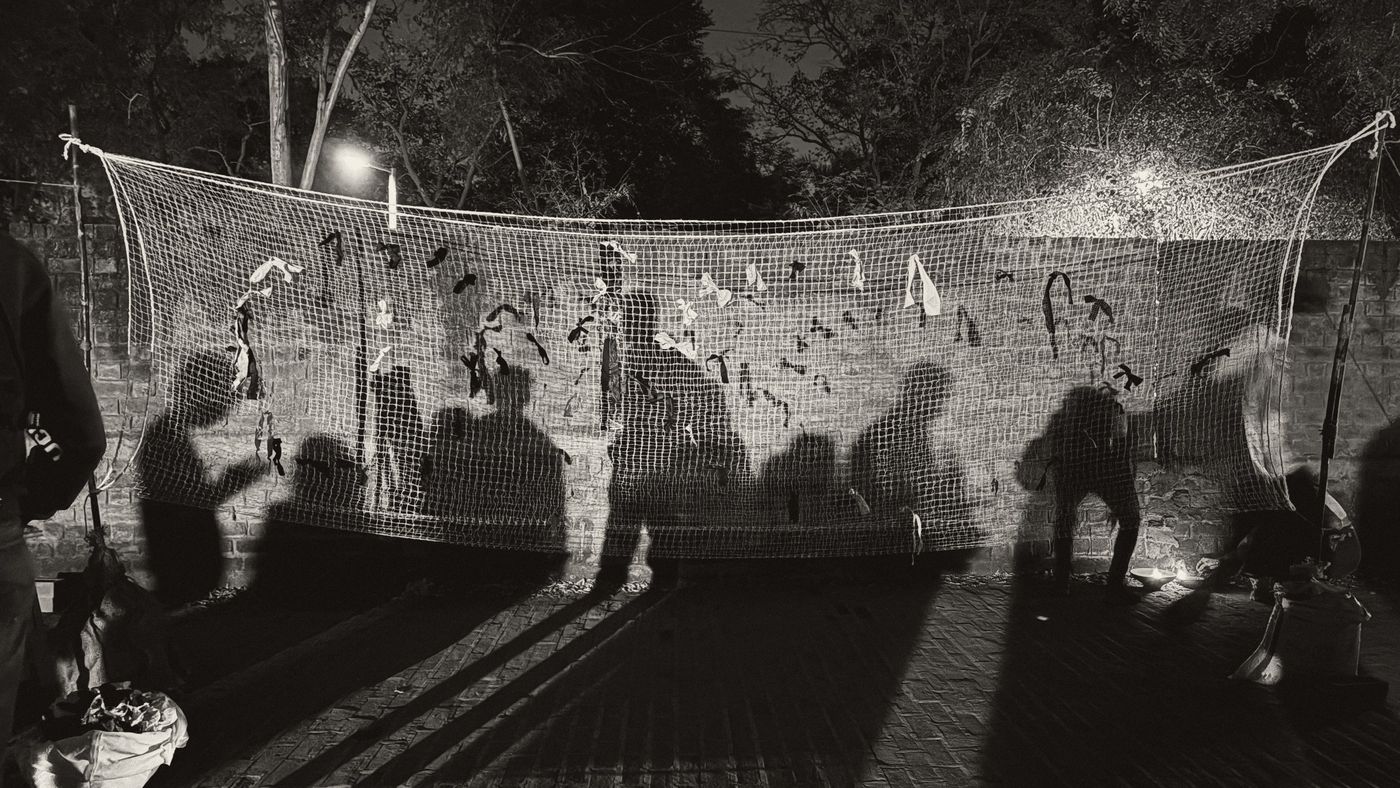
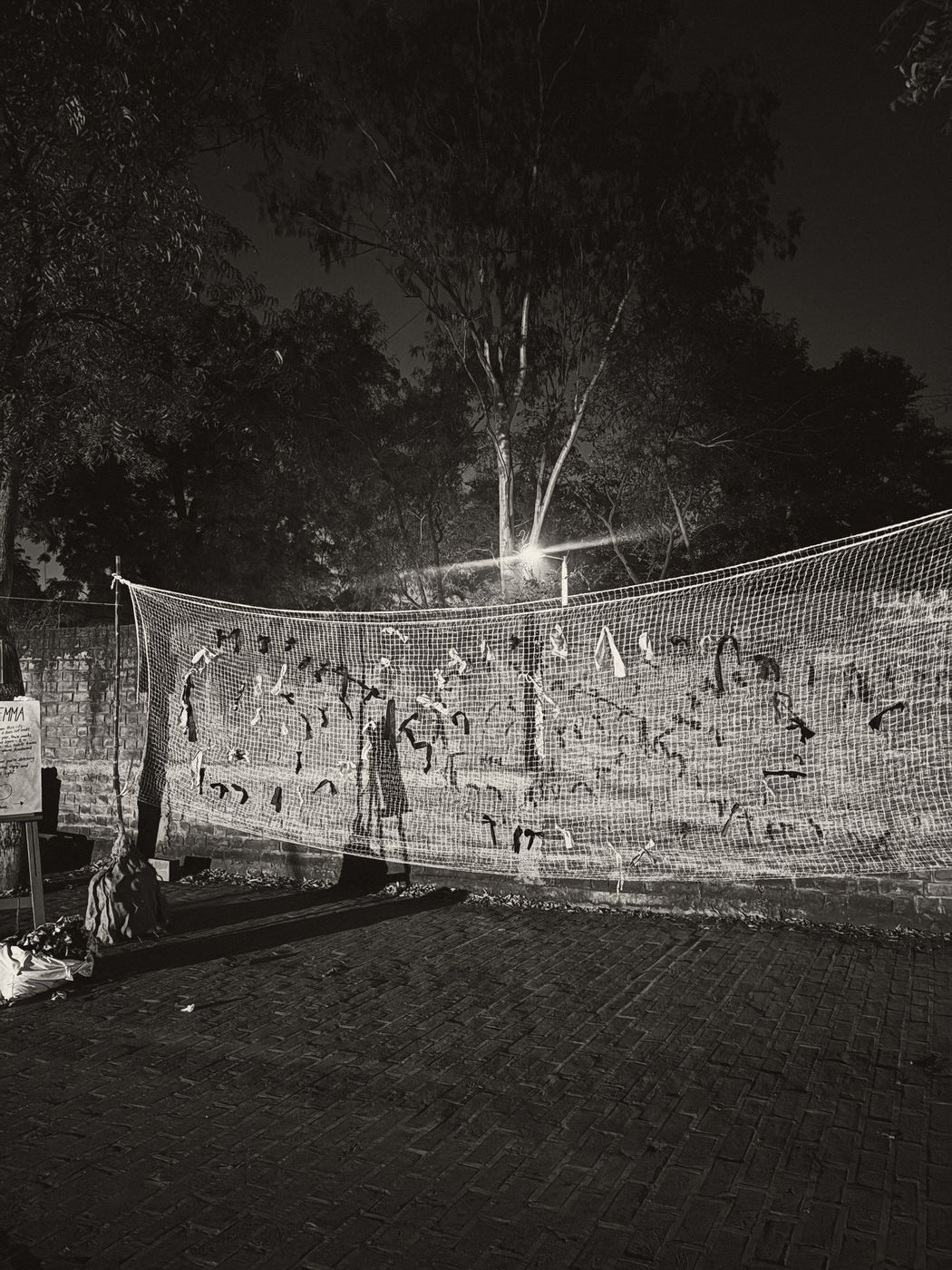
20:33. convenor At the solstice instant the people inside the Gufa, 40 to 50 at once, with no queue, were in a sound-healing meditation led by Anshita of Heal the Soul: the first, by the convenor's account, ever held inside the Gufa. Whether people outside knew the moment had come is not recorded.
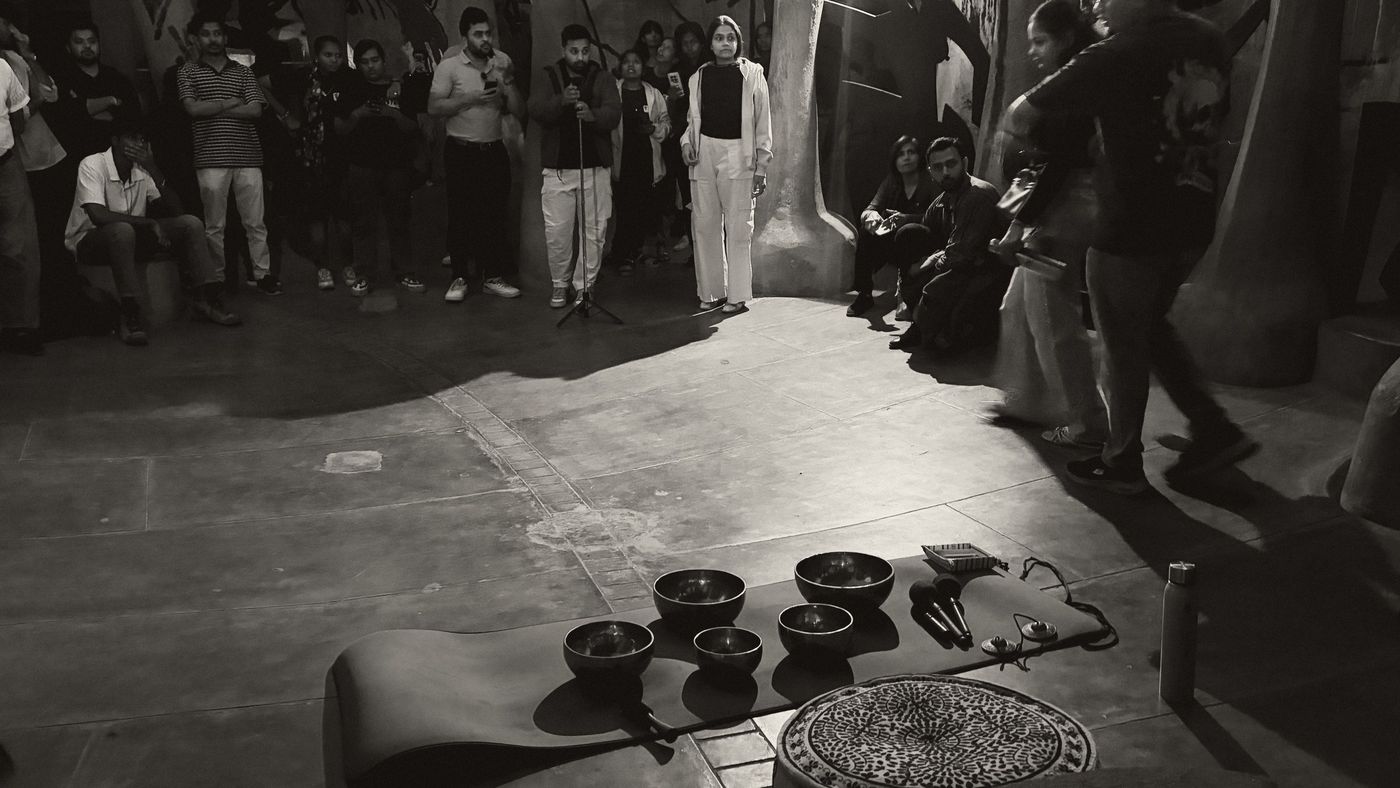
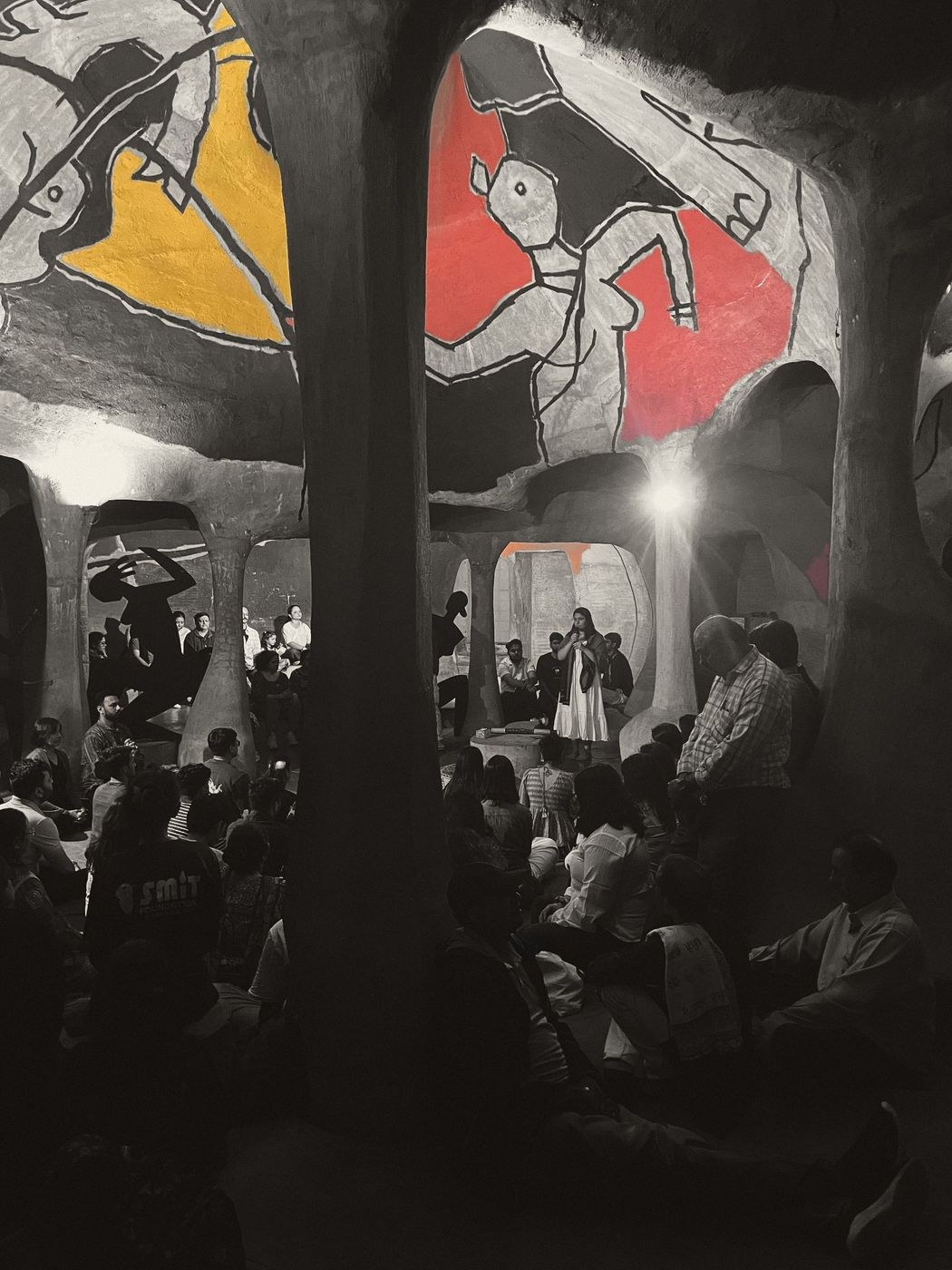
At 20:33 I was inside the Gufa, in a room full of people sitting in silence for the sound healing. Nobody announced the moment. We just sat in it, together, under a roof built from broken plates, while the Sun turned. Transformative, to say the least.
Manav Sumara
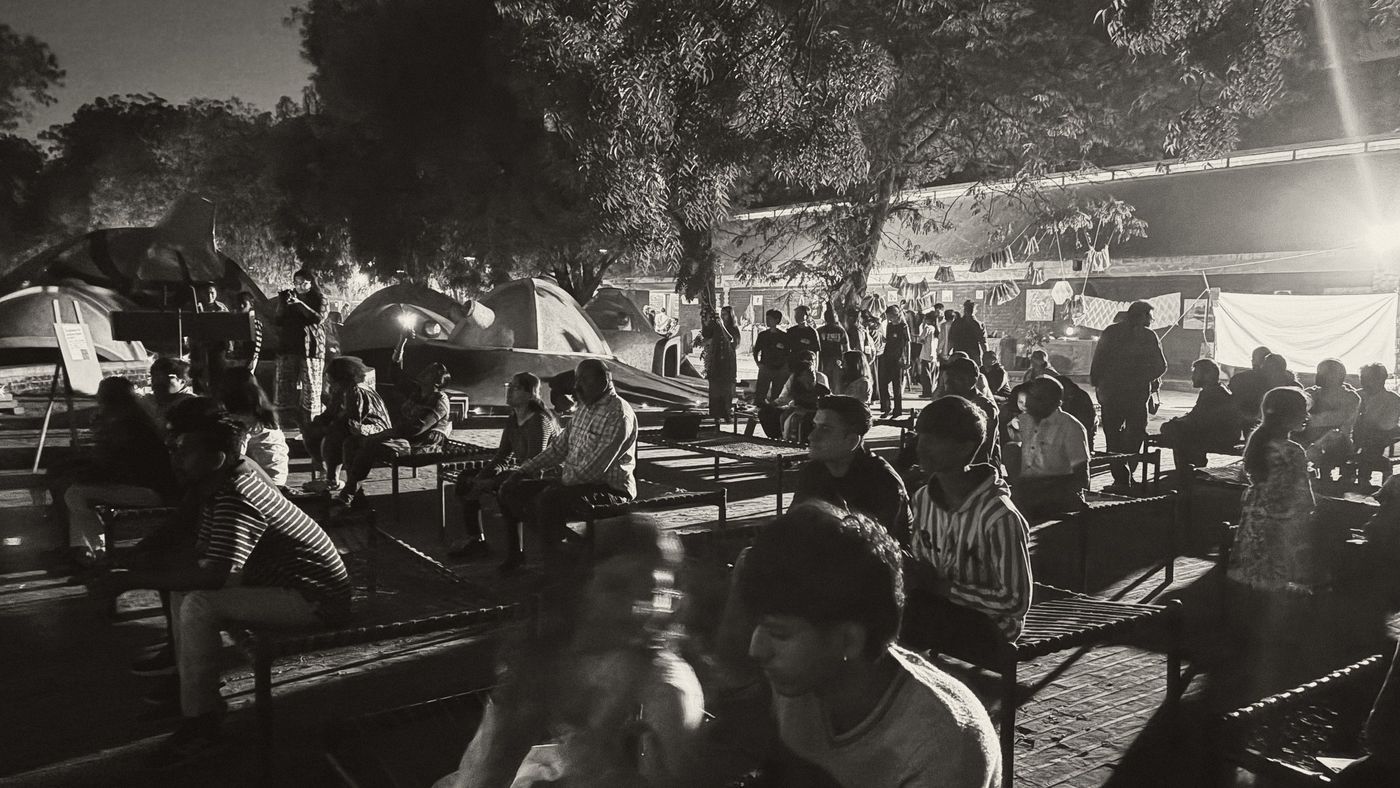
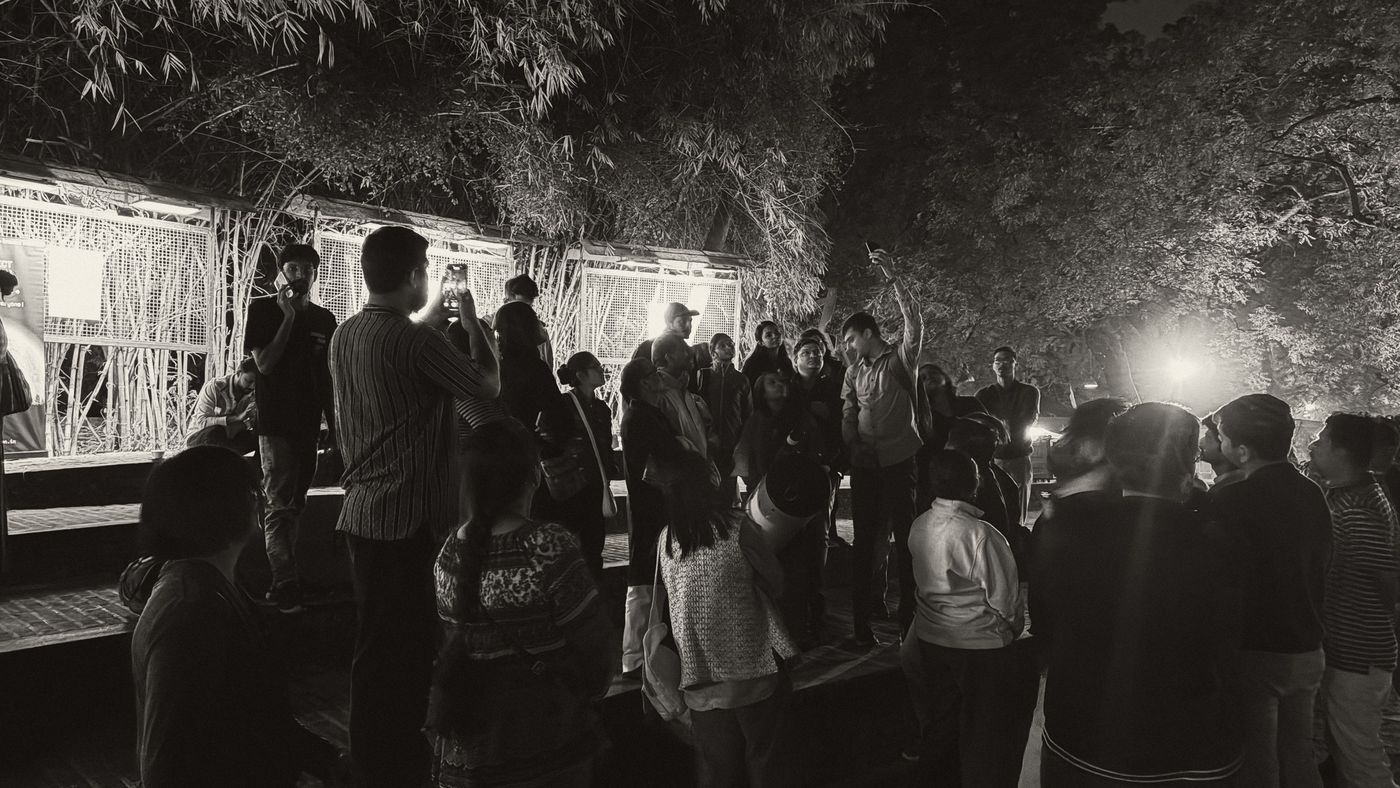
The market that stopped. convenor Soulstitch planned a zero-commission market where makers would keep everything they sold. The venue's management ruled during the evening that nothing could be sold on the premises; the word reached Manav as the tables were open. He told the makers he had only just found out, and asked them to take the details of anyone interested and sell afterwards. The one part of Edition 2 designed to put money in contributors' hands was the part the venue could switch off. Nothing in writing had covered it.
Asking. Two signs asked visitors to contribute through a QR code: "Do you believe the artists here should be paid? Fairly, fully, always", and, near the exit, "Before you leave: you experienced tonight without a ticket". convenor The money that came in went to Gathering Green as a donation to its ecological work, not to the festival.
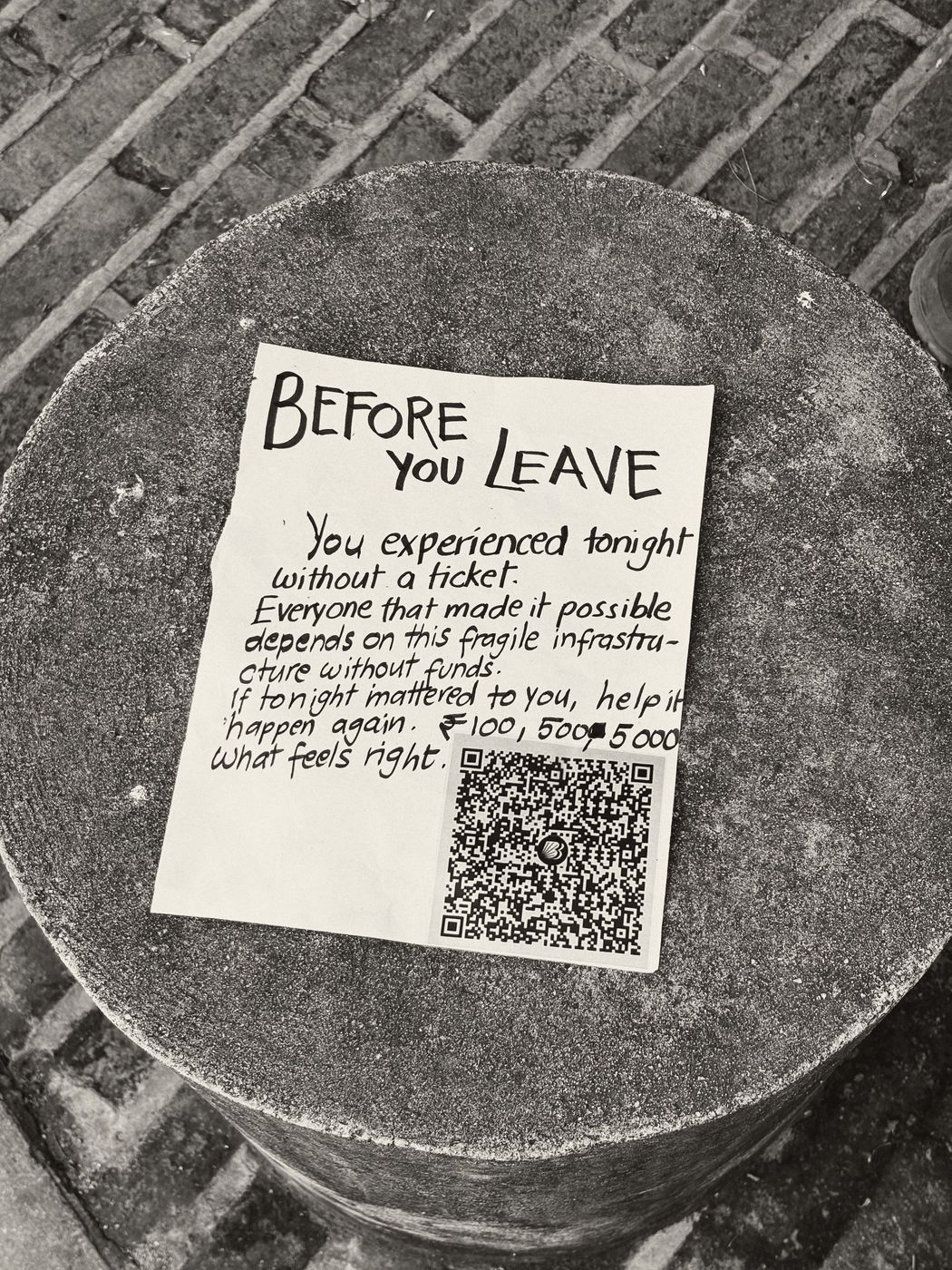
Who paid. convenor The evening's costs were met from Hiren Joshi's and Manav's own pockets. No contributor was paid.
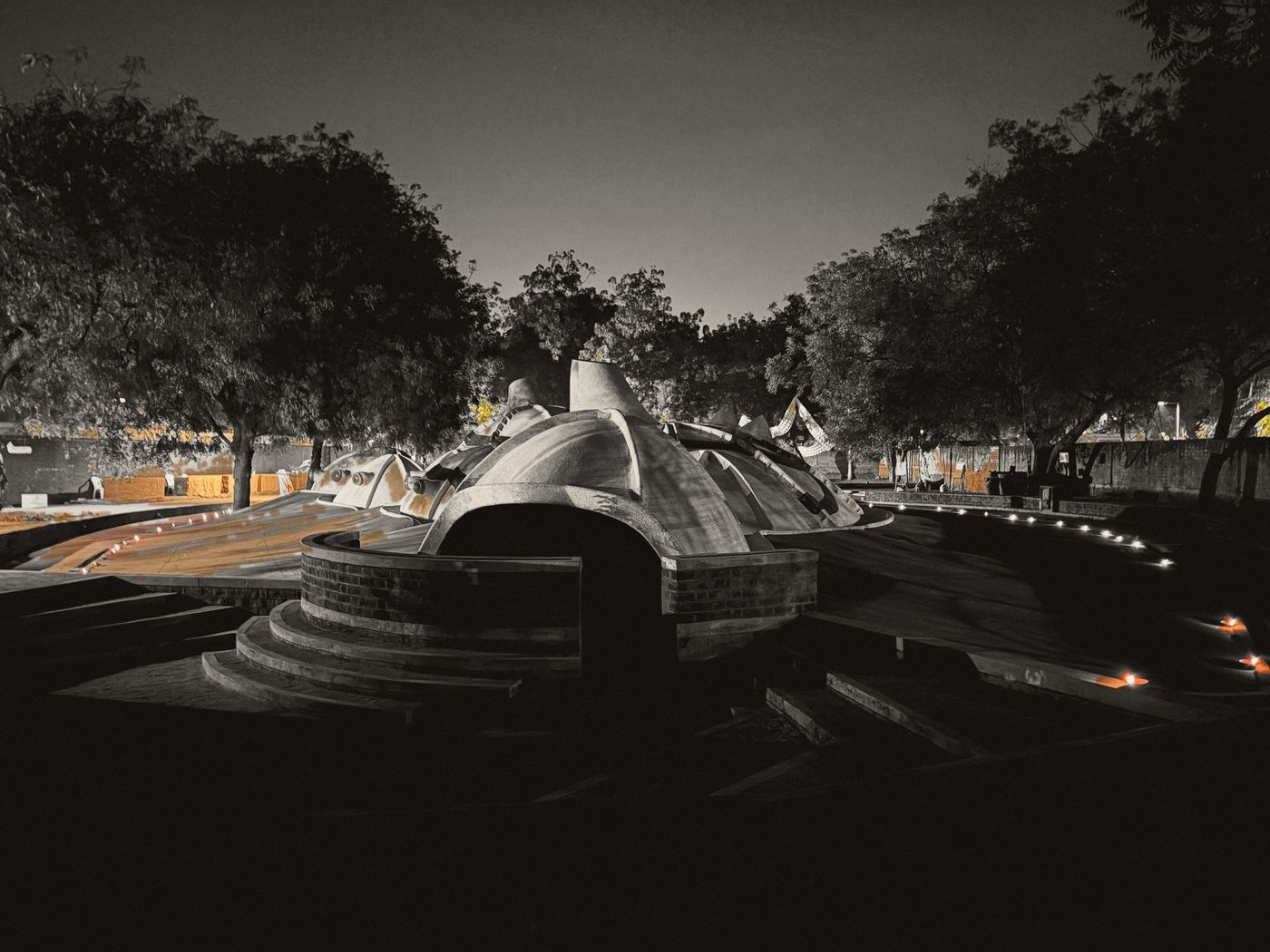
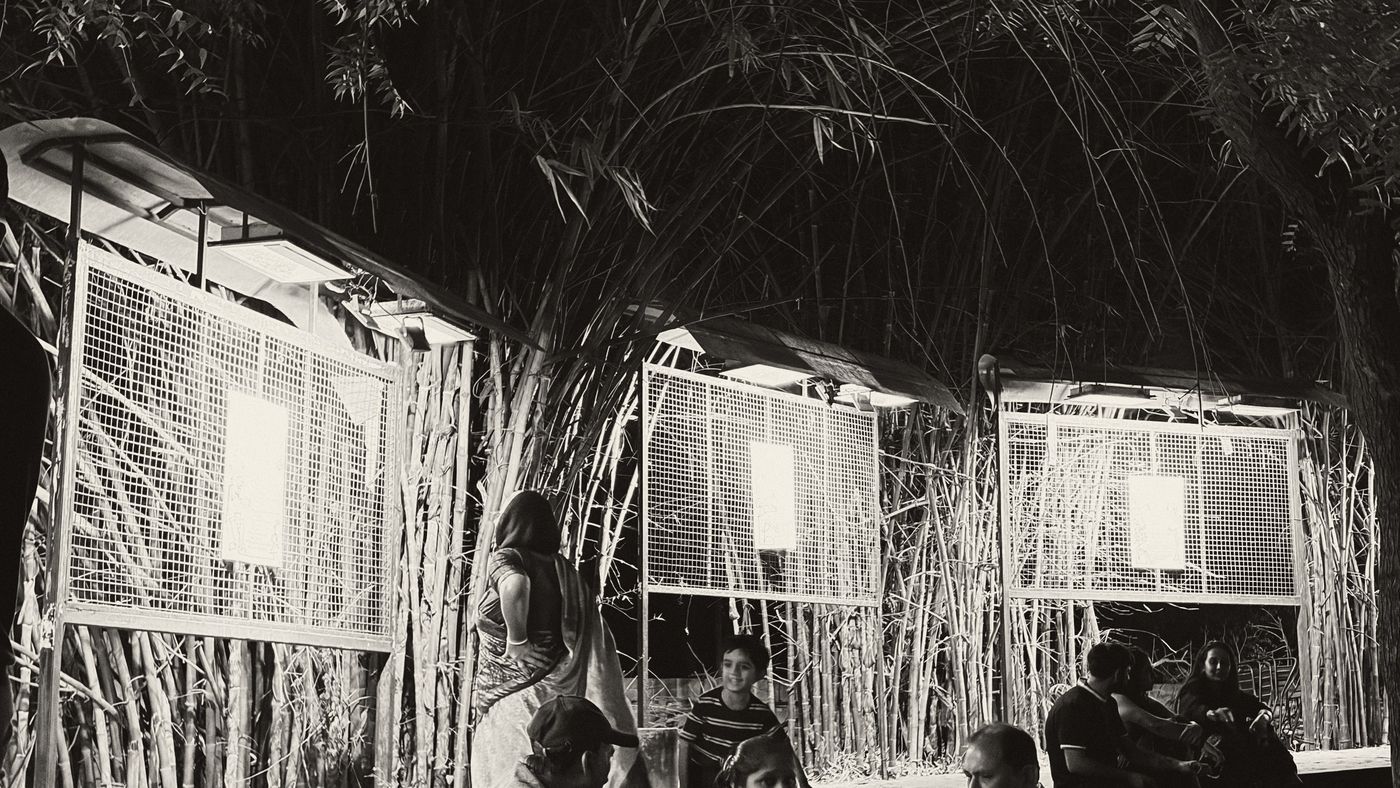
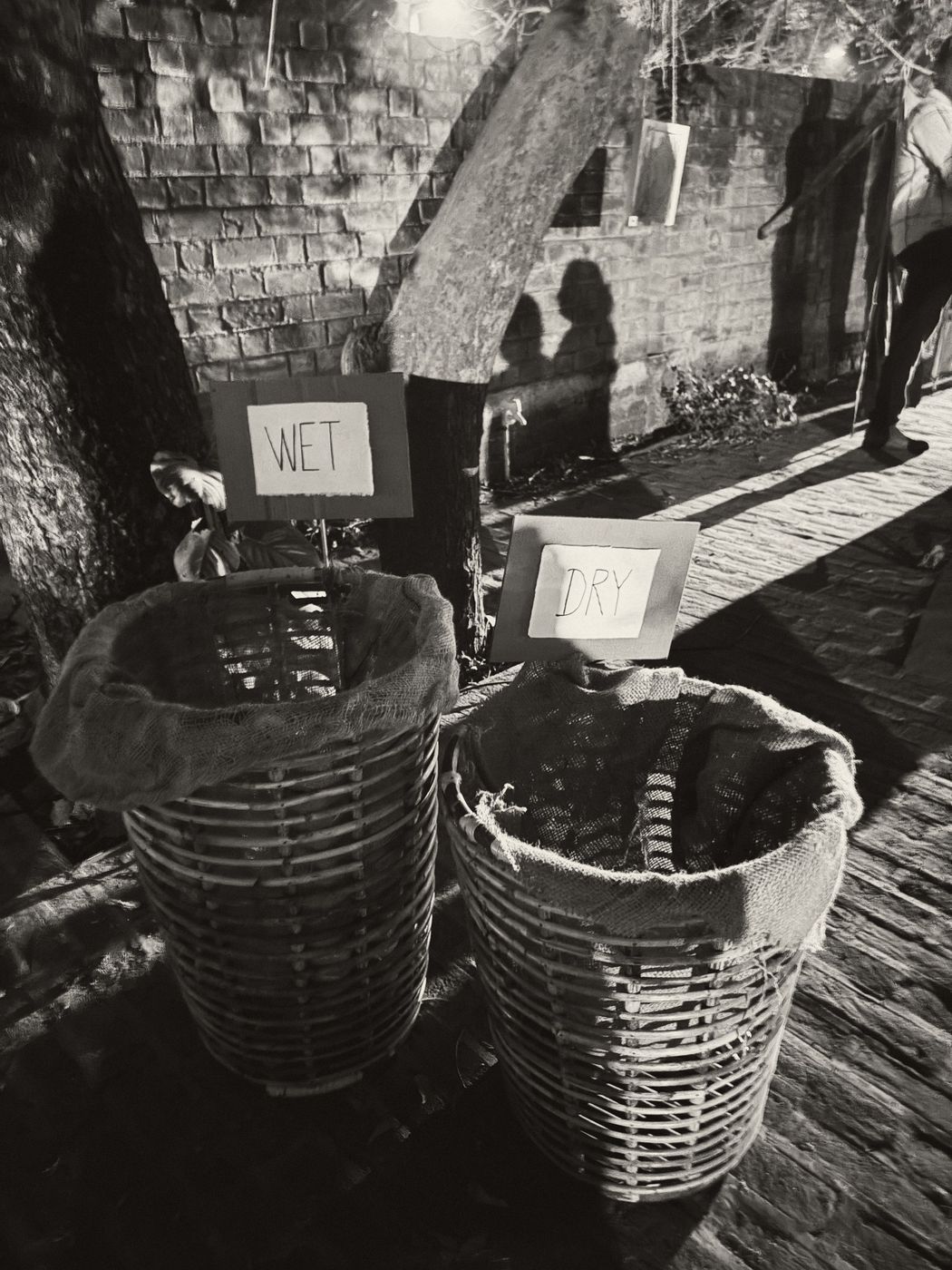
After. convenor Manav led the clean-up, with Hiren Joshi and Kairavi Shah. Waste was sorted by kind. The soil-path heaps were segregated and used again for growing and ecological work. Organic waste was composted, and the compost went into a Miyawaki forest planting by Gathering Green. Lent things went back: the blocks to Gathering Green, the terracotta diyas, cleaned first, to Diving Deep. The canopies, hessian and jute were collected and reused for art; the bamboo poles went on to other projects; the broken hanging terracotta was recycled. The grains from five homes were scattered for birds and other animals, which ate them. The paper cups had come plastic-lined, as the market sells them; the lining was peeled off by hand so the paper could be composted. No food was left over. Bamboo baskets marked DRY and WET stood on site. The walkthrough filmed at 13:02 the next day shows most installations still standing, and also paper cups, paper sheeting, a printed flyer and one plastic bottle in the WET basket where food had been served, and a shattered heap of hanging terracotta at the entrance.
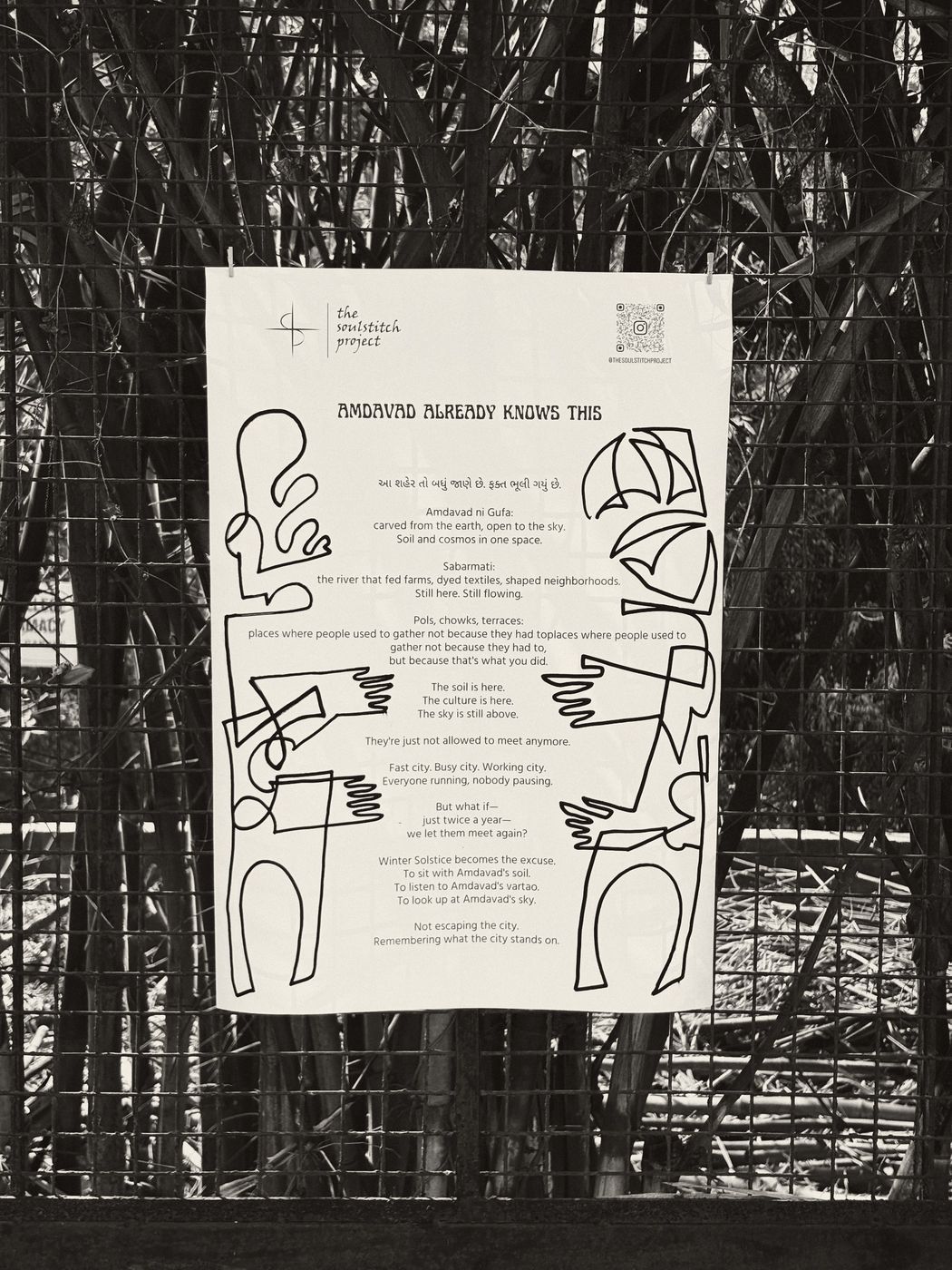
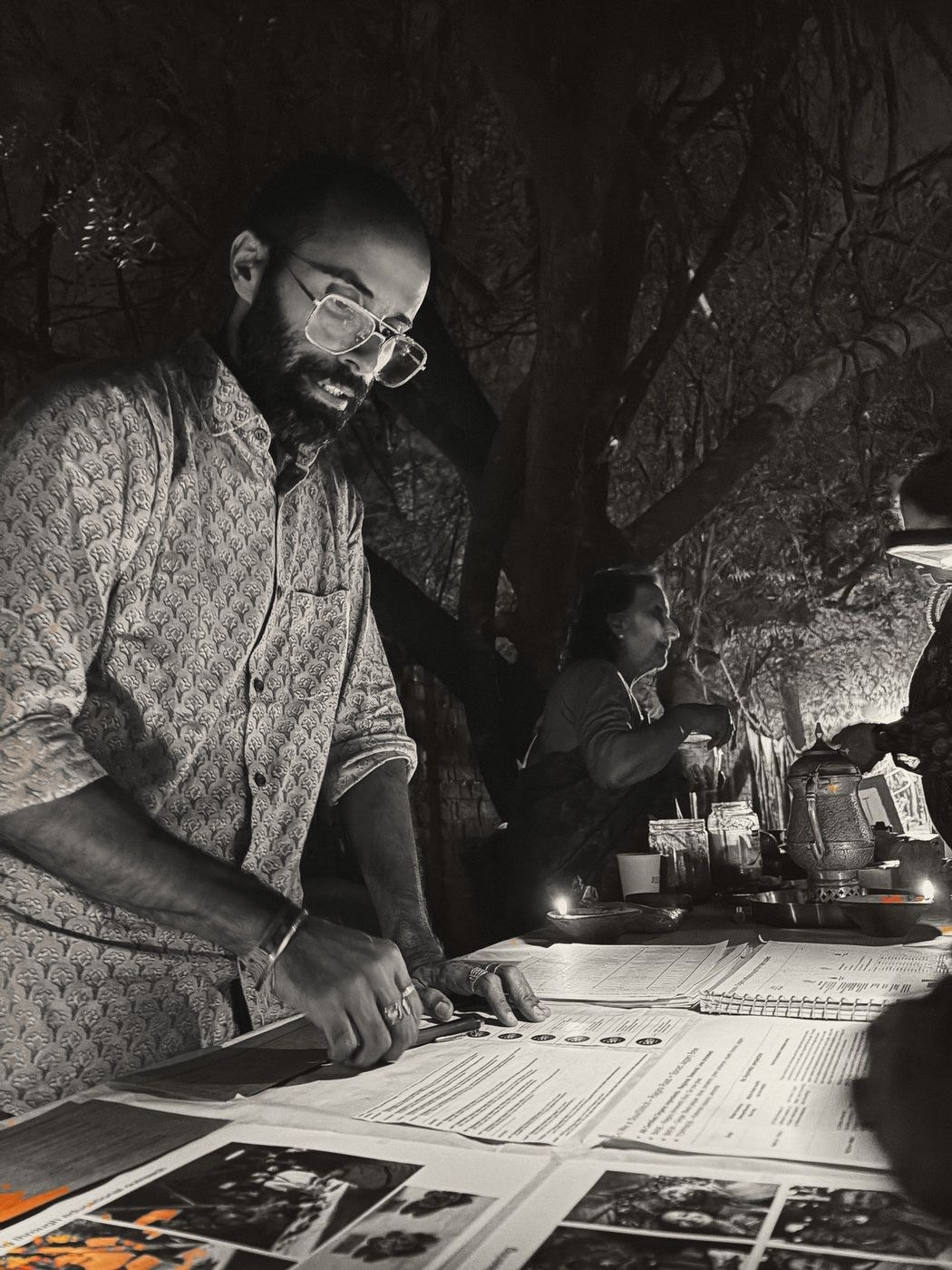
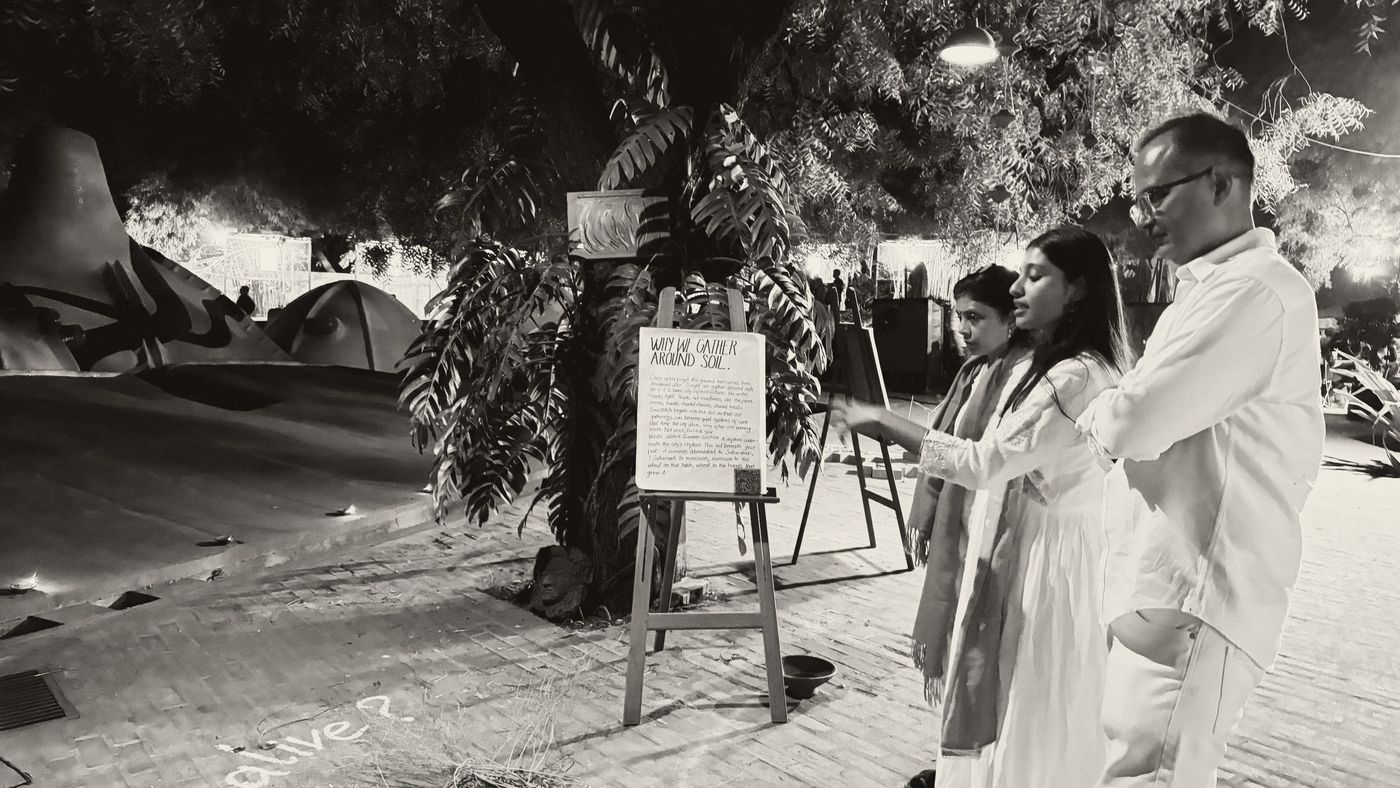
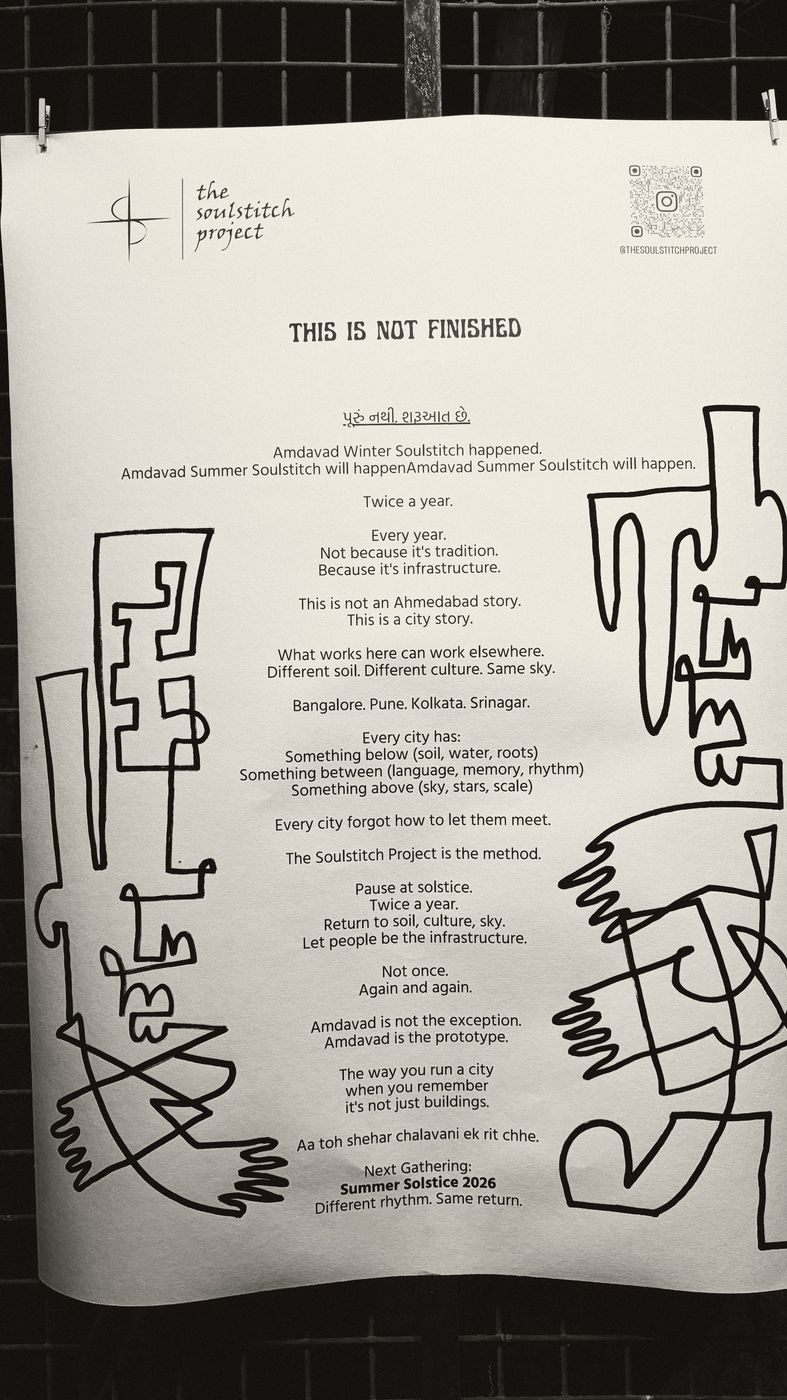
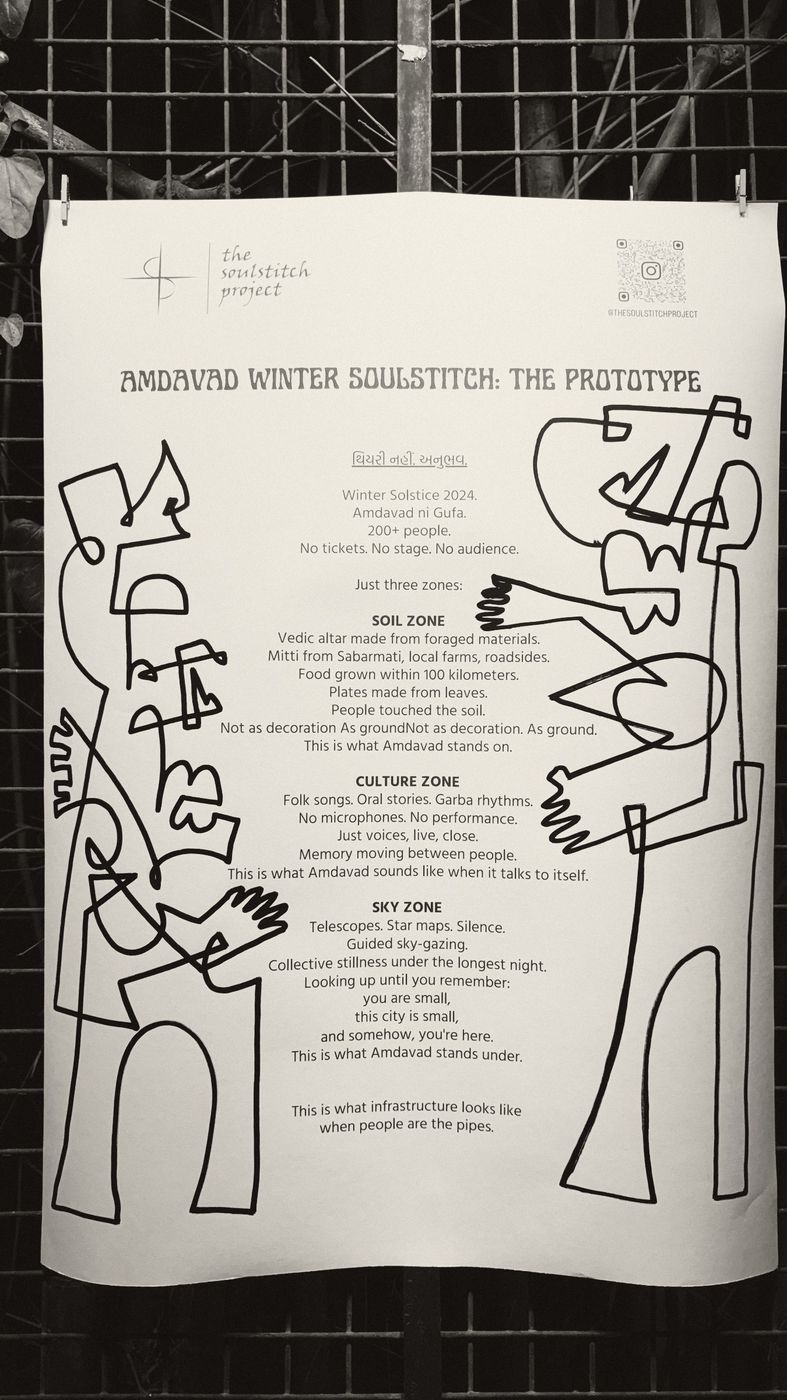
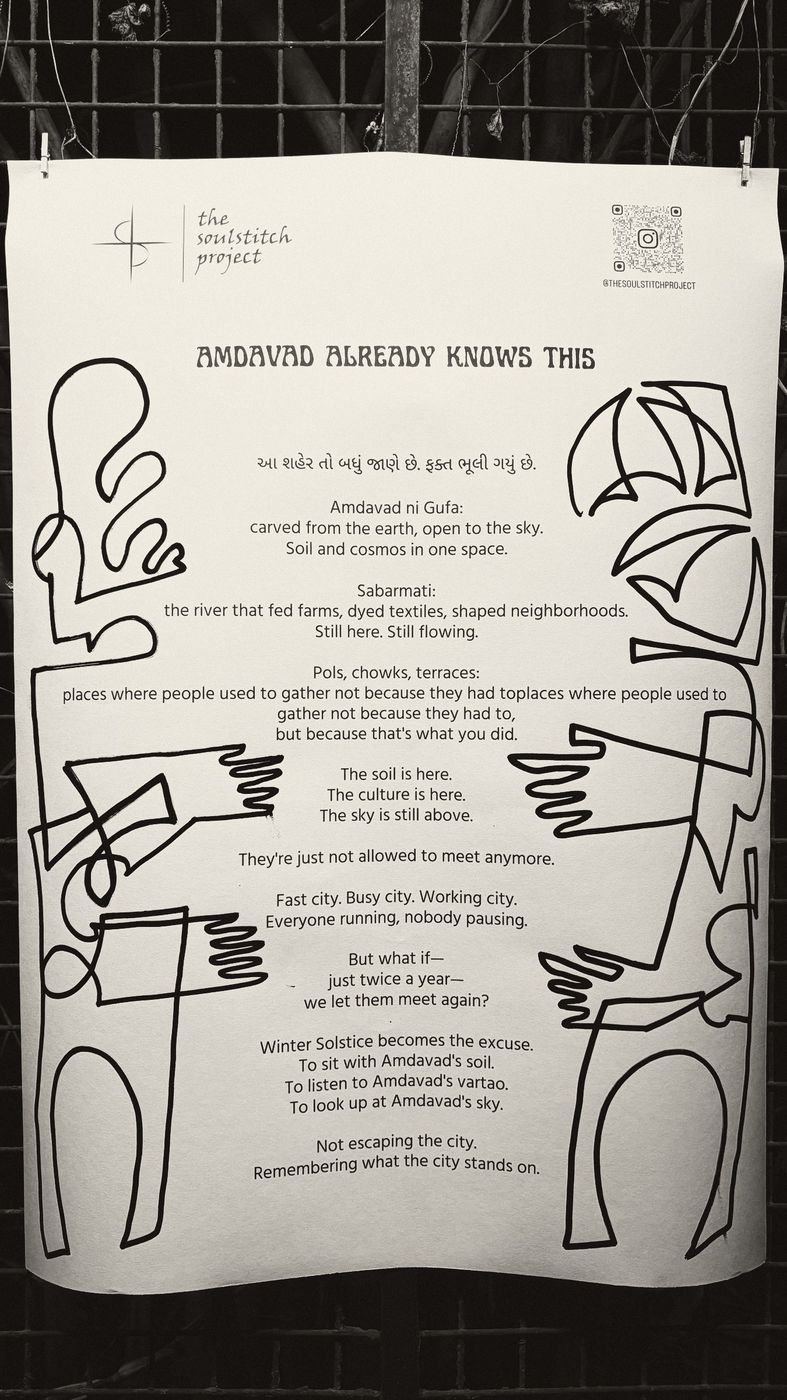
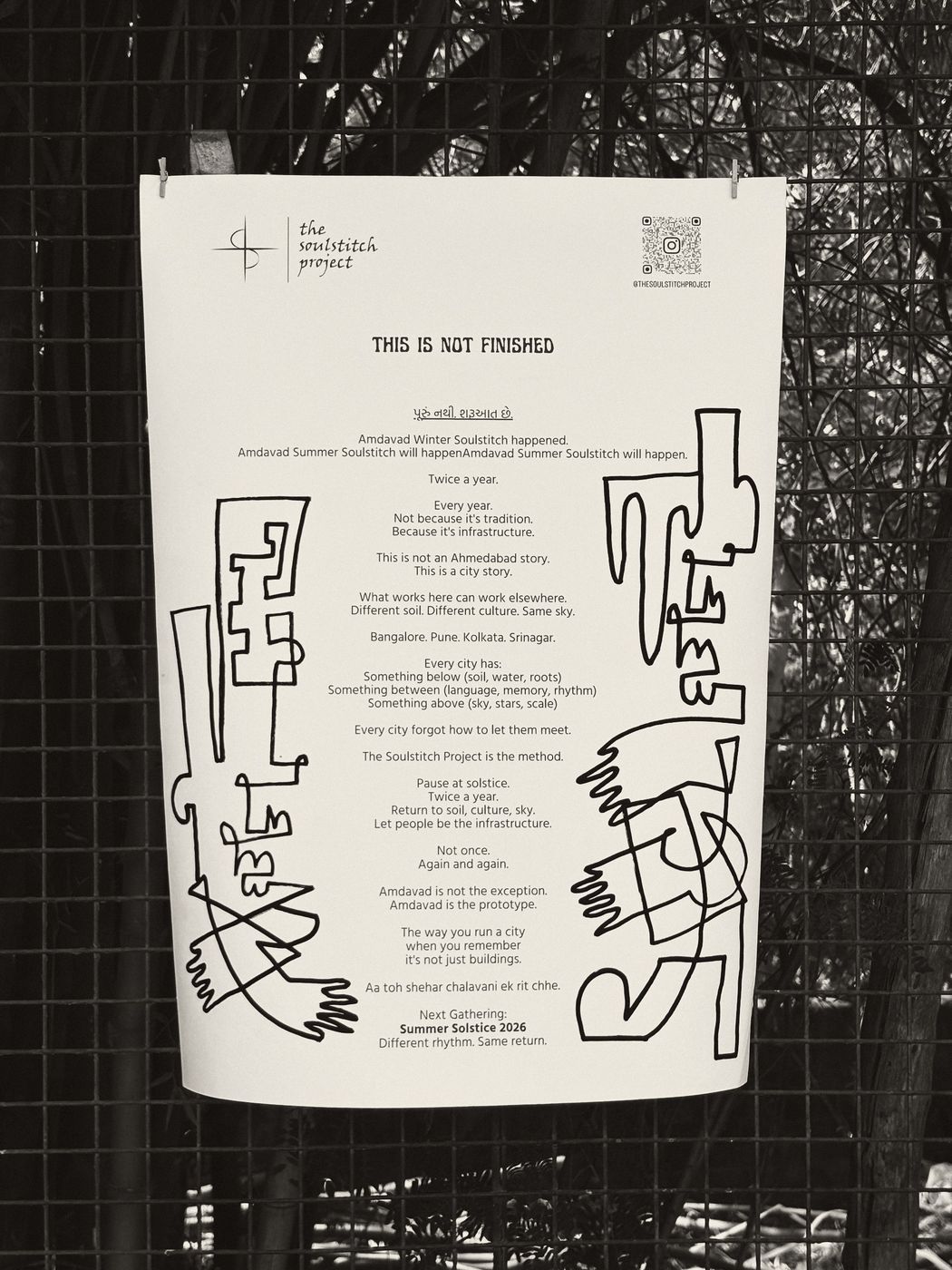
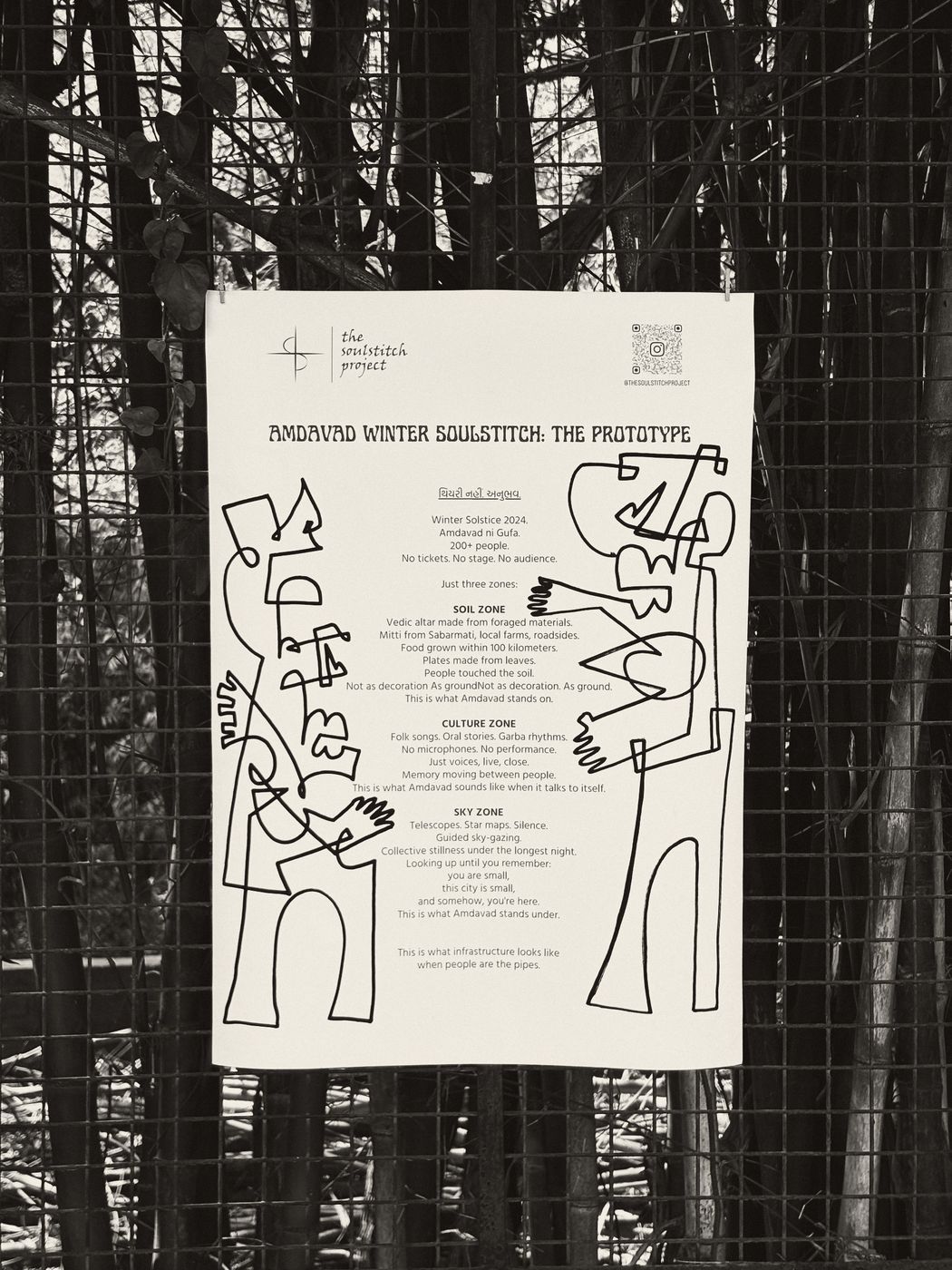
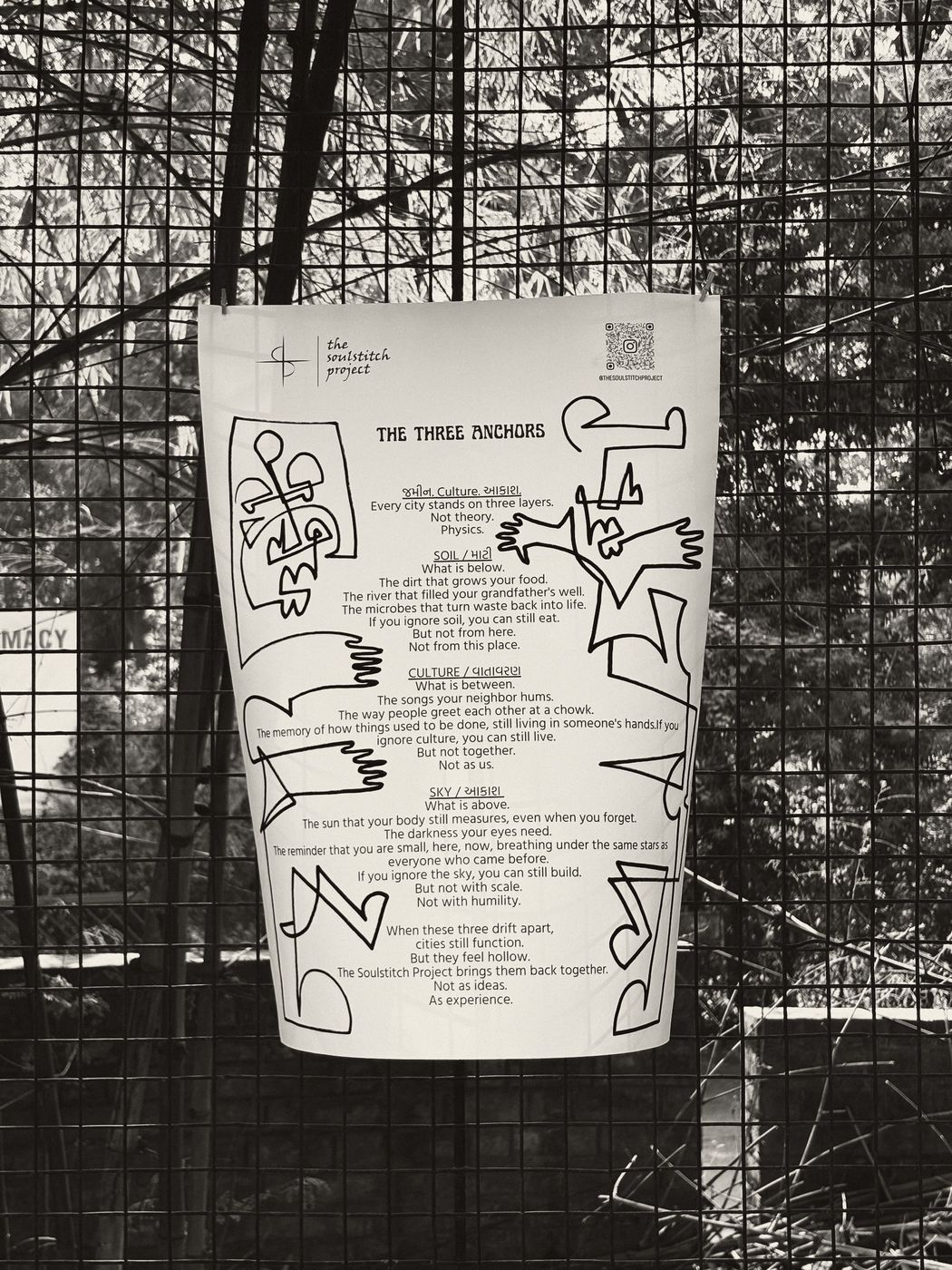
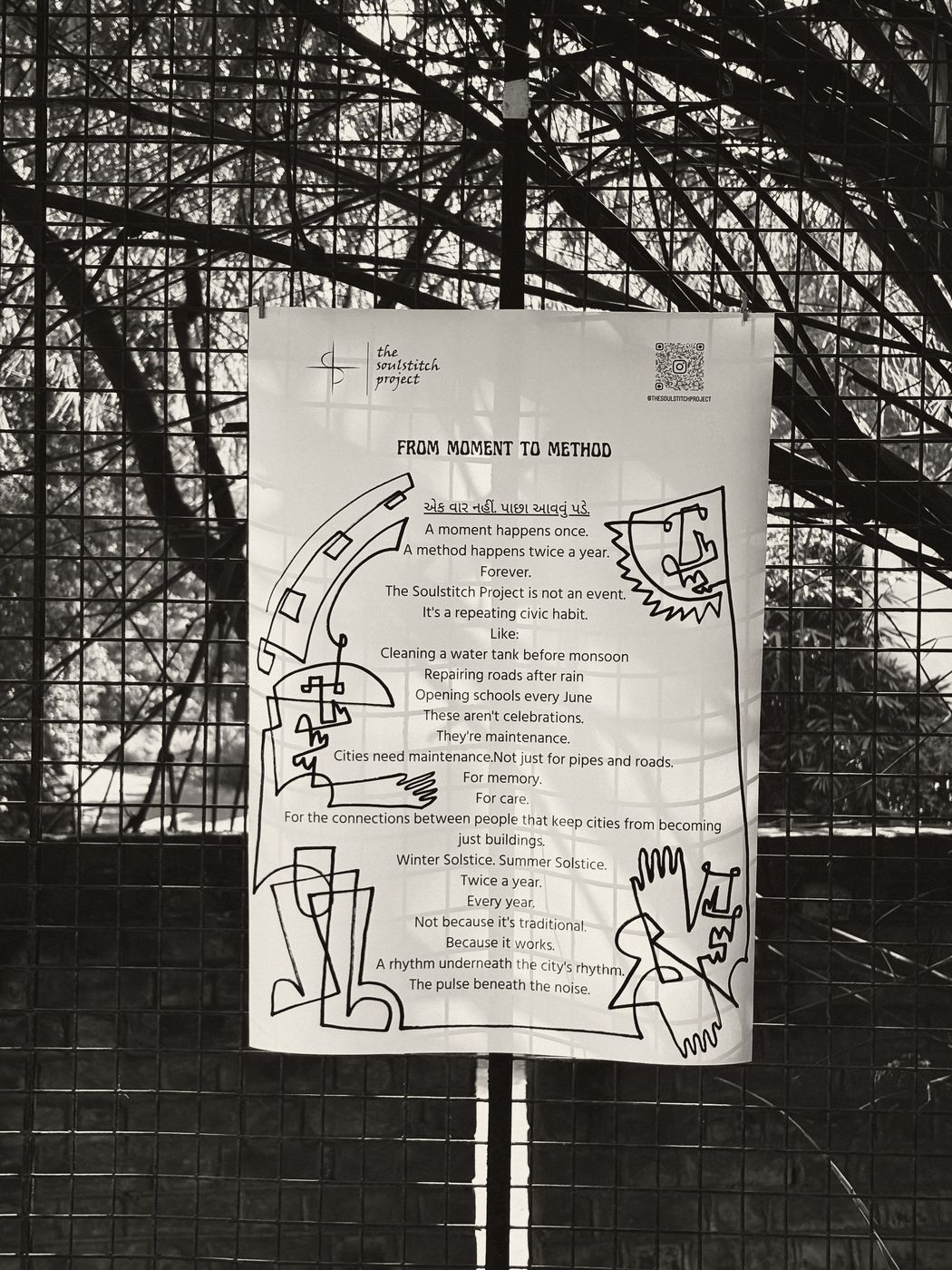
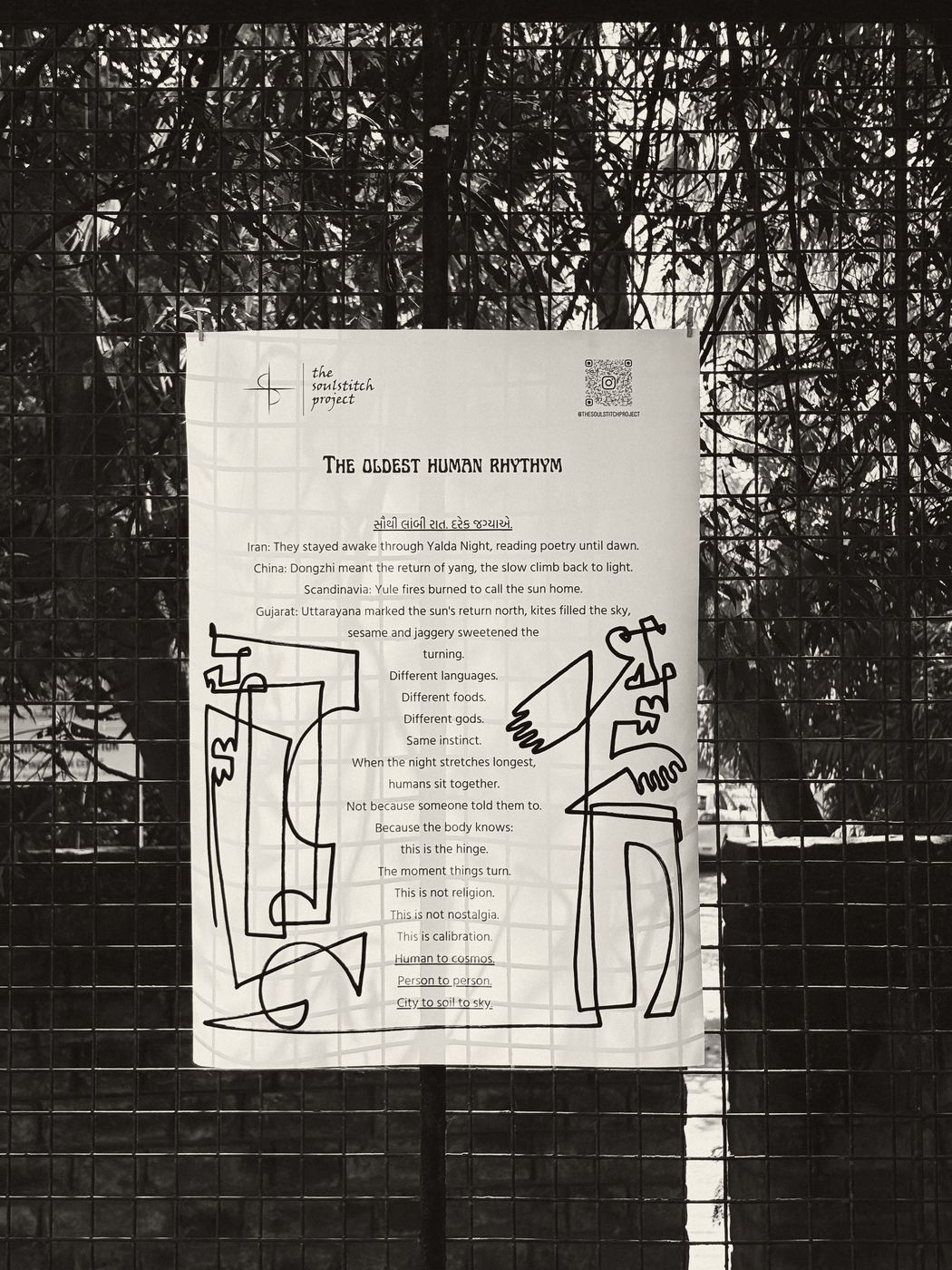
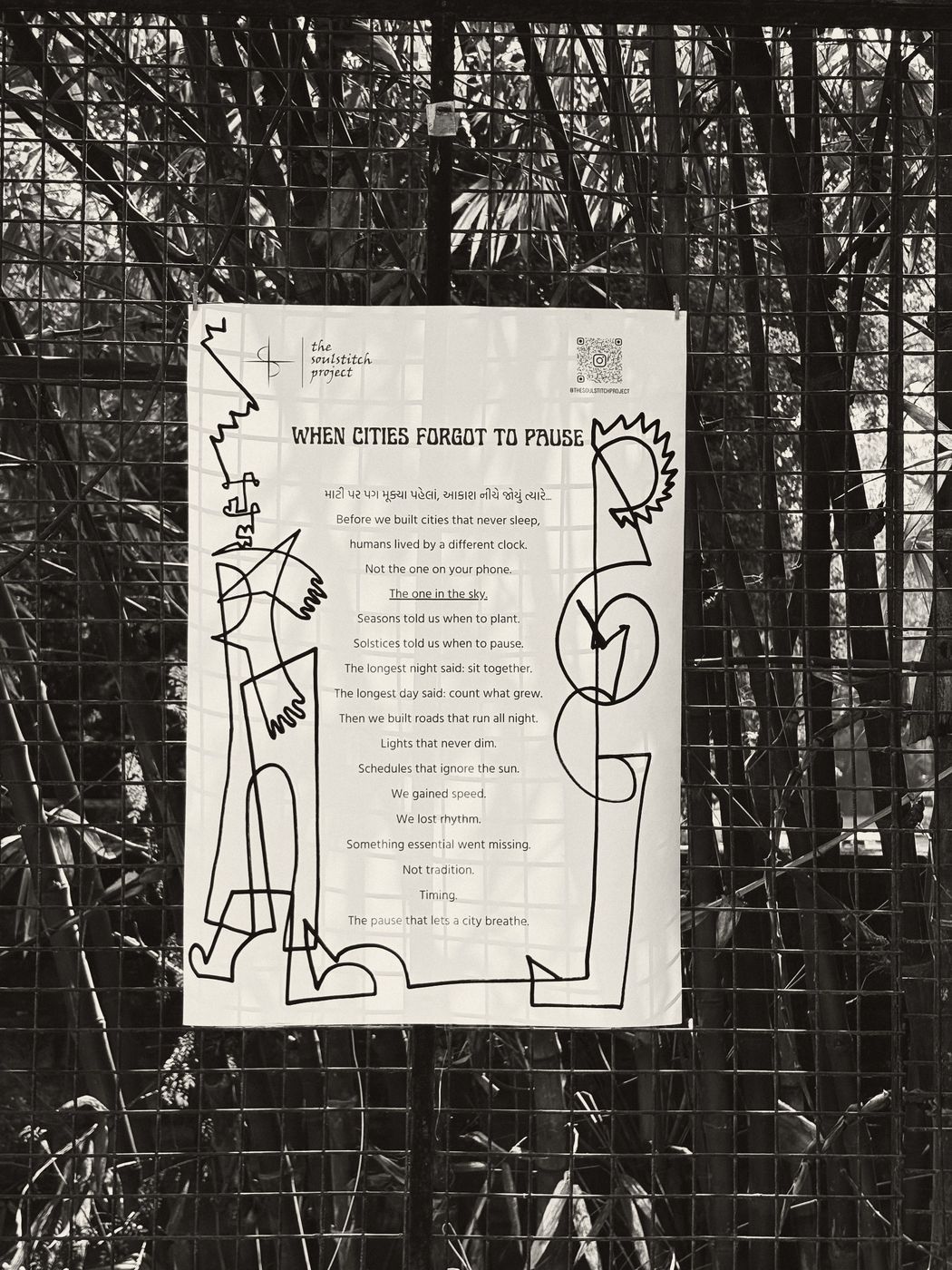
The texts, at night and the next noon. At least eight printed texts hung on the fence and the easels, with hand-lettered signs among them. Three were photographed at night, at 21:58 and 22:00; two of those were photographed again at 12:56 the next day, still in place, and five more were photographed at noon. They are the knowledge the evening left in public, and the culture stock's only written record.
Part V
This is the part of the paper anyone can check. Every material that entered the 2025 evening is followed from where it came from, through its use, to where it went, and every number says how we know it. The method, every assumption and every photograph a count came from are in Appendix B.
The boundary. The consumable and installation materials brought to the Gufa site, from the first collection on 19 December 2025 to the clean-up after the evening. Durable equipment lent for the evening and taken home by its owner is outside the boundary and listed in Section 9.4: it was used, not used up. Food is reported separately: all of it was eaten. The car trips that gathered the materials, every visitor's journey and the venue's electricity are outside the boundary, and named below as leakage.
680kgof material, by our estimate (90% interval 610–830 kg), carried into one evening for an estimated 600 to 1,200 people. About 21 kg of it was bought new. Every one of its 18 materials has an afterlife on record; only the plastic lining peeled from the cups, about 150 g, has no recorded destination.
The headline. About 680 kg of material passed through the evening (90% interval 610 to 830 kg), plus about 40 kg of food ingredients, all of it eaten. Nothing was weighed: blocks, diyas, heaps and signs were counted in the photographs, and masses come from published sources or from size.
Earth blocks
about 60 (50–70), counted in photograph 26
Terracotta diyas
150–250 in all; the 85 in red were counted on one rack
Soil heaps
10–12, in photographs 08 and 11
Signs
at least 8 printed and about 15 hand-written
Servings (one mark = 10)
never counted: 400 assumed (dotted), up to 900
Solid: counted. Loose outline: the range up to the highest count. Dotted: assumed, not counted. Grains, plants and thread were not counted, so they are not drawn as units.
| Reading | Central | 90% interval | Mark |
|---|---|---|---|
| Bought new for the evening: rope and jute (to shape foraged material into art), printed texts, paper cups and bowls; about 21 kg | about 3% | 2 to 4% | |
| Kept in use: back to its lender, kept, reused, recycled or made into art | about 76% | 67 to 82% | |
| Returned to the ecosystem: composted, used again on the land, or eaten by birds | about 24% | 18 to 33% | |
| Lost or degraded | none known | convenor | |
| Destination not recorded: the plastic lining peeled from the cups, about 150 g | under 0.1% | ||
| Afterlife attested item by item, by a photograph or a specific account | about 99% | 98 to 99% |
Ribbon height is mass, at one scale. Loose edges: an afterlife resting only on the convenor’s general account, or not recorded. Small flows are drawn at a minimum height so they can be seen; their masses are printed.
Where it came from. About 65% of the mass was lent: by Diving Deep (the terracotta diyas), Gathering Green (the earth blocks) and Khushboo Padiyar (the origami). About 25% was foraged or collected from the city's roadsides, gardens and heaps, including the material the canopies were made from and the hanging terracotta. About 7% was given, brought or already held: the bamboo poles, the cow-dung diyas, the grains, the thread, the cloth and the banner. About 3% was bought new.
Where it went. convenor The earth blocks went back to Gathering Green and were used again. The terracotta diyas were cleaned and given back to Diving Deep, to be lit again. The canopies, hessian and jute were collected and reused for art. The bamboo poles were reused in other projects. The hanging terracotta broke, and was recycled. The cow-dung diyas are still in use. The net, with its cloth, and the banner are kept by Multopia. The soil-path heaps were segregated and used again on the land. Organic waste was composted, and the compost went into Gathering Green's Miyawaki planting. The grains from five homes were scattered for birds and other animals, and eaten. The cups' paper was composted after the plastic lining was peeled off; where the lining went is the one thread still loose.
Three cautions. They keep the numbers honest.
The grains. The smallest flow, about 1 kg, is the easiest to over-read. Food eaten by animals ranks above compost in the US EPA's Wasted Food Scale. But grain scattered in a city mostly feeds pigeons and crows, and public feeding is one reason rock pigeons have more than doubled in India since 2000 (State of India's Birds 2023). We count the grains as a fate, not a gain.
The borrowed blocks bring no production carbon into this account: by the usual cut-off rule, the emissions of making them belong to their first use. Had Vedi been built new, its earth blocks would have embodied about 45 kg CO₂e (28 to 67 kg), and the same mass of fired clay brick about 140 kg (110 to 310 kg) (Max Fordham 2021; AIT 2018). That compares design choices. It is not an avoided emission, because nobody would have built a brick altar for one evening. We do not claim a figure for landfill methane avoided by composting: what the foraged plants would otherwise have become is not known (Appendix B).
For scale. About 21 kg (10 to 37 kg) of new material for an estimated 600 to 1,200 people is about 18 to 35 g a person (9 to 62 g across the ranges), and all of it stayed in use or went to compost except the cups' lining. The single-use flow, the paper cups and bowls with their lining, comes to roughly 3 to 19 g a person. The average UK music festival reports 0.68 kg of waste per person per day (The Show Must Go On, Edition 3, 2026). Those are multi-day, mostly camping events with other boundaries, and our attendance was never counted. This is scale, not comparison.
Printed so the next account can close them.
Ecology reading: rose. Little was bought new, and what was bought stayed in use or went to compost. Every material has an afterlife on record, nothing is known to have been lost, and the year since has seen the afterlives hold: the blocks used again, the bamboo in other projects, the cloth in new art, the compost in a young Miyawaki forest, the heaps back on the land. A quarter of the mass went back to the ground and to the animals that live on it. What keeps this short of proof is that nothing was weighed and the afterlives rest mostly on the convenor's account. The account is still the strongest evidence in this paper, because anyone can recount it from the photographs.
| Indicator | Edition 1 | Edition 2 | Mark |
|---|---|---|---|
| Who made the evening | Two designers, two host organisations | 18 contributors (people, teams and organisations) across the zones, and eleven named volunteers, five of whom were also contributors | convenor |
| Work the public finished | Carried the wood, lit the fire, started the garba | Tied cloth to the Stitch all night; at least nine ritual arrangements still on the ground the next day | |
| The anchor met together | No: the instant fell at 14:50, before the evening | Yes: 40–50 people in silence inside the Gufa at 20:33 | convenor |
| A practice that changed | Not recorded | Harsh Hingu's first live charcoal drawing | artist |
| Knowledge left behind | None recorded | At least eight printed texts, seven of them photographed still standing the next noon; labels; this paper | |
| Who came | Gated by price, space and distance | Free, in a public institution in the city centre. Children, elders and every age between, from different economic classes, as the team saw it; nobody counted | convenor |
artist Harsh Hingu: "This was my first ever attempt using charcoal on paper in a live setting, and it shifted something deeply within me… The process gave my art a new rhythm and made me feel strong in my choices and my voice."
Soulstitch calls itself non-confessional and religiously plural. In both editions the forms that carried the evening came largely from one tradition: garba and the daayro's devotional songs; an altar built on Vedic geometry. These are the forms the city shares, and no contributor did anything wrong. But it means we can claim convergence, not yet plurality, and the festival has no stated rule for how a contributor's tradition sits inside a non-confessional frame.
Culture reading: rose. Contributors, public making, an instant met together and a changed practice are real gains, and the year since has kept them: the relationships are active, the net and the banner are kept, and the artist's practice changed. They rest on single cases and on the convenor's account; Section 16 sets out how the next edition will record them. A rise in culture can also be uneven: in East London, the social capital that local festivals built went mostly to people who already had it (Stevenson 2016). Who gained at Soulstitch, by neighbourhood, class and tradition, is not recorded; the next edition asks visitors where they came from (Section 16).
| Flow | Edition 1 | Edition 2 | Mark |
|---|---|---|---|
| Who paid for the evening | The host (ground, services, food); the core team (prints) | Hiren Joshi and Manav Sumara, from their own pockets | convenor |
| Paid to contributors | Not recorded | ₹0 | convenor |
| Visitors paid | Tickets, kept by the host | Nothing at the gate | convenor |
| Makers' sales | None planned | Zero-commission market, stopped by the venue during the evening; sales afterwards not recorded | convenor |
| Contributions from visitors | None | A QR appeal; the money went to Gathering Green as a donation | convenor |
Micro-economy reading: fell, and this is the next step. Edition 2's generosity is the strongest evidence that the city wanted it, and the plainest reminder that someone carried it. Contributors gave their time, skill, equipment and materials unpaid, and lenders got their materials back; two people drew down their own money; the one mechanism designed to pay back was switched off by the venue. The visitors' contributions crossed into ecology, through Gathering Green's work: a real cross-flow, but one that left the micro-economy stock lower. This is not a failure of intent. It is the frontier of the work, and the first design problem of the next edition.
The micro-economy reading is not a local accident, and economics has long had words for it. Kapp (1950) described social costs: costs of production that never appear in an enterprise's accounts because they are shifted onto third persons or the public. Fraser (2022) argues that the formal economy rests on background conditions it does not pay for: care, nature, communities and public power. In cultural work, hope labour names unpaid or under-paid work done for exposure or experience in the hope that paid work will follow, a relation that shifts costs and risks onto the individual (Kuehn and Corrigan 2013).
Gatherings sit where all three meet. In India's Time Use Survey 2024, women aged six and over who did unpaid domestic work spent 289 minutes a day on it; men, 88 (National Statistics Office 2025). Much of the labour of weddings and festivals is this work, and none of it appears in what an event is said to cost. After two concert nights in Ahmedabad in January 2025, the municipal corporation reported clearing 550 tonnes of waste with 492 workers (Knocksense 2025). A private evening's waste became a public workforce's shift. And culture's share of company CSR spending fell from about 3.7% to 2.0% between 2019–20 and 2023–24 (Section 1.1).
Read this way, the table above is a small instance of a large pattern: Edition 2's ecology account balanced partly because its makers' time sat off the books. That is why the unit refuses to let one stock pay for another (Section 6.3), and why the next edition's first design problem is a return for the people who make the night, agreed before it happens (Section 16).
Edition 2: culture and ecology drawn whole, as they held through the year after the night by the team’s account; micro-economy frayed. Ecology’s carbon is not read. Funders: the two people who met the costs. Each cord is drawn as its weakest strand, and names the strand to mend next.
| Stock | Edition 1 | Edition 2 |
|---|---|---|
| Ecology E | Not known: foraged fuel burned; ash not recorded | Rose: about 3% new, about 76% kept in use, about 24% back to the ecosystem, nothing known lost; the afterlives held through the year |
| Culture C | Gained on the night, for a gated few; not followed after | Rose: 18 contributors, public making, the instant met, a practice changed; held through the year, by the team's account |
| Micro-economy M | Fell: value to the host, costs to the core team | Fell: unpaid contributors, a stopped market, costs on two people |
| Holders who gave | The core team carried the prints | Contributors and the two people who met the costs (Hiren Joshi and Manav Sumara) carried a loss; lenders got back what they lent |
| Reading | Not yet regenerative; drawing down: micro-economy | Not yet regenerative: rising in ecology and culture; drawing down in micro-economy, on the people who made the night |
We print it this way because it is what the evidence says, and what the rule says: a gathering is named by its weakest strand. We also print it with some pride. Whether a gathering can give back more than it takes is a civilisational question. Here it was asked in a city of millions, with borrowed earth, foraged plants and the goodwill of a few dozen makers; no single evening answers it, and a test that could only say "yes" would teach nothing. In its second year this one found two strands rising and named the third, the time and money of the people who make the night, as the next thing to mend. The ecological loop, which most "green" events treat as the whole story, turned out to be the part Soulstitch could already do. The next loop to close is the economy of care.
Part VI
It would be easy to describe two evenings as pleasant and leave it there. The evidence supports more than that. Here is what the prototype changed, each with its thread.
None of the seven changed the micro-economy. The dots show the stock each change touches (culture, ecology, micro-economy), by our reading.
Part VII
What travels. The unit and its test; computing the anchor for one's own place; making a gathering of what people bring; borrowing, foraging and giving back, and counting it; stating each contributor's return before the night; letting the public finish the work; keeping traditions side by side, not merged; and naming stewards.
What belongs here. The Gufa, a building that already joins soil, sky and reused material; Gujarat's shared forms, garba and daayro, which gave a crowd something it already knew how to do together; this particular network of people; and a cool December night. Another city needs its own.
A rule applied against growth. Soulstitch was conceived as twice-yearly. It has never held a summer edition, by choice: a gathering that claims to give back to its city's ground cannot ask hundreds of people to stand on hot concrete in an Ahmedabad May to prove it can.
How this paper measures up. We judge it by the four principles for transdisciplinary research quality of Belcher et al. (2016).
| Principle | How this paper meets it | Where it falls short |
|---|---|---|
| Relevance | A named problem in one city, studied by the people who run the gathering, for use by them and others | Relevance to other gatherings is argued, not shown |
| Credibility | Every claim marked; ranges printed; method and code published with this paper (doi.org/10.5281/zenodo.24465155); a test that can fail | Estimates, not weights; no baselines; one person assigned the marks |
| Legitimacy | Contributors named, credited and asked for consent; disagreements printed | Contributors did not frame the research; the public's voice is absent |
| Positioning for use | The unit, the marks and the protocol are open | No one else has used it yet |
Two editions produced stories and estimates. The next iteration is measured with a method fixed now and registered publicly, with a date, before the night, so the answers cannot be shaped afterwards, as pre-registration does for qualitative research (Haven and van Grootel 2019).
| What | What is recorded | How |
|---|---|---|
| People | How many come | A count at every entrance in half-hour bands, by named volunteers |
| Ecology | Every material in and out | Weighed at arrival and at clean-up, photographed at the moment of counting, with origin and afterlife, by a named owner; lenders sign for what comes back |
| Micro-economy | What each contributor received | A published list: credit, payment, sales, materials, contacts |
| Culture | What persists | Practices, relationships and kept objects, recorded again one year after the night |
| All three stocks | The horizon reading | Each stock recorded on fixed dates through the year after the night, and read at its close |
| Ground | The host's terms | Written before announcing: selling, hours, light |
The unit's own next step is the one Multopia's notes deferred: baselines for each stock before the night, so the change can be measured rather than reconstructed.
RQ1. Can a gathering be read as a small system? Yes, as a specification with partial evidence. The unit reads a gathering through three stocks of its place (culture, ecology, micro-economy), the inflows its four anchors generate, and the flows between them. We read two editions with it from photographs, counts, documents and accounts, after the fact. Whether a volunteer team can collect the indicators on the night, "at almost no cost", is not yet shown. The next edition tests that.
RQ2. What must it refuse to count? Two things: a rise that vanishes after the night, and a gain in one stock paid for by a loss in another. A third rule makes the verdict hard to soften: the whole is named by its weakest stock. Applied to its own makers, it said "not yet" where it mattered most, and named what to mend. That is the best evidence that it can fail, and that it can guide.
RQ3. What does it show for Soulstitch? In ecology, the 2025 evening handled about 680 kg of material (610 to 830 kg). About 3% was bought new, and even that stayed in use or went to compost, except the cups' plastic lining. About 76% stayed in use: lent and returned, kept, reused, recycled or made into art. About 24% went back to the ground and to the animals that live on it. Nothing is known to have been lost. convenor Through the year, the afterlives held: the terracotta diyas were cleaned and given back to Diving Deep to be reused; the canopies, hessian and jute were reused for art; the bamboo went into other projects; the compost went into a Miyawaki planting; the grains were eaten by birds. That makes the material account the strongest evidence in this paper. It is still estimated from photographs, not weighed. In culture, the evening gained 18 contributors, a public of every age that finished the work by hand, an instant met together and an artist's changed practice, and those gains held through the year by the team's account. In micro-economy, the stock fell: contributors were unpaid, the market was stopped, and two people carried the costs. By the unit's own rule, Edition 2 is not yet regenerative, and the strand that holds it back is named: the time and money of the people who make the night. Edition 1 was held back by the same strand, without the ecological gain. That is where most "green" events do not look, and where Soulstitch goes next.
RQ4. What travels? The test, the marks and the method for following materials travel. The verdict does not, and neither do the Gufa, garba, the daayro or this network of people. Another city reads its own gathering, with its own forms, against the same three stocks.
It does not show that Soulstitch is regenerative. It is not, yet; it shows how far it has come, and what is next. It does not show that the festival caused any change outside the evenings: there are no baselines and no comparison. It does not show how many came: nobody counted, though the team saw every age and many walks of life. It does not show that the unit works for other gatherings; it has been applied to two editions of one festival, by its own convenor. It does not show the afterlives as documents: most rest on the convenor's account. It does not show that the contributors read their evening as we do: they have not yet been asked to check our reading. And the carbon figures are illustrations of scale, not findings.
Two editions surfaced questions they could not settle. Each is printed with why it matters, a method, the data it needs, and the disciplines that could take it up. Most trace back to a loose thread in the text. Section 16 is Multopia's own protocol; these are open to anyone.
To other researchers. Use the unit on a gathering you know. Fork it: rename the stocks, add an exchange, write it as patterns for your place. Test it, and send us the reading, especially if it fails, or if it fails us. Correct us: corrections will be dated and printed in later versions. Multopia has published, openly (doi.org/10.5281/zenodo.24465155), the material account as data and code and the codebook of the six marks; it will publish a catalogue of the photographic archive (dates and subjects, with the faces of the public withheld), the protocol for the next reading, registered before the night, and the register of loose threads.
To ourselves. We hold our next edition, wherever and whenever it is held, to what we decided as this year closed: count the people at the gate; weigh or count every material in and out, with a named owner; publish what each contributor received; let one zone run without the convenor; and before the next edition, contributors read these findings and help set its questions and indicators. Before any announcement, we agree written terms with the host on selling, hours and light. And at this December's solstice, as the year since the Gufa closes, we add a dated record of the three stocks to the running one, and publish it.
At 02:20 on 22 December 2026 the Sun will turn again over Ahmedabad, while most of the city is asleep. Nobody has to gather for that to happen. That is where Soulstitch started: one anchor the evening takes from nobody. Everything else a gathering takes, it takes from someone: their ground, their materials, their skill, their evening. This paper ties off one thread. Two evenings, counted as well as we could count them, judged by a test that said "not yet" where it matters most, and honest about what it could not see. The next thread starts at the same knot. The year turns; what we owe the people who make the night is still owed. We have written down how we will know when it is paid.
The author. Manav Sumara (Multopia), convenor and principal investigator. convenor Conceived The Soulstitch Festival and its research design; developed the Soulstitch Regenerative Systems Architecture and the Minimum Regenerative Unit; curated the evening and managed its artists and contributors; designed the experience, the zones and the exhibition, including the open-air theatre exhibition; designed all digital and printed materials; negotiated with the venue and partners; co-funded Edition 2; ran production on site from 8 am to the last departure; led the clean-up; and documented both editions and wrote this paper. For Edition 1, co-designed the evening with Aftab Pathan.
Edition 1. Aftab Pathan, architect: co-designed Edition 1 and its visual language; held the evening from the stage. Hiren Joshi (Gathering Green): co-organised Edition 1. Inner Circle Garba: hosted Edition 1; ground, services and food.
Edition 2, in alphabetical order.
| Contributor | Organisation or practice | Edition 2 |
|---|---|---|
| Anshita | Heal the Soul | Sound-healing meditation inside the Gufa |
| Apurva | a.gain | Recycled cloth stitched into usable art |
| Diving Deep | Terracotta diyas, lent; cleaned and given back | |
| Harsh Hingu | Artist | Live charcoal drawing; lent paintings |
| Harshdeep Jadeja and team | Daayro | |
| Hiren Joshi and volunteers | Gathering Green | Earth blocks, foraged leaves, site cleaning before and after, compost to a Miyawaki planting; co-funded Edition 2 |
| Kairavi Shah | Soil steward | The soil path, with Saloni Gajjar; clean-up |
| Kanchi Shah | Amatra Wellness | Closing meditation |
| Kavin | Core team | Illustrations; the welcome banner |
| Khushboo Padiyar | Badhikala | Origami works at the entrance tree and over the arena |
| Nithin Kumar | Kaley Studio | Handmade clay |
| Palak Patel | Soil steward | Vedi, the falcon-altar installation |
| Pooja Mathur | Greenstraw Foundation | The foundation's work |
| Radhika and Stavan | 0 OD | Laser projections |
| Rakesh Wani and team | Daayro | |
| Ravi Varasada and the Project Orion team | Invincible NGO | Sky steward; three telescopes |
| Rohin Sher | Project Co.We. | Food for everyone: rajgira raab and a spiced jaggery brew |
| Saloni Gajjar | The Rooted Circle | The soil path, with Kairavi Shah |
| Shrutav Patel | Core team | Sound design and engineering; own equipment |
| Vrikshit Foundation | Dhoop and cow-dung diyas, kept and still in use |
Volunteers: Damini Motwani, Disha Shah, Diving Deep, Hiren Joshi and Gathering Green's volunteers, Janhvi Oza, Kairavi Shah, Kavin, Palak Patel, Rohin Sher, Shrutav Patel, Shruti Sanghvi.
Photographs and film were sent in by volunteers, artists and visitors; we did not record who took each one, and from now on we will. They are edited here to black and white, with the colour of the main subject kept where noted; people are always shown in black and white. The clips are cut from the same archive, muted, and graded the same way. Harsh Hingu's drawings shown in this paper are original artworks, and remain his.
The evidence for this paper is held by Multopia: project decks (1 and 9 December 2025), the venue request, the unit and materials notes, 418 photographs and 92 video clips (19–22 December 2025), recorded and written accounts (2026), and the material account (material_account.py and its output). The material account (code and data) and the codebook of marks are published with this paper, openly, at doi.org/10.5281/zenodo.24465155: text, tables and data under CC BY 4.0, code under the MIT licence. A catalogue of the archive will follow in a later version. Photographs showing identifiable members of the public are not published. Recordings are held with the consent of the speakers and are available on request for research, with their agreement.
Solstice instants from Meeus, Astronomical Algorithms, ch. 27, converted to IST: 21 Dec 2024, 14:50; 21 Dec 2025, 20:33; 22 Dec 2026, 02:20. Sunrise, sunset and twilight from the NOAA solar equations for 23.0225 N, 72.5714 E. Moon, planets and stars for 21 Dec 2025 from PyEphem; matching published guides for that week. The figures of the Sun's path in this paper are computed from the same NOAA equations: the equation of time against the declination, at the same clock time each day.
material_account.py, published with this paper; it prints every figure in Section 9.Method
Regeneration, commons, scale
Events, access, materials
Event standards, capitals and fair pay
Economics of cost, care and labour
Ahmedabad
The solstice
Primary sources (Multopia archive)
Written by Multopia, with the consent of everyone named in it. Set in Soulstitch Nouveau and Jost. Lines are computed from data and drawn over by a stroke generator; the hand in them is simulated. November 2026. A working paper, not peer reviewed. Corrections are welcome and will be dated in later versions. 21 November 2026: in the web edition, sources, cross-references, names and words now open in place, after a reader's suggestion; the argument is unchanged. 23 November 2026: the paper, its code and the codebook are deposited openly and permanently, with a citable DOI, doi.org/10.5281/zenodo.24465155.